
Mapping the Digital Frontline: Conflict Detection in the Russia-Ukraine Linguistic Mosaic
• Information systems → Data extraction and integration; • Networks → Network dynamics; • Security and privacy → Social engineering attacks
This paper presents a multi-disciplinary framework for detecting and analyzing online conflict within the linguistically diverse Reddit landscape during the 2019 Russia-Ukraine intervention. By combining Latent Dirichlet Allocation (LDA) for topic modeling and sentiment signal analysis (Entropy/Variance), the study successfully maps the evolution of echo chambers and user roles in high-stakes political discourse.
TL;DR
Geopolitical conflicts aren't just fought on the ground; they are mirrored—and often preceded—by "total warfare" in Online Social Networks (OSNs). This study dives into the Reddit landscape of the 2019 Ukraine elections to map how conflict unfolds across a linguistically diverse environment. By analyzing sentiment stability and entropy, the researchers uncover how echo chambers form and how certain "bridge" users sustain cross-community friction.
The Challenge: NLP in a "Surzhyk" World
Most sentiment analysis tools are optimized for "high-resource" languages like English or Spanish. However, the Russia-Ukraine border is a linguistic melting pot. The study highlights Surzhyk, a hybrid of Ukrainian and Russian spoken by roughly 25% of the population.
Current SOTA tools often fail here because:
- Dictionary Gaps: Standard libraries like Polyglot yielded 75% empty entries for Slavic code-switching.
- Contextual Risk: Users often adopt "bridge languages" or informal dialects to mask their identity or mitigate political risk, making standard sentiment extraction inaccurate.
Methodology: Beyond "What" is Said to "How" it Evolves
The researchers moved beyond static word analysis to look at the dynamics of the signal. They combined Topic Modeling (LDA) with Network Science to see if users discussing the same topic actually belong to the same social "cluster."
1. Topic & Community Extraction
Using LDA, the authors identified four primary discourse clusters. Crucially, they visualized the overlap between semantic topics and modularity-based social communities. This reveals "closed" communities—true echo chambers where everyone shares the same view—versus "open" communities that interact with outsiders.
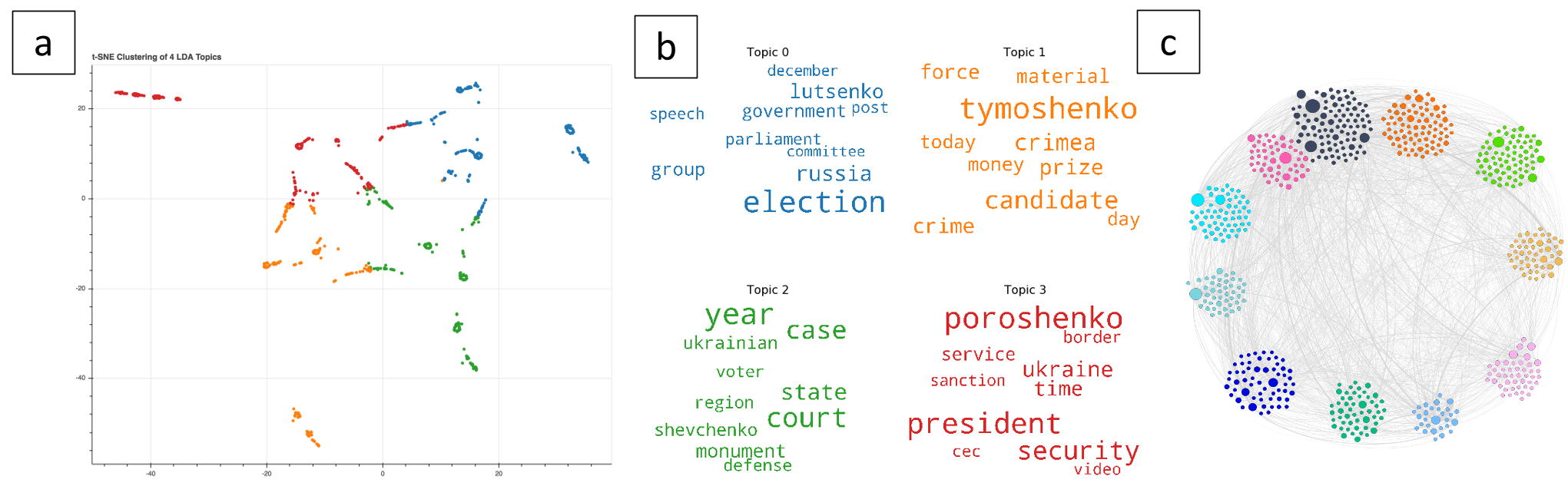 Figure: The interaction between LDA-identified topics and the visual network structure of Reddit users.
2. The Math of Loyalty: Variance and Entropy
The heart of the paper lies in how it tracks an individual's "sentiment trajectory" using two key metrics:
- Sentiment Variance: How much does a user's tone fluctuate? The study found that users typically "lock in" their opinion early (within the first ~20% of their posting history).
- Shannon Entropy (H): This measures the diversity of a user's interactions.
- Low Incoming Entropy: You only hear from people in your own echo chamber.
- High Outgoing Entropy: You are actively "attacking" or debating users in opposing communities.
Results: The Pulse of Polarization
The experimental results on the r/ukraina subreddit (a hub of high activity during the 2019 elections) showed a rapid stabilization of sentiment.
 Equation: Shannon Entropy calculation for cross-community interaction.
By tracking these signals, the authors could identify users with "unstable behavior"—those who act as the glue (or the friction) between polarized groups. The study observed that while sentiment variance decays (opinions harden), outgoing entropy often remains flat, suggesting that "bridge" users consistently engage with the "enemy" rather than retreating into a bubble.
Critical Insight: Why This Matters
This work shifts the focus from content to behavioral signals. In a world of "fake news" and bot-driven campaigns, the literal meaning of a post is often less important than its structural role in the network.
Limitations: The study relies on commercial "black-box" APIs for the underlying sentiment scores, which limits reproducibility compared to open-weight LLMs. Future Outlook: Integrating these entropy metrics into real-time radicalization detection systems could help platform moderators identify brewing real-world violence before it escalates from Reddit threads to physical ground action.
Conclusion
The Russia-Ukraine case study proves that even in under-resourced linguistic landscapes, the mathematical properties of social interaction provide a clear map of conflict. By understanding the "bridge" users and the decay of sentiment variance, we can begin to predict how online radicalization evolves into tectonic shifts in geopolitics.