
Architecting the Social Web: A Typology of IT Capabilities for Digital Networks
Information Technology Capabilities for Digital Social Networks
This paper proposes a comprehensive typology of Information Technology (IT) capabilities for digital social networks. It categorizes network usage into four distinct dimensions—building, observing, extracting, and disseminating—and identifies specific design-related opportunities and challenges for Web applications.
TL;DR
Social networks are more than just lists of "friends." This seminal paper by Grange and Benbasat provides a robust framework to understand the technical levers that power digital social structures. By decomposing network activity into Building, Observing, Extracting, and Disseminating, the authors provide a roadmap for designers to navigate the complex trade-offs between user engagement, resource sharing, and privacy.
The Core Challenge: Beyond Simple Connectivity
In the early days of the Social Web, the primary focus was on "connecting people." However, as platforms like Facebook, LinkedIn, and online shopping networks (OSN) matured, it became clear that connectivity alone wasn't enough. Users faced Social Information Overload—the fatigue of managing too many weak ties—and Identity Fragmentation, where the "professional self" clashed with the "social self."
The authors argue that we need a specific language to describe how IT facilitates social outcomes. Their insight is that every digital social feature must serve one of four fundamental goals.
Methodology: The Four Pillars of Social IT
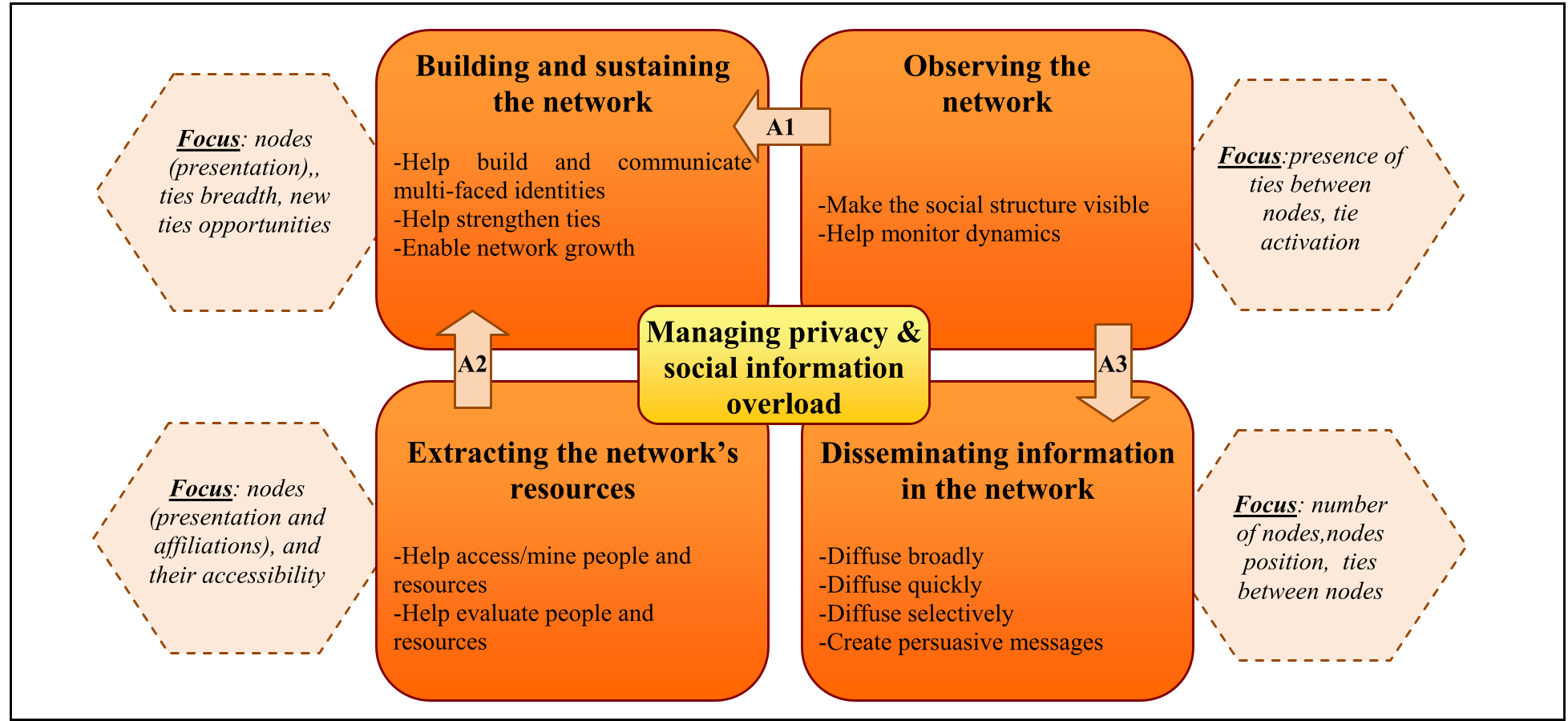
The paper categorizes IT capabilities based on the interaction between nodes (people) and ties (relationships).
1. Building and Sustaining the Network
- Focus: Identity management and tie strength.
- The IT Lever: Features that allow for "multi-faced social identities" and rich communication channels to turn "lurkers" into "insiders."
2. Observing the Network
- Focus: Structure awareness and surveillance.
- The IT Lever: Data mining and visualization tools that show who is influential (centrality) and who is connected to whom, helping users monitor the "state" of their social circles.
3. Extracting Resources
- Focus: Accessing expertise and psychological support.
- The IT Lever: Search and evaluation tools (like reputation systems) that allow users to find and trust the right expert within a massive network.
4. Disseminating Information
- Focus: Scale, speed, and persuasion.
- The IT Lever: Viral mechanisms and "mass interpersonal persuasion" tools that allow a single message to activate thousands of nodes almost instantly.
Synergies and Tensions
One of the most profound insights of the paper is the interconnectivity between these domains:
- The Awareness Bridge: "Observing" the network identifies "Influentials," which is a prerequisite for effective "Dissemination."
- The Privacy Paradox: Features meant to help "Extract" resources (like detailed public profiles) often create friction with the user's need to "Build" a safe, private social space.
Critical Analysis: Reflections for the Modern Era
While written in 2009, this framework is remarkably prescient. Today’s challenges—from "Context Collapse" on X (formerly Twitter) to the algorithmic "Observation" of TikTok—fit perfectly into the Grange and Benbasat typology.
Limitations: The paper is theoretical and lacks a quantitative index or empirical validation of the four constructs. It also bypasses "Massive Collaboration" (like Wikipedia), focusing strictly on social networking rather than peer production.
Conclusion: A Blueprint for Social Design
This paper serves as a foundational text for researchers and product managers alike. It reminds us that successful social platforms don't just "host" people; they provide the IT levers necessary to manage identities, discover resources, and navigate the delicate balance between public influence and private intimacy.
Future Outlook: As we move into the era of Decentralized Social Networks (DeSo) and AI-curated feeds, the "Observation" and "Extraction" capabilities will likely become the most contested and valuable IT levers in the digital ecosystem.