
The Architecture of Digital Deception: Why We Lie on Social Networks
An Informed Model of Personal Information Release in Social Networking Sites
This paper presents an informed game-theoretic model of personal information disclosure in Online Social Networks (OSNs), identifying three primary user behaviors: sharing, withholding, and deception. The authors develop a payoff-driven framework that characterizes how users balance social capital, privacy, and morality within their inner circles of influence.
TL;DR
A user's decision to share, hide, or fake information on social media isn't just about privacy—it's a calculated move to maximize "Social Capital." This paper bridges the gap between social psychology and mathematics by using Evolutionary Game Theory to model how our "inner circles" influence our digital honesty.
Background: The Privacy Paradox
For years, researchers have been puzzled by the Privacy Paradox: users claim to value privacy yet voluntarily upload granular details of their lives. This paper argues that information release is not a binary switch but a complex negotiation involving social pressure, morality, and the quest for popularity.
Dissecting the Motivation
Through a survey of nearly 300 OSN users, the authors found that:
- Privacy awareness does not stop deception: High concern for data leakage did not statistically correlate with the choice to lie or withhold information.
- Peer Pressure = Disclosure: The more pressure users feel to be active, the less likely they are to withhold information, particularly regarding their whereabouts.
- Lying as Strategy: Deception is most frequent for sensitive but unverifiable data (like location or GPA) and is used specifically to curate a successful social image.
Methodology: The Petri Net & Game Theory
The authors translate these social insights into a Stochastic Payoff Function. They model the user as a "player" who allocates 100% of their effort across three strategies: Truth (), Withhold (), and Lie ().
The objective function consists of:
- Social Capital (): The reward for contributing content.
- Privacy Capital (): The value of keeping secrets.
- Deception Cost (): The social penalty if a lie is caught (where is the probability of discovery).
- Moral Cost (): The internal friction of being dishonest.
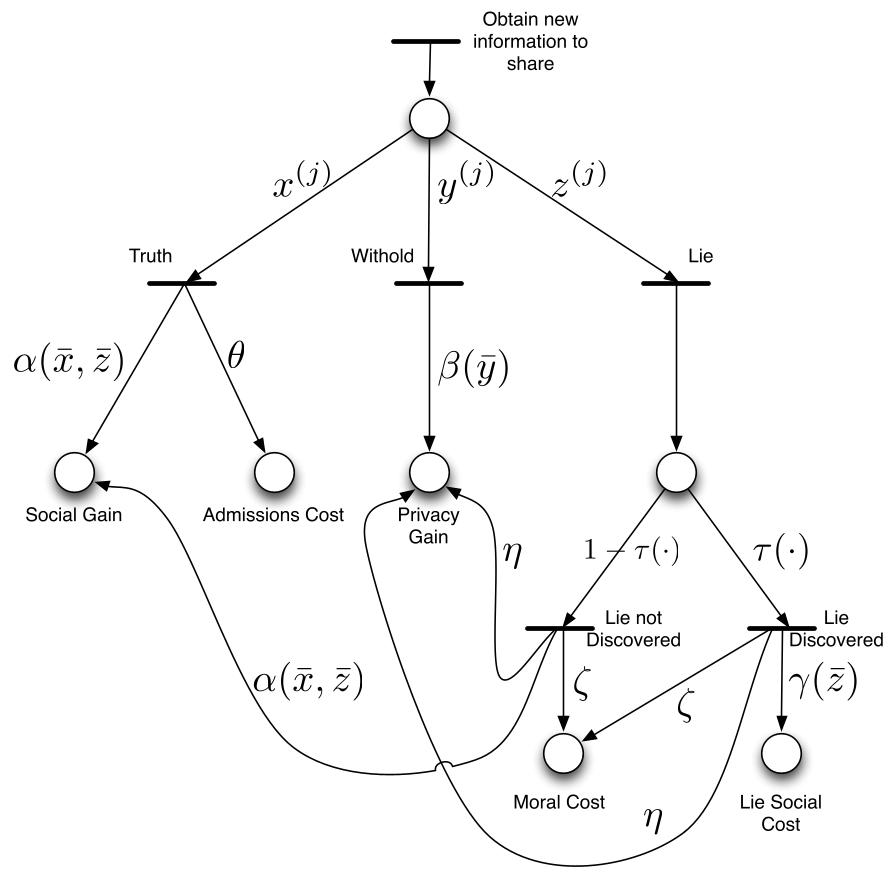
The genius of this approach is the Evolutionary Dynamic. Users don't find the "perfect" strategy immediately. Instead, they observe their friends, adjust their behavior by a small "learning rate" (), and gradually converge toward a Nash Equilibrium.
Experimental Insights & Simulations
The paper uses simulations to show how different "personalities" (weights in the payload function) react to the network:
- The Popularity Seeker: When social capital () is high and moral cost () is low, we see a massive initial spike in deception. However, as the user shares more info, the risk of getting caught () increases, eventually forcing them back to truthful sharing.
- The Moral Withholder: If a user considers lying unethical (), they don't just "tell the truth"—they switch to withholding () as a primary defense mechanism.
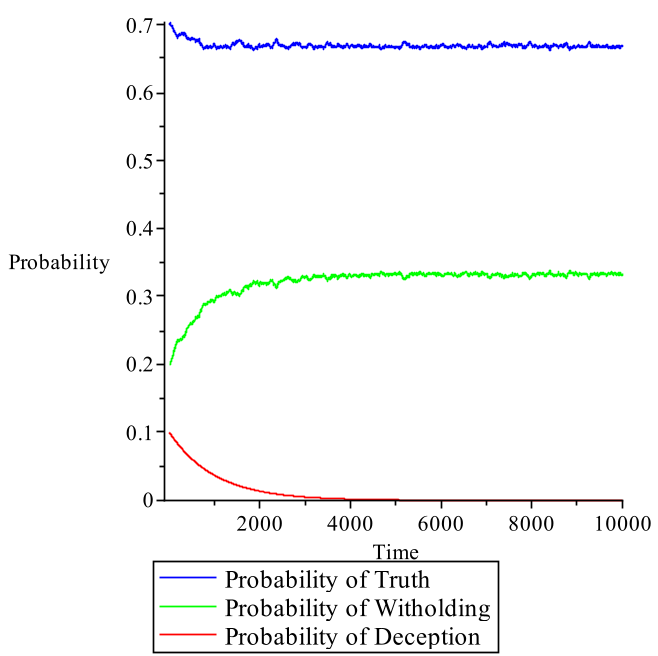 Fig: In scenarios with low moral penalty, deception spikes early but subsides as the cumulative information makes lies easier to detect.
Critical Analysis & Future Outlook
This work accurately predicts that our "inner circle" (the 50-100 friends who actually check our profiles) is the only group that truly influences our behavior, regardless of our total follower count.
Limitations: The model assumes that the "probability of detection" increases linearly with time/sharing. In the age of AI and deepfakes, the ability to maintain a lie might actually become easier or more technically complex than this 2012 model suggests.
Takeaway: To understand online privacy, stop looking at "privacy settings" and start looking at the "Social Payoff." People don't lie because they are afraid; they lie because they want to belong.