
Info*Warder: Quantifying the "Political Minefield" of Information Systems
Info*Warder: Group Support Software for Tackling Ownership and Political Aspects of Information Systems Proposals
The paper introduces Info*Warder, a Group Support Software (GSS) designed to identify ownership and political conflicts during the information systems (IS) project proposal stage. It leverages a theoretical model of "Information Wards" to map stakeholder claims and visualize potential institutional resistance.
TL;DR
Information Systems (IS) projects don't just fail because of bad code; they fail because of power struggles. Info*Warder is a group support tool that treats organizational politics as a primary data point. By mapping out "Information Wards," it identifies who "owns" what and where proposed projects will trigger institutional resistance before the first line of code is ever written.
Problem & Motivation: The Myth of Rational Development
In the world of academic Information Systems, there is a persistent myth: that systems are built for "efficiency" and "integration." However, as any veteran IT manager knows, information is power.
The author argues that:
- Methodological Neglect: Major frameworks (like Information Engineering) often completely ignore ownership and politics.
- The Integration Paradox: The push for "integrated systems" is inherently a political act because it undermines existing power bases and shifts control over data.
- Invisible Resistance: Resistance occurs when a system "takes over" a business process that a player perceives as their own territory—their Information Ward.
Methodology: Mapping the "Information Ward" (IW)
The core of the paper is built on the distinction between two conceptual spaces:
- Information Ward (IW): All data and processes a stakeholder perceives they own.
- Political Information Ward (PIW): A subset of the IW that the stakeholder is willing to defend using political maneuvers (legitimate or otherwise).
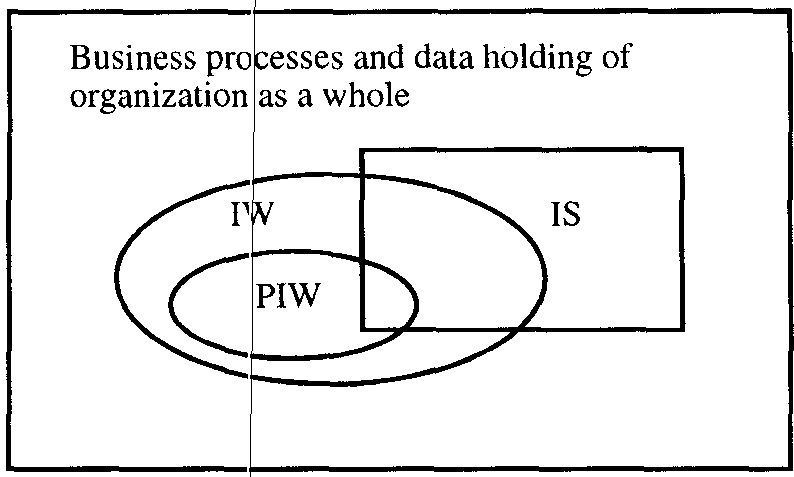
The Info*Warder Mechanism
The software acts as a "negotiation sandbox" where stakeholder representatives make three levels of claims:
- Exclusive: "This belongs only to us" (The PIW).
- Non-exclusive: "We control this, but it's negotiable" (The IW).
- No Claim: Neutral territory.
The Problem of the "Superuser"
One of the most insightful technical decisions in the Info*Warder architecture is the rejection of a "superuser." In a politically charged environment, giving one admin access to everyone's "hidden agendas" is a security risk. Instead, the system uses a consensus-based "hiding" and "unhiding" logic for data management, ensuring the tool itself doesn't become a weapon in the organizational struggle.
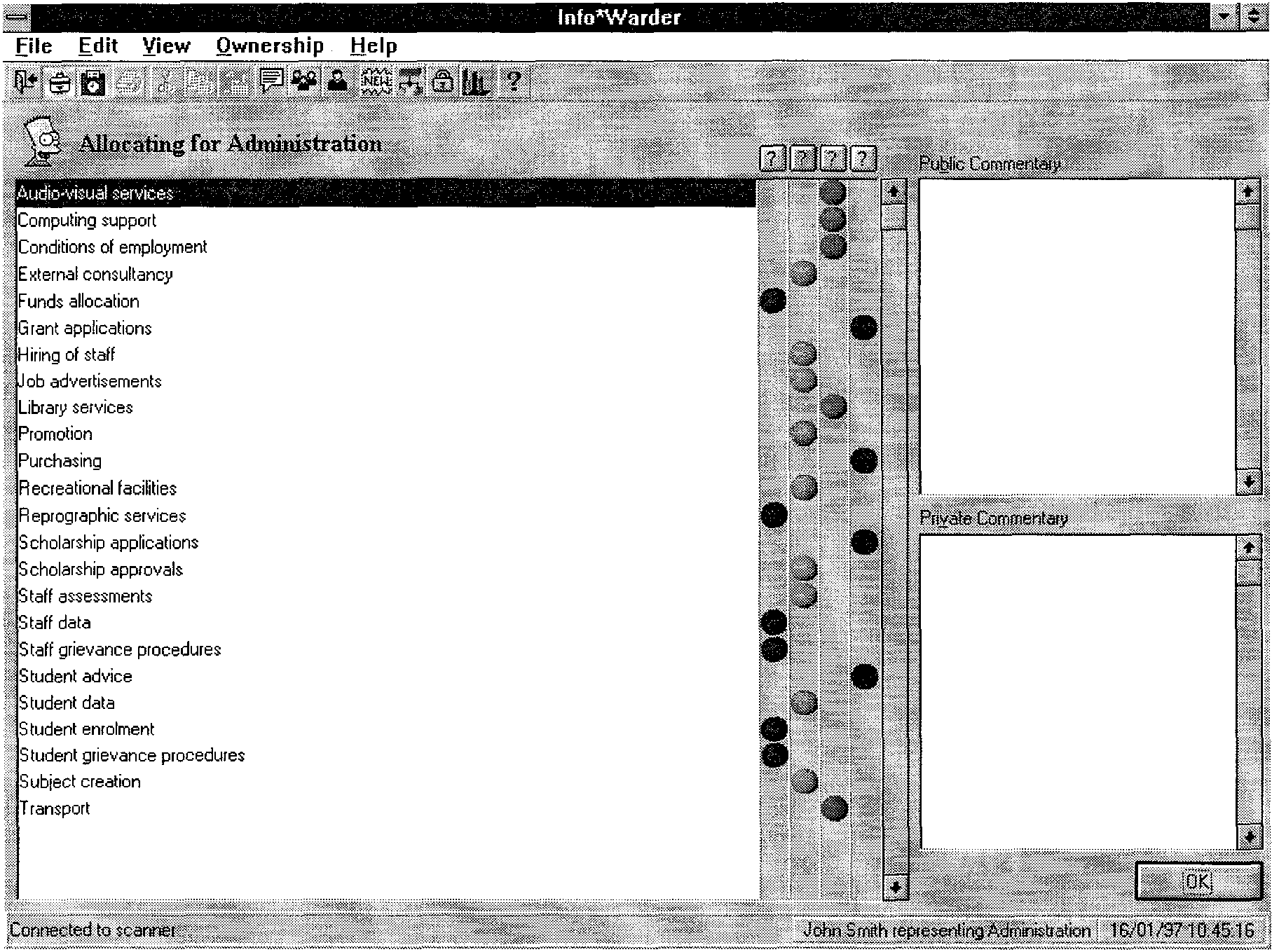
Experiments & Results: Visualizing the Conflict
Info*Warder transforms subjective feelings into objective visualizations. The system aggregates claims using a "Maximum Priority Union"—if one representative of a group claims an item is exclusive, the entire group is marked as claiming exclusivity to represent the "strongest" political stance.
Key Outputs:
- Group View of Stakeholder Ownership: Shows how the rest of the organization perceives a specific group's rights.
- Conflict Matrix: A cross-reference of items vs. stakeholders.
- Conflict Ranking: Perhaps the most valuable feature, this ranks data items by the "intensity" of overlapping exclusive claims.
By seeing these "hotspots" early, project managers can choose to negotiate, compromise, or circumvent the trouble areas rather than being blindsided during implementation.
Critical Analysis & Conclusion
Takeaway: Info*Warder is a "head-on" approach to organizational reality. It acknowledges that politics aren't an "error" to be fixed but an environmental factor to be managed.
Limitations:
- The system identifies where trouble will occur, but not how to solve it.
- It relies on stakeholders being willing to participate honestly (though the private/public comment split helps mitigate this).
Future Outlook: As we move toward even more decentralized and data-driven organizations, the "meta-level" ownership (control over data definitions and access) becomes the primary battlefield. Tools that can quantify these "soft" power dynamics are essential for the survival of large-scale digital transformation projects.
Note: This research highlights that the earlier a political "programming error" is found, the cheaper it is to fix.