
Thwarting the Mob: Why Traditional Social Network Strategies Fail Against Complex Contagions
Inhibiting diffusion of complex contagions in social networks: theoretical and experimental results
The paper investigates the inhibition of complex contagions (e.g., rumors, social movements) in social networks, where nodes require multiple affected neighbors to change state. It introduces the SCS-MNA and SCS-SASN optimization problems and presents two novel heuristics, CBH and PBH, which significantly outperform traditional simple contagion blocking methods on datasets like Epinions and Wikipedia.
TL;DR
Recent research shifts the focus from simple virus-like spread to Complex Contagions—behaviors requiring social affirmation from multiple sources (). This paper proves that finding optimal "critical nodes" to block such spreads is computationally impossible to approximate (NP-hard), but offers two powerful heuristics, CBH and PBH, that outperform standard centrality-based methods by orders of magnitude.
The "Simple" Fallacy
In the world of network science, we often treat information spread like a flu virus: if you talk to one infected person, you catch it. This is a Simple Contagion. To stop it, you vaccinate the "super-spreaders" (high-degree nodes).
However, human behaviors—like joining a strike, adopting a new technology, or participating in a riot—are Complex Contagions. A person usually waits for a "critical mass" of friends to commit before joining. The authors reveal a startling truth: the tools we use to stop viruses (like NetShield or Eigenvector Centrality) are remarkably ineffective at stopping social behaviors because these contagions thrive in local clusters and can easily bypass global "hubs."
Methodology: The Anatomy of Blockage
The authors define the problem as finding a Smallest Critical Set (SCS) to minimize the spread. Since global optimization is NP-hard for , they propose two strategies:
1. Covering-Based Heuristic (CBH)
CBH treats the boundary of the contagion as a "coverage" problem. It looks at the nodes set to be infected in the next time step and uses a greedy Set Multicover algorithm to select the fewest "firewall" nodes needed to ensure no one in the next layer meets their threshold.
2. Potential-Based Heuristic (PBH)
PBH assigns a "Potential" score to each node. It isn't just about degree; it's a recursive measure of how many people a node could infect, weighted by how early it gets infected. Nodes that get affected early and have vast downstream reach are prioritized for removal.
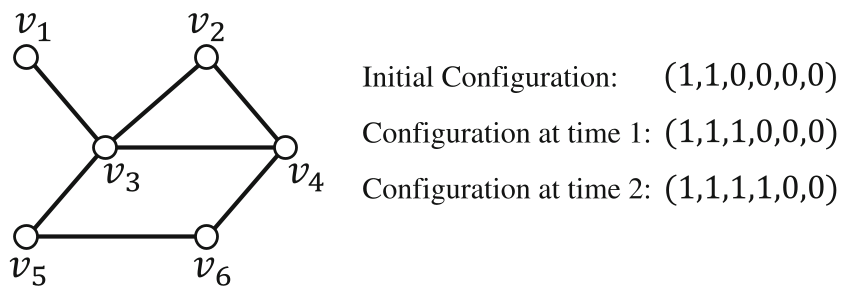 Fig 1: A visualization of a 2-threshold system. Note how node v3 requires both v1 and v2 to be affected before it flips state.
Experimental Showdown
The authors tested their methods against five SOTA baselines (including High-Degree and Betweenness Centrality) across three networks: Epinions, Wikipedia, and Slashdot.
| Metric | Traditional SOTA (NetShield) | Our Method (CBH/PBH) |
|---|---|---|
| Avg. Affected (Epinions, t=2) | ~20,929 nodes | 2.0 nodes |
| Avg. Affected (Wikipedia, t=2) | ~1,876 nodes | 2.0 nodes |
The difference is staggering. While traditional high-degree blocking helps slightly, CBH and PBH essentially halt the contagion in its tracks.
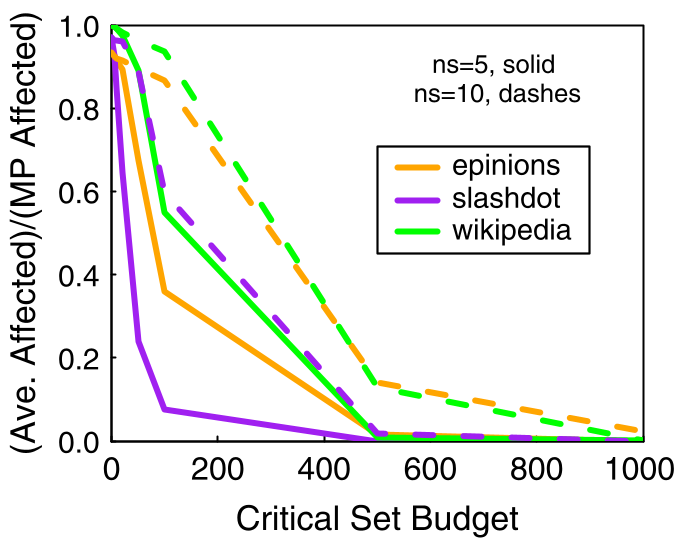 Fig 2: Spread fraction vs. budget. Note how our heuristics (solid lines) drop to near-zero spread much faster than traditional methods.
Deep Insight: The -core Bound
One of the most elegant contributions is the theoretical upper bound. The authors show that the maximum possible spread of a -threshold contagion is limited by the size of the largest connected component of the -core (the subgraph where every node has degree ).
This provides a static way to measure a network's vulnerability. If a network doesn't have a large -core, a complex contagion simply cannot "explode" into a global cascade, regardless of the seed nodes.
Critical Analysis & Takeaways
- The Power of Local Knowledge: The reason CBH and PBH work so well is that they assume the seed set is known. Traditional methods often try to protect a network blindly; this paper proves that knowing where the rumor starts changes the defense strategy entirely.
- Clustering Matters: Networks with low clustering coefficients (like Slashdot) are easier to protect because complex contagions struggle to find the "multiple sources" needed to jump between communities.
- Limitations: The heuristics require simulating the diffusion first to identify "potential." In real-time scenarios (like a fast-moving riot), this computational overhead might be a bottleneck, though the authors' complexity for PBH is highly efficient.
Conclusion
This work serves as a warning to social media moderators and public health officials: you cannot stop a social movement using the same math you use to stop a computer virus. By pivoting to -core analysis and using boundary-covering heuristics, we can achieve significantly better control over the "explosive" dynamics of social contagion.