
Trust Before Use: Why Young Adults Hesitate to Adopt Password Managers
Understanding Dynamics of Initial Trust and its Antecedents in Password Managers Adoption Intention among Young Adults
This study investigates the precursors of initial trust in password managers (PMs) among young adults using the Initial Trust Model (ITM). Analyzing data from 289 non-users, the research identifies how reputation and institutional safeguards drive the intention to adopt PMs, achieving a cross-disciplinary view of security tool acceptance.
TL;DR
Why do we trust a piece of software to hold the "keys to our kingdom"? This study reveals that for young adults, Initial Trust is the gateway to adoption. Surprisingly, it isn't about whether the user is a "trusting person" (Propensity to Trust); it is almost entirely driven by the Firm's Reputation and Structural Assurances like encryption guarantees and privacy policies.
The "Expert-User" Divide
There is a massive chasm in the cybersecurity world. While security professionals view Password Managers (PMs) as a "Top 5" essential tool, adoption among regular users is dismal—some reports suggest it is as low as 3%. The primary friction point isn't lack of utility; it's a lack of trust.
The authors of this paper argue that trust isn't a monolith. It evolves in phases. The most critical phase for adoption is Initial Trust—the trust formed before any hands-on experience.
Methodology: Deconstructing the Trust Engine
The researchers surveyed 289 European young adults (aged 18-35) who were not currently using password managers. They used Structural Equation Modeling (SEM) to analyze how three core "antecedents" lead to an intention to adopt.
The Research Model
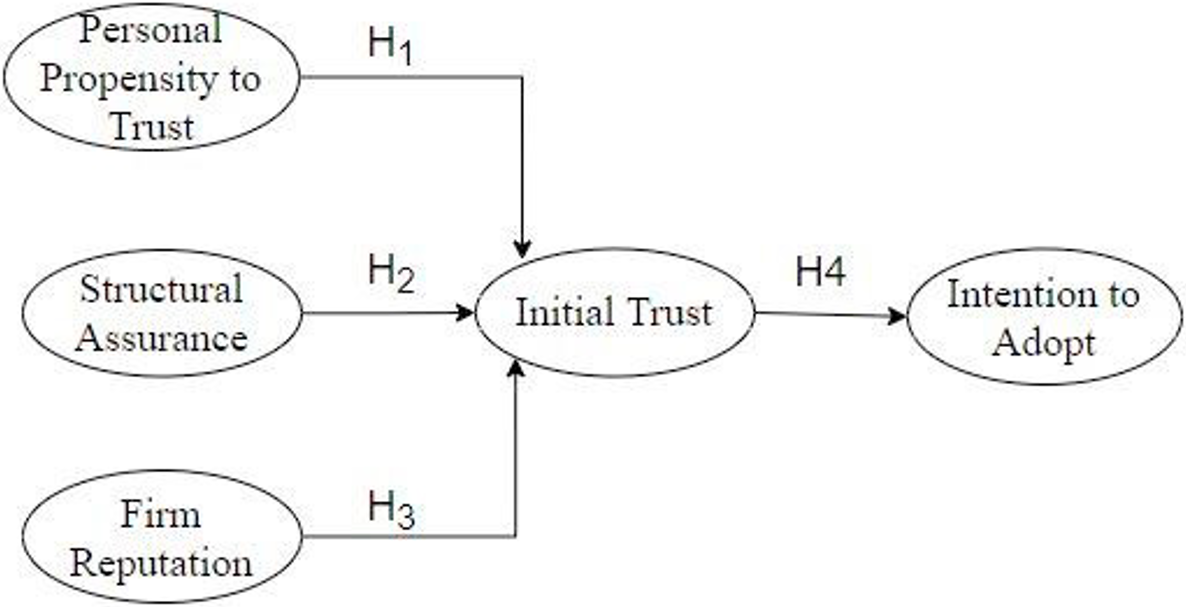 Figure 1: The hypothesis-driven model based on the Initial Trust Model (ITM).
- Personal Propensity to Trust: One's general faith in humanity and technology.
- Structural Assurances: Technical and legal safeguards (encryption, certifications).
- Firm Reputation: The perceived competence and integrity of the vendor.
Key Insights: What Actually Moves the Needle?
1. Reputation and Safeguards are King
The data showed that Firm Reputation (β = 0.44) and Structural Assurances (β = 0.38) are the heavy hitters. Together, they explain nearly 60% of the variance in initial trust. If a user perceives a company as reputable and sees clear "guarantees" (like ISO certifications or clear privacy policies), their trust spikes.
2. Personality is Irrelevant
In a shocking finding, Personal Propensity to Trust (H1) was not supported. This means that even "cautious" or "skeptical" individuals can be persuaded to use a PM if the external cues (reputation and security features) are strong enough. This is good news for the industry: adoption is a marketing and engineering challenge, not a psychological deadlock.
3. The Path to Adoption
Initial Trust serves as the mediator. It converts the abstract "good feelings" about a firm into a concrete Intention to Adopt (β = 0.33).
 Table 2: Statistical significance of the hypothesized relationships.
Critical Analysis & Conclusion
Summary
This paper effectively shifts the focus from "usability" to "institutional signaling." For a young adult population that is digitally native but increasingly privacy-conscious, the institution behind the code matters as much as the code itself.
Limitations
The study focused on a generic concept of PMs. However, the trust dynamics might change drastically when comparing a browser-integrated manager (like Google/iCloud) versus a standalone third-party app (like Bitwarden or 1Password). Furthermore, the sample was limited to Europe; cultural perceptions of "Firm Reputation" may differ in regions with less stringent data protections.
Future Outlook
For PM developers, the message is clear: Transparency is the best feature. Highlighting third-party audits, simplified privacy policies, and public-facing security guarantees is mathematically more effective at gaining new users than simply "making the app easier to use." The future of cybersecurity adoption lies in building institutional integrity that mirrors technical robustness.