
The Strategic Illusion: Why Organizational Behavior Fails as a Lifeline for IS/KMS
Innovating strategically in information and knowledge management: Applications of organizational behavior theory
This paper critically evaluates the strategic integration of Organizational Behavior (OB) within Information Systems and Knowledge Management Systems (IS/KMS) departments at business schools. It argues that top-down strategies mandating specific academic fields are dysfunctional and discovers that OB, while broad, fails to provide a concrete theoretical platform for IS/KMS research.
TL;DR
Is "Organizational Behavior" (OB) the ultimate strategic anchor for modern business schools, or just a bureaucratic convenience? This study analyzes a real-world scenario where a business school attempted to enforce a top-down strategy prioritizing OB as a strategic field. The findings are sobering: OB is often too broadly defined to be useful, rarely appears in the core methodology of research papers, and is viewed by IS/KMS scholars as a "red herring" rather than a theoretical asset.
The "Top-Down" Trap: A Strategy of Divide and Conquer
The authors start with a critical observation: most elite business schools (like Harvard, Stanford, or HEC) do not single out specific academic departments as being "strategic" relative to others. Instead, they focus on broad themes like internationalization and research excellence.
The paper critiques the "Animal Farm" approach to management—where all departments are equal, but some are "more equal" than others. In the case study provided:
- Top management allocated resources and prestige to five academic fields (Finance, Economics, Marketing, Law/Accounting, and OB).
- IS/KMS was told its survival depended on aligning with the Department of Organizational Behavior.
The motivation for the study was to see if OB actually offers theories that could sustain and innovate the IS/KMS field.
Methodology: Testing the "Pudding"
The authors conducted a rigorous analysis across three dimensions to see if the strategic importance of OB was reality or rhetoric:
- Global Benchmarking: Inspecting the strategy statements of 11 world-leading institutions.
- Bibliometric Evidence: Using the EBSCO EconLit database to analyze over 9,000 entries.
- Peer Recognition: Interviewing active IS/KMS researchers on their theoretical orientations.
 Table 1 illustrates that while OB is a frequent search term, its overlap with IS/KMS is minimal compared to its use in Economics, suggesting a lack of specialized utility for information systems.
Why OB Fails the "Theoretical Usefulness" Test
The data revealed a shocking gap between administrative labels and academic reality. In many publications:
- OB is used by database editors as a convenience label (subject/descriptor), but authors almost never include it in their own Keywords.
- In a sample of articles ostensibly about "OB and Marketing" or "OB and KMS," the term "Organizational Behavior" rarely appeared in the text at all.
- Researcher Insights: Interviewees noted that IS/KMS is a distinct discipline. One participant famously stated: "They are as separate fields as physics and math."
 Table 2 confirms that OB is virtually absent from article titles, abstracts, and body texts in relevant samples, proving it serves as an "empty entity" in rigorous research.
A New Macro Model for Innovation
Instead of relying on the "red herring" of OB, the authors propose that IS/KMS research should double down on Innovation and Change theories. They suggest a macro model that integrates:
- Organizational/Actor Maturity.
- The Lifecycle of the Innovation (Idea -> Artifact -> Use -> Demise).
- Cognitive development phases.
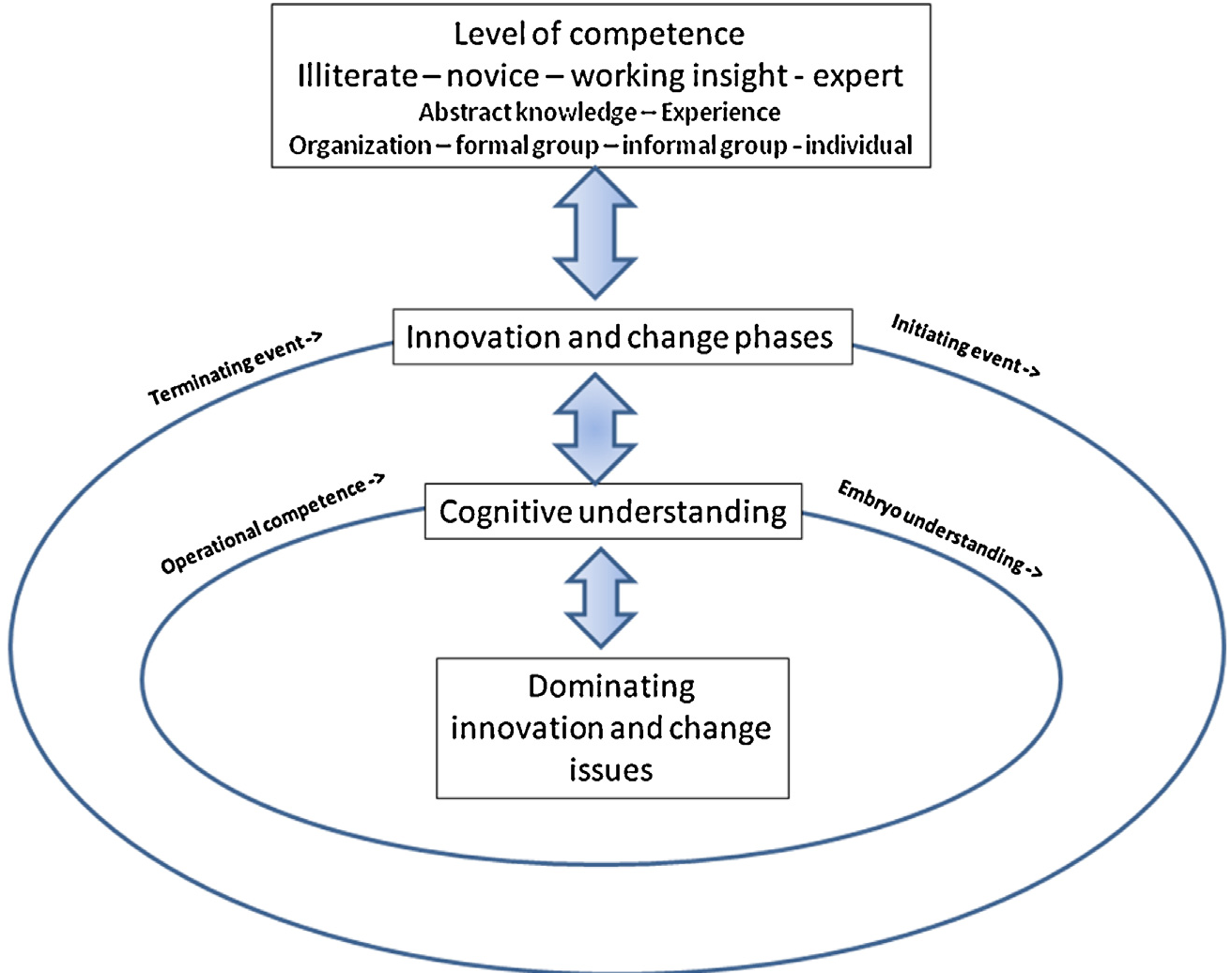 The proposed framework aims to bring logical rigor to "intuitive" practitioner thinking, focusing on the dialectic struggles between man and machine.
Deep Insight & Conclusion
The takeaway for university admins and researchers is clear: Top-down selection of academic winners is dysfunctional. It demotivates faculty, encourages power games to "stay on the inside," and stifles the very innovation it claims to promote.
Limitations: The study focuses on one specific academic setting and database. However, the consistency of findings—that OB is an administrative umbrella rather than a theoretical engine—suggests that for IS/KMS to thrive, it must remain an independent, interdisciplinary field rooted in the physical and human realities of technology, rather than being "swallowed" by generic management theories.
Future Outlook: The bright future for IS/KMS lies in exploring the "order and chaos" between systems and human intuition, not in retreating to generic organizational labels.