
UHM: Breaking the Accuracy-Diversity Dilemma in Digital Libraries via Unbalanced Physics-Inspired Diffusion
SPECIAL SECTION ON INNOVATION AND APPLICATION OF INTERNET OF THINGS AND EMERGING TECHNOLOGIES IN SMART SENSING
The paper introduces an Unbalanced Multistage Heat Conduction and Mass Diffusion (UHM) algorithm for educational digital libraries (edu-DL). By modeling user-resource interactions as a weighted bipartite network, the method aims to improve both the precision and diversity of academic resource discovery.
TL;DR
In the vast ocean of educational digital libraries (edu-DL), finding specific, high-quality academic resources is often a "needle in a haystack" problem. This paper proposes the Unbalanced Multistage Heat Conduction and Mass Diffusion (UHM) algorithm. By reimagining user interactions as energy flowing through a bipartite network and introducing "unbalanced" transmission physics, the authors significantly boost recommendation precision, diversity, and long-tail resource coverage.
Problem & Motivation: The Limits of Keyword Search
Existing academic search engines like Google Scholar or PubMed primarily rely on keyword-based matching. However, this approach has two fatal flaws in the context of educational libraries:
- Ambiguous Intent: Users often explore topics without precise terminology.
- Popularity Bias: Standard algorithms tend to recommend the most cited or viewed papers, burying niche but highly relevant pedagogical resources.
While traditional physics-inspired models like Heat Conduction (HC) (great for diversity) and Mass Diffusion (MD) (great for accuracy) exist, they treat all users and resources as equal nodes. This "balanced" view ignores the reality that some users are more influential ("power users") and some resources are "over-exposed," leading to poor coverage and the classic accuracy-diversity trade-off.
Methodology: The Core Intuition
The authors propose a Weighted Bipartite Network where users and resources are nodes, and edges represent both explicit (ratings) and implicit (views, downloads) interactions.
1. Unbalanced Energy Transmission
The breakthrough lies in how energy (relevance) flows between nodes. Instead of equal distribution, the UHM model uses:
- User Influence Stretching: Active users are given a "louder voice" in the network. Their energy transmission capacity is increased proportional to .
- Resource Popularity Compression: To combat the "rich-get-richer" effect, popular resources have their energy transmission compressed, forcing the algorithm to find relevant items in the "long tail."
2. Multistage Pipelined Hybridization
While most models stop at two stages (Resource → User → Resource), the UHM introduces Multistage Energy Transmission (). This allows energy to propagate further into the network, reaching "cold" resources that would otherwise receive zero energy in a standard two-stage walk.
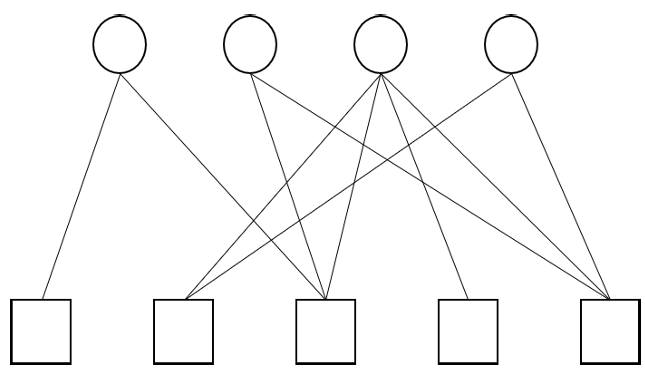 Figure: The Bipartite User-Resource Network used as the foundation for energy flow.
Experiments & Results
The model was tested on the Sowiport User Search Sessions (SUSS) dataset, containing a year's worth of academic search logs.
Performance Highlights:
- Accuracy vs. Diversity: By tuning the hybrid parameter , the UHM model allows administrators to find the "sweet spot" between precision and novel discovery.
- Coverage Gains: The multistage process () significantly improved resource coverage compared to the baseline HHM model, proving that deeper network propagation surfaces more of the library's hidden gems.
- Superior Ranking: The UHM achieved a higher Ranking-score, indicating that relevant hits are being placed higher in the results list, which is critical for user experience.
 Table: Comparison of individual algorithms. Note how UMD excels in Precision while UHC dominates in Diversity.
Critical Analysis & Conclusion
Takeaway
The UHM algorithm proves that we can break the "accuracy-diversity dilemma" by acknowledging the inherent inequality of network nodes. In educational settings, where high-quality but niche resources are often overlooked, this "unbalanced" approach is mathematically elegant and practically effective.
Limitations & Future Work
The current model relies heavily on interaction topology. A potential extension would be to incorporate Content Features (e.g., using NLP to analyze document text) or Social Networks (user-user relationships) to refine the "influence" parameters further. As educational resources continue to grow, moving from "keyword matching" to "topology-aware discovery" is no longer optional—it is a necessity.