
From Equations to Agents: Decoding the Mechanics of Innovation Diffusion
Innovation Diffusion in Social Networks: A Survey
This survey paper provides a comprehensive review of the "Innovation Diffusion" process, categorizing models into traditional mathematical frameworks and modern social network approaches. It highlights the transition from macro-level aggregate equations to Micro-level simulations that account for network topology and individual heterogeneity.
TL;DR
How does a new idea go from a niche invention to a mainstream staple? This survey explores the evolution of Innovation Diffusion modeling—moving from rigid 19th-century population growth equations to modern, agent-based social network simulations that account for human psychology and complex connectivity.
Contextual Positioning
In the landscape of social physics and marketing science, this paper serves as a vital Taxonomic Guide. It bridges the gap between the macro-theoretical framework established by Everett Rogers and the micro-computational methods required to simulate today's hyper-connected digital societies.
The Problem: The "Homogeneous" Blind Spot
Early diffusion research relied heavily on "Aggregative Approaches." Models like Logistic and Gompertz viewed a population as a single bucket where everyone interacts with everyone else simultaneously.
- The Flaw: It ignores the "social distance." In reality, you are more likely to adopt a new AI tool because your immediate colleague uses it, not because a stranger on the other side of the country does.
- The Missing Link: These models cannot reproduce the "Failure to Launch" scenario where an innovation exists but fails to reach critical mass due to a fragmented social structure.
Methodology: The Core Models
The paper categorizes the evolution of modeling into several distinct "families":
1. The Mathematical Pioneers (Macro)
- Bass Model: The gold standard in marketing. It splits adopters into Innovators (influenced by external media) and Imitators (influenced by internal social pressure).
- Shortcoming: It requires high-quality historical data to estimate parameters, making it "backward-looking" rather than truly "forward-predictive."
2. Social Network Models (Micro)
To fix the macro-blindness, researchers shifted focus to three areas:
- Threshold Models: Based on the idea that an individual has a specific "tipping point." If 20% of my friends adopt a technology, I will too.
- Epidemic Approach: Treating an idea like a virus (SIR Model: Susceptible Infectious Removed). This is the best fit for "Word-of-Mouth" marketing.
- Evolutionary Models: The "new frontier." These view adoption as a learning process. Decision-making is seen as an evolutionary vector that changes over time based on feedback from the environment.
 Figure 1: A proposed taxonomy of innovation diffusion models, categorizing them by their underlying mechanics.
Why Social Structure Matters
The authors highlight that the "S-Curve"—the classic sigmoidal growth of any successful product—is actually an emergent property of the underlying network.
- Homophily: We tend to connect with people like us. This "echo chamber" effect can accelerate diffusion within a group but create "structural holes" that prevent the innovation from jumping to new demographics.
- Opinion Leaders: Following Rogers' theory, "Early Adopters" act as the bridge. Without these "high-degree nodes," the diffusion dies in the "Innovator" phase.
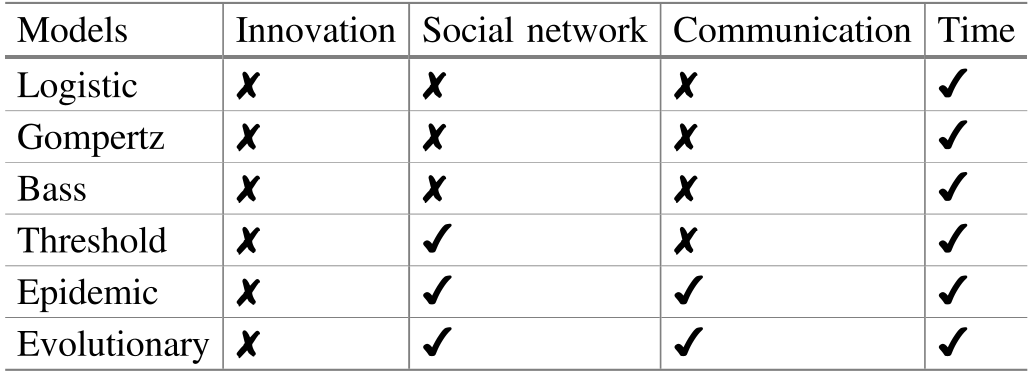 Table 1: Comparison of how different models account for innovation features, social networks, communication, and time.
Critical Insight & Future Outlook
While we have mastered modeling "Who" adopts and "When" they adopt via social networks, the authors point out a glaring omission in current literature: The Innovation itself.
Most models treat every innovation as a generic "token." In reality, an innovation with high Complexity (hard to use) will diffuse differently than one with high Observability (easy to see others using it). The next generation of models must integrate these qualitative features into the mathematical weights of the network links.
Conclusion (The Takeaway)
If you are building a product or researching social change, the lesson is clear: Network topology is destiny. Mathematical models give us the "what," but Evolutionary and Threshold models give us the "how." To drive adoption, one must not only provide a great product but also target the specific structural nodes that facilitate social learning.