
Inside-Out Innovation: Why Your Best Ideas are Hiding in Your Employee Directory
Inside-Out: How Internal Social Media Platforms Can Accelerate Innovation and Push External Crowdsourcing Towards New Frontiers
This paper explores "Internal Crowdsourcing" as a strategic evolution of traditional suggestion schemes, utilizing social media mechanics to drive corporate innovation. Through participatory action research across 10 organizations, the authors identify key success factors and analyze why companies struggle to integrate internal and external crowdsourcing efforts.
TL;DR
Innovation often looks outward—to customers, experts, and the "crowd." However, this paper argues that the next frontier is Internal Crowdsourcing. By applying social media mechanics (likes, comments, gamification) to their own workforce, companies can solve complex problems faster than traditional suggestion boxes. The catch? Most firms treat it as a "side project" rather than a core strategy, failing to bridge the gap between internal expertise and external fresh perspectives.
Background: The "White Spot" of Corporate Innovation
For a decade, "Open Innovation" has been the buzzword of choice. We know how to run a contest for customers (External Crowdsourcing), but we treat employee ideas with antiquated "Continuous Improvement Processes" (CIP). The researchers identify a critical gap: internal data is often locked behind confidentiality walls, and internal R&D departments frequently suffer from the "Not-Invented-Here" (NIH) syndrome, rejecting any idea they didn't personally conceive.
The Problem: Silos and Structure
Why do companies rarely run internal and external crowdsourcing in parallel?
- Structure & Red Tape: Internal projects face HR, legal, and workers' council hurdles that external "satellite" projects bypass.
- Differing Objectives: Internal is seen as "fixing processes," while external is for "new products." This artificial divide prevents a unified innovation funnel.
- Capacity Constraints: Most innovation teams are too lean to manage two distinct communities simultaneously.
Methodology: Insights from the Trenches
The researchers didn't just observe; they participated in over 70 initiatives. They compared high-performing cases, such as a large bank that activated 3,600 employees to generate 765 disruptive business ideas, against external contests in the steel industry.
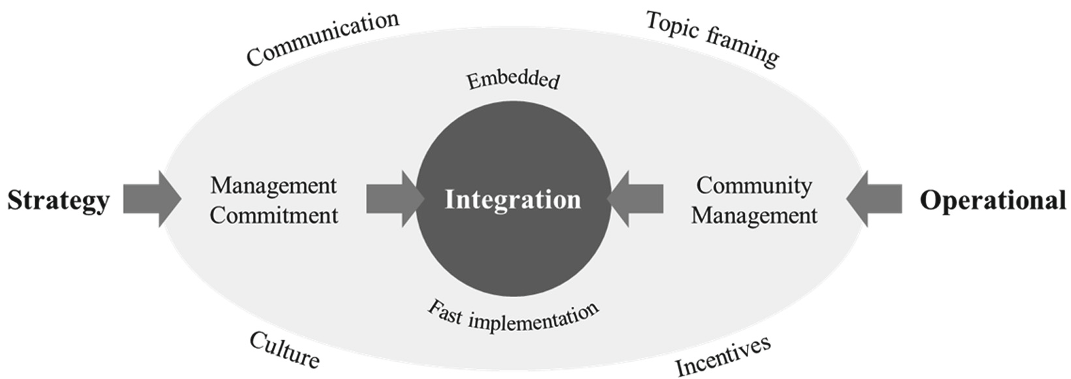 The model above illustrates the Strategic vs. Operational levers required for internal success.
Key Findings: The Internal Advantage
The study reveals a surprising truth: Internally sourced ideas often have higher implementation rates.
- Context is King: Employees already understand the market constraints and technical feasibility that external "dreamers" might ignore.
- Early Bonding: By involving R&D experts as "coaches" on internal platforms, they become co-authors of the ideas, effectively neutralizing the "Not-Invented-Here" defense.
- The Funnel Effect: Success in internal "protected" environments builds the organizational muscle needed to eventually handle the chaos of an external crowd.
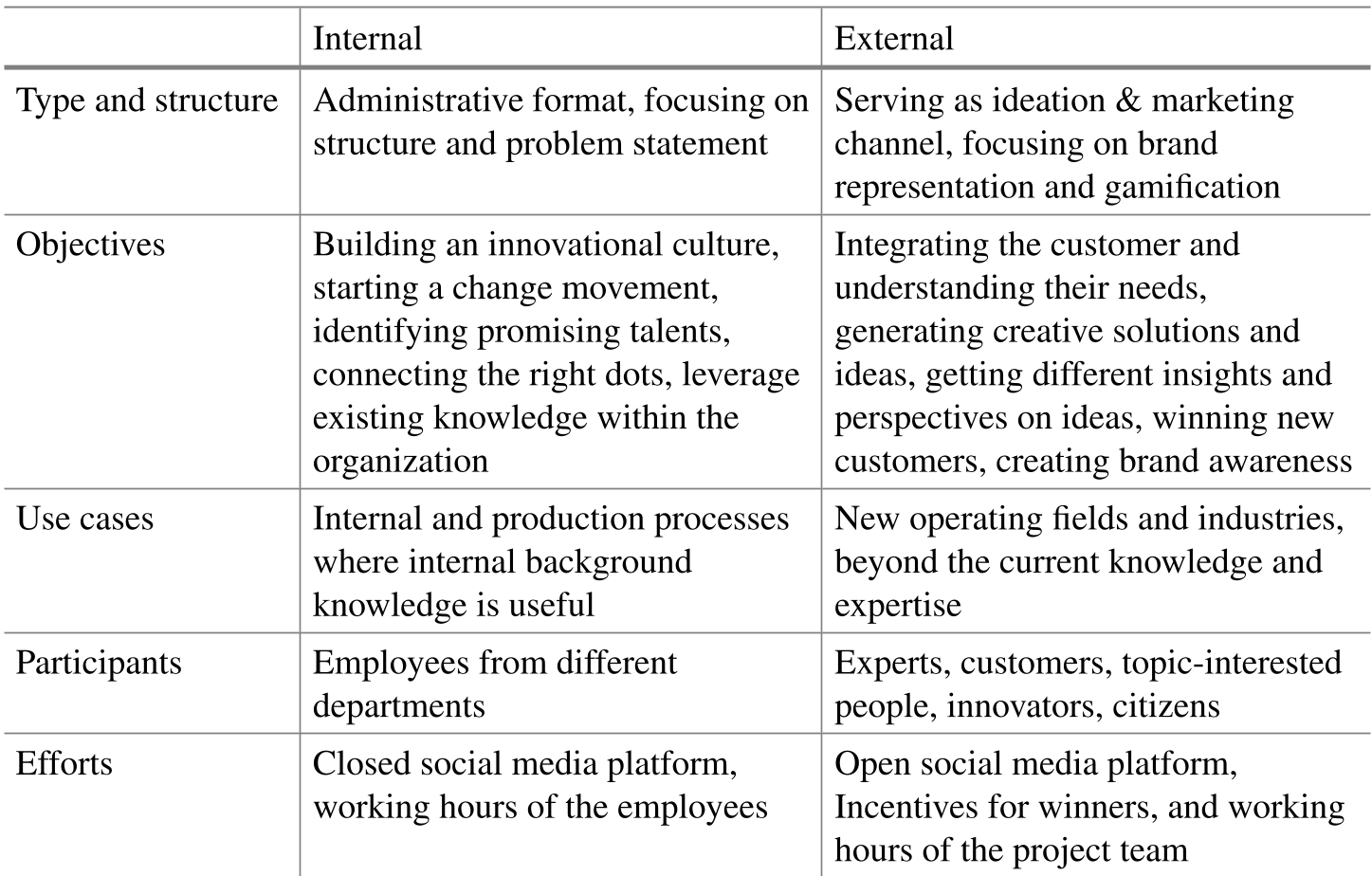 Comparative analysis showing the distinct objectives and participants of each method.
Critical Insight & Managerial Action
Professionalizing innovation requires three shifts:
- Stop mixing CIP and Crowdsourcing: Efficiency improvements (lean Six Sigma) are fundamentally different from disruptive ideation. Use different gates for each.
- Bridge Gaps Early: Map your stakeholders. If the R&D head isn't on the jury, the idea will die in the lab.
- Target Parallelism: The ultimate goal is an Omnichannel Crowdsourcing Strategy. Start internal to build the culture, then use those "vetted" topics to frame a laser-focused external challenge.
Conclusion: A Marathon, Not a Sprint
Internal crowdsourcing isn't just a platform; it’s a cultural shift. The paper emphasizes that "innovation is a marathon." Companies should run at least three campaigns to find their rhythm, adjusting incentives from simple cash prizes to managerial recognition and the chance for employees to "pitch and build" their own concepts.
Note: This synthesis is based on the research by Rapp, Kröger, and Scheerer (2026).