
Navigating the Collective: How 'Insideness' and 'Outsideness' Redefine Digital Learning
The Influence of ‘Insideness’ and ‘Outsideness’ on Learning in Collective Intelligence Systems
This conceptual paper introduces a theoretical framework using the metaphors of 'insideness' and 'outsideness' to analyze learning within Collective Intelligence (CI) systems. It contrasts traditional top-down educational models with emergent social-networking-driven strategies used by neo-millennial students to achieve academic agency.
TL;DR
Higher education is undergoing a seismic shift. As students increasingly turn to social media and collective intelligence (CI) systems, the traditional roles of "expert" and "learner" are blurring. This paper introduces the concepts of Insideness and Outsideness to explain how students use digital networks to bypass traditional classrooms, creating a new form of "academic agency" that is as disruptive as it is powerful.
The Friction: Why Traditional Classrooms are Stalling
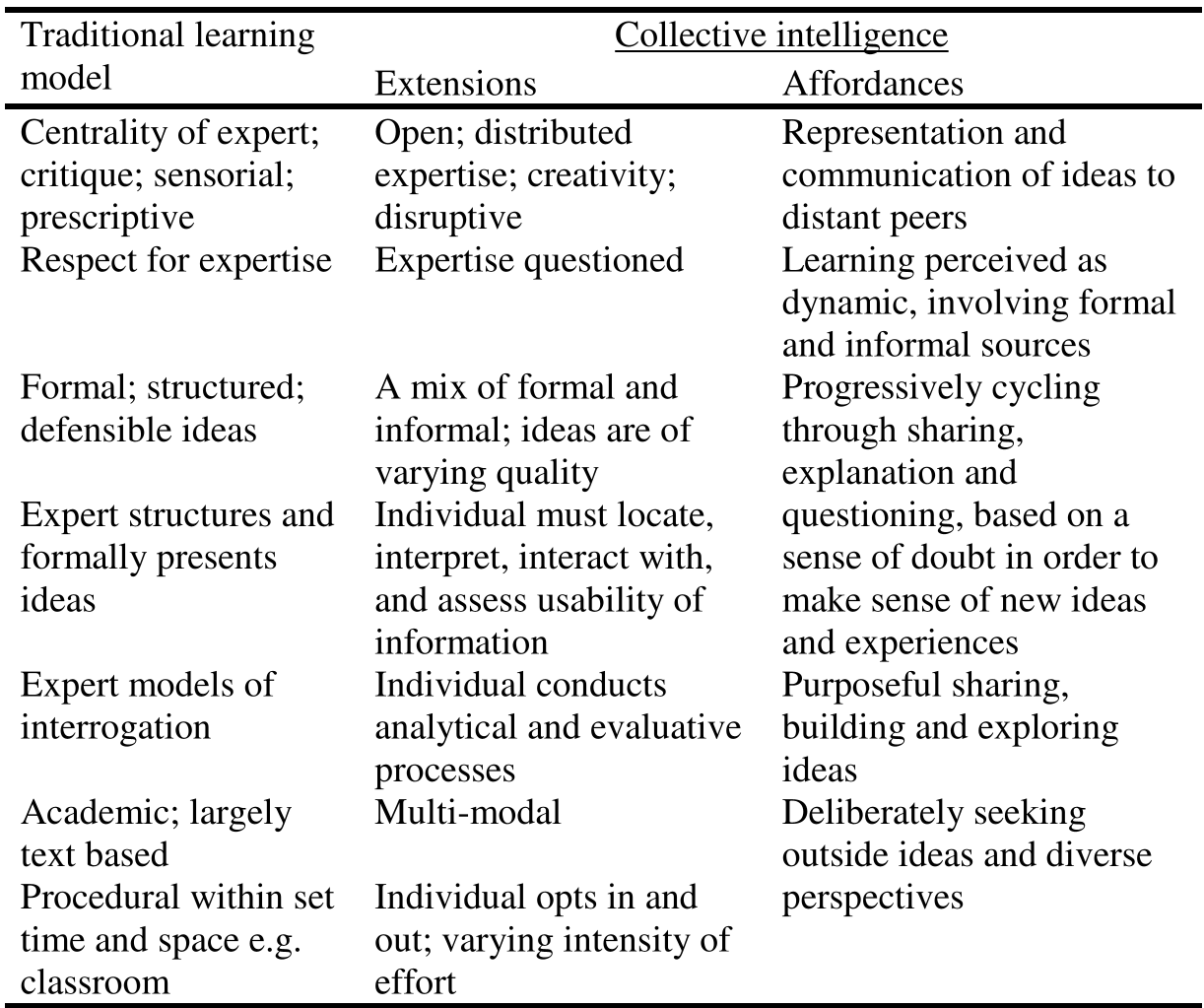
The modern "knowledge society" is built on uncertainty and complexity. However, traditional higher education often relies on top-down, prescriptive, and text-heavy routines.
The authors argue that "neo-millennial" students are naturally fluent in multi-modal media and active learning. They don't just consume information; they subvert exploratory learning through informal peer support and "collusion" in virtual spaces. This creates a fundamental tension: How can a rigid, classroom-based system accommodate a student body that thrives on non-linear, distributed expertise?
The Metaphorical Framework: Insideness vs. Outsideness
To understand this shift, the authors propose a dual-lens framework.
1. Insideness: The Comfort of the Known
Insideness represents interactions with local peers—those who share the same language, cultural context, and strategic goals (e.g., passing a specific exam).
- Mechanism: Face-to-face meetings or private group chats.
- Benefit: High sense of control and shared purpose.
- Risk: It can create "echo chambers" where outsiders are viewed as alien and diverse perspectives are undervalued.
2. Outsideness: The Power of Disturbance
Outsideness refers to an individual’s engagement with geographic and cultural differences. It is based on the theory of Expansive Learning, where knowledge is co-constructed with no definitive end-point.
- Mechanism: Engaging with global communities of practice, experts, and unknown peers via social media.
- Benefit: Exposure to a variety of ideas and the "productive doubt" necessary for deep critical thinking.
- Key Insight: The driving influence here is disturbance—unexpected events and contradictions that force a learner to adapt.
From Social Media to "Academic Conversation"
The core challenge identified in the paper is moving students from brief, informal communication (like texting) to Academic Conversation.
The authors define Academic Conversation as a sophisticated cycle:
- Sharing: Presenting an initial idea.
- Doubt/Questioning: Encountering "outsider" perspectives that challenge the idea.
- Adaptation: Refining explanations in response to rigorous feedback.
- Reflection: Assessing the usability of the newly constructed knowledge.
Critical Analysis: The Tensions of Agency
While the framework is promising, the authors highlight several unresolved dilemmas:
- The Alienation Factor: Not all students feel empowered by social networking; some find it alienating or "dispassionate."
- The Validation Crisis: In a world of distributed expertise, how do we validate that the knowledge generated in a CI system is "academic" or "credible"?
- Fragmented Meaning: There is a risk that social media disaggregates information into "disparate individual pockets," making it hard for students to form a coherent understanding of complex subjects.
Future Outlook: Reclaiming the "Outside"
The paper concludes that higher education must stop viewing social media as a distraction and start seeing it as a component of a Collective Intelligence System.
The future of pedagogy lies in teaching students strategies to handle "outsideness"—how to seek diverse perspectives, how to reconcile conflicting data, and how to turn a chaotic Twitter thread into a structured academic insight. We must learn from the way students are already "hacking" their education if we hope to remain relevant in a wired world.
Takeaway: Agency is the power to "do otherwise." In the age of CI, student agency is defined by the ability to navigate between the safety of the 'inside' and the creative disruption of the 'outside.'