
Inspecting Interactions: The Hidden Synergy of Global News Media on Social Media
Inspecting Interactions: Online News Media Synergies in Social Media
This study investigates news content propagation and media synergies across Twitter and Facebook, utilizing the ConOrigina framework to distinguish between original content and replicas among 48 global news outlets. By analyzing 232K posts, the authors classify media roles into self-originators, providers, and consumers, establishing predictive models for audience engagement.
TL;DR
Not all news on your feed is "new." This research analyzes 232,000 posts from 48 major news outlets to map the ecosystem of news production. By distinguishing between content originators, providers, and consumers, the study reveals that being first and original is the only statistically significant way to drive engagement on Twitter and Facebook.
Background: The Social Media Migration
Traditional news media—newspapers, TV, and radio—have long transitioned to social platforms. However, the move has turned the news cycle into a complex web of replication. While we see the same headlines everywhere, very little is known about the actual "pedigree" of a news item. This paper settles the score by categorizing how giants like CNN, Reuters, and the Associated Press (AP) actually interact behind the digital curtain.
The "ConOrigina" Method: Tracking Digital DNA
To identify who actually wrote a post, the researchers used a framework called ConOrigina. This isn't just a simple text match; it uses:
- SCAP (Source Code Author Profile): Analyzes byte-level n-grams to find unique "writing fingerprints."
- Circadian Typology: Tracks the temporal habits of posters to verify if the timing of a post matches the suspected originator’s historical behavior.
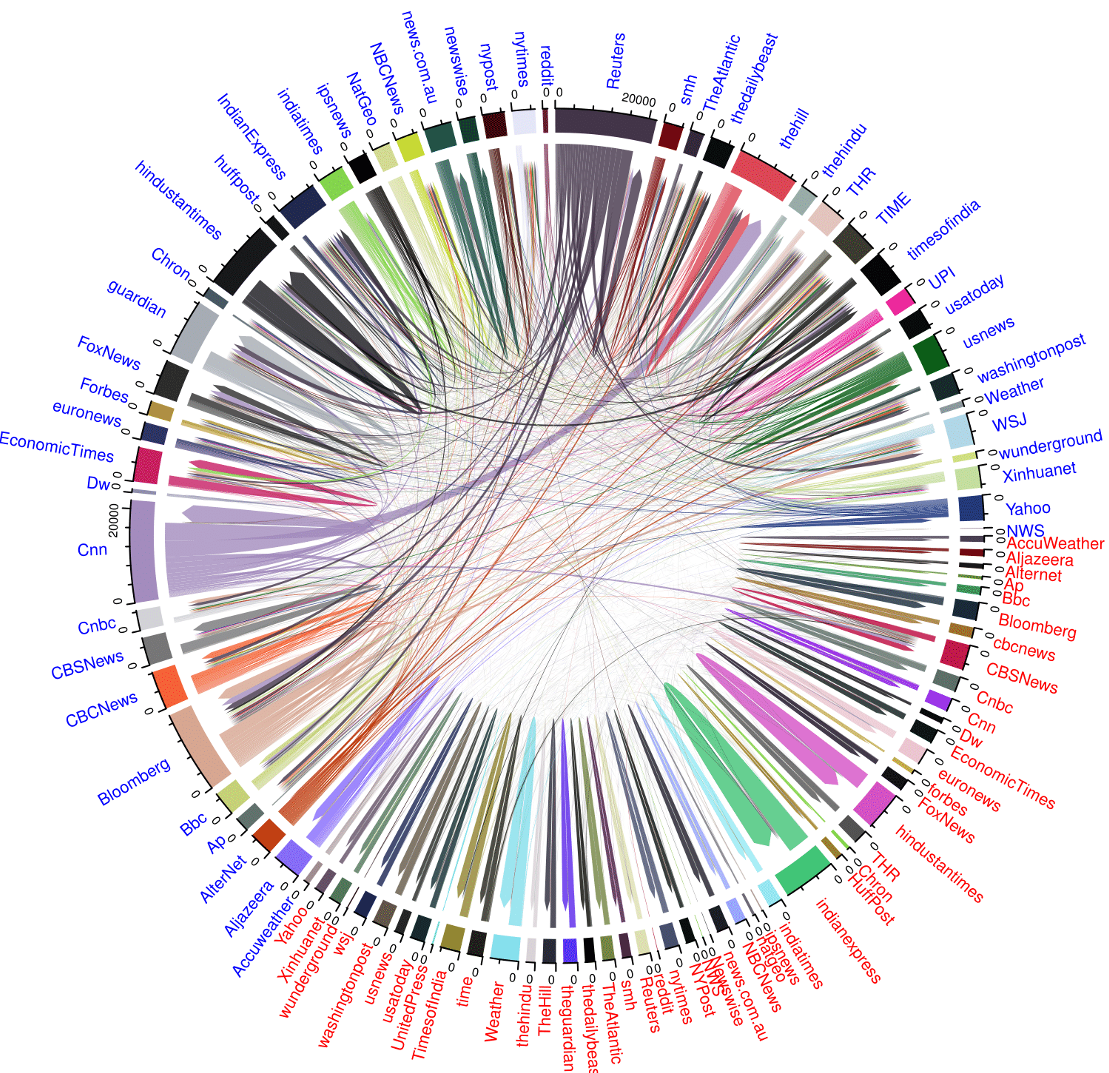 Figure 1: The news propagation web. Moving links represent the flow of content from originators (DispersedLinks) to consumers (AcquiredLinks).
Identifying the Players: Originators vs. Consumers
The study defines three key roles in the news ecosystem:
- Self-Originators (The Producers): Outlets like CNN, Accuweather, and DW produce over 80% of their own content. They are the "engines" of the news cycle.
- Content Providers (The Leaders): Entities like Reuters and Ipsnews share their content widely, acting as the primary sources for the rest of the community.
- Content Consumers (The Aggregators): Interestingly, the study identifies the Associated Press (AP) and Indian Express as strong consumers in this context—meaning a vast majority of their social media output consists of replicas or shared content from the broader network.
The Popularity Algorithm: Why "First" Beats "Frequent"
One of the most valuable insights for social media managers is the Reader Reactions Predictive Model. The researchers tested three variables to see what actually causes Favorites and Retweets:
- Number of Posts: Surprisingly, simply posting more does not correlate with popularity.
- Number of Followers: Predictably, a large base helps.
- Interaction Index (In): This was the "secret sauce." Media outlets that originated their own content and saw that content dispersed to others gained significantly more traction.
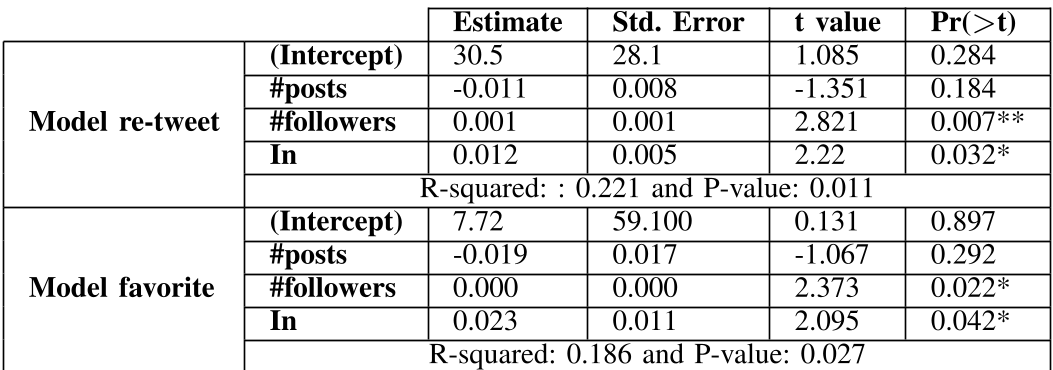 Table 1: Regression analysis showing that Interaction (In) and Followers are the only significant predictors (p < 0.05) for engagement.
Deep Insight: Twitter for Speed, Facebook for Reach
The data confirms a platform schism:
- Twitter is the "Newsroom": Outlets are more active here (77% of cases), but the lifespan of a tweet is short, and engagement is lower per capita.
- Facebook is the "Lounge": While outlets post less frequently, the content receives significantly more interactions (Likes/Shares).
Conclusion & Future Value
The takeaway for the industry is clear: Originality is the ultimate currency. News organizations that rely heavily on AcquiredLinks (replicating others) essentially act as "echo chambers," which may fill a feed but does not build the same level of authority or engagement as originating fresh content. As AI-generated news begins to fill social streams, these metrics of "original authorship" will become even more critical for platform integrity and brand value.
Limitations: The study focuses on English editions and was conducted during a specific one-month window, which may be influenced by the specific news cycle of that period.