
Instagram Success Decoded: Dual-Attention and the Power of User Context
How to Become Instagram Famous: Post Popularity Prediction with Dual-Attention
This paper introduces a Dual-Attention model for personalized post popularity prediction on Instagram, specifically focusing on whether a post will be "popular" for a given individual user. By integrating image features, text captions, and a newly defined "user environment" (past posting history), the model achieves a SOTA accuracy of 71.19% on a custom Instagram dataset.
TL;DR
Why does a simple selfie get hundreds of likes for one person but fail for another? Researchers have developed a Dual-Attention Model that predicts post popularity not based on global trends, but on a specific user's historical context. By analyzing the relationship between current content (image/caption) and the "user environment" (past behavior), the model hits a 71.19% accuracy in predicting what will go viral for you.
Background: The Relativity of "Famous"
Most social media AI research treats popularity as an absolute number. However, the academic community is shifting toward individualized prediction. A post with 200 likes is "famous" for a hobbyist but a "flop" for a Kardashian. This paper tackles the "how-to" of becoming famous by looking at the delta between a user's new post and their established "norm."
The Bottleneck: Why Standard Fusion Fails
Existing methods typically use "Early Fusion" (smashing image and text vectors together) or "Late Fusion" (averaging scores). These methods miss two things:
- Dynamic Relevance: Not every word in a caption is equally important to the image.
- User Habituation: If a user always posts food, their 100th food post is less likely to be "popular" than a surprising selfie. This is the "User Environment" problem.
Methodology: Dual-Attention Architecture
The core innovation is a two-pronged attention strategy that treats the current post as an "explicit" event and the user's history as an "implicit" context.
1. Explicit Attention (Image-Caption Pairs)
The model uses a modified co-attention mechanism. It calculates an affinity matrix between ResNet-50 image features and LSTM-encoded caption features. Unlike standard VQA tasks, social media images are often simple (landscapes, selfies); thus, the attention is focused on capturing keywords (emojis, hashtags) that elevate the visual.
2. Implicit Attention (The User Environment)
This is the "secret sauce." The researchers defined two environments:
- Image Environment (): The centroid of all previous image features.
- Topic Environment (): A 400-dimension LDA topic distribution representing what the user usually talks about.
Instead of just adding these, they used Multimodal Residual Learning. The parameters are hidden in element-wise multiplication, allowing the model to learn a joint representation of "Environment" without needing explicit spatial labels.
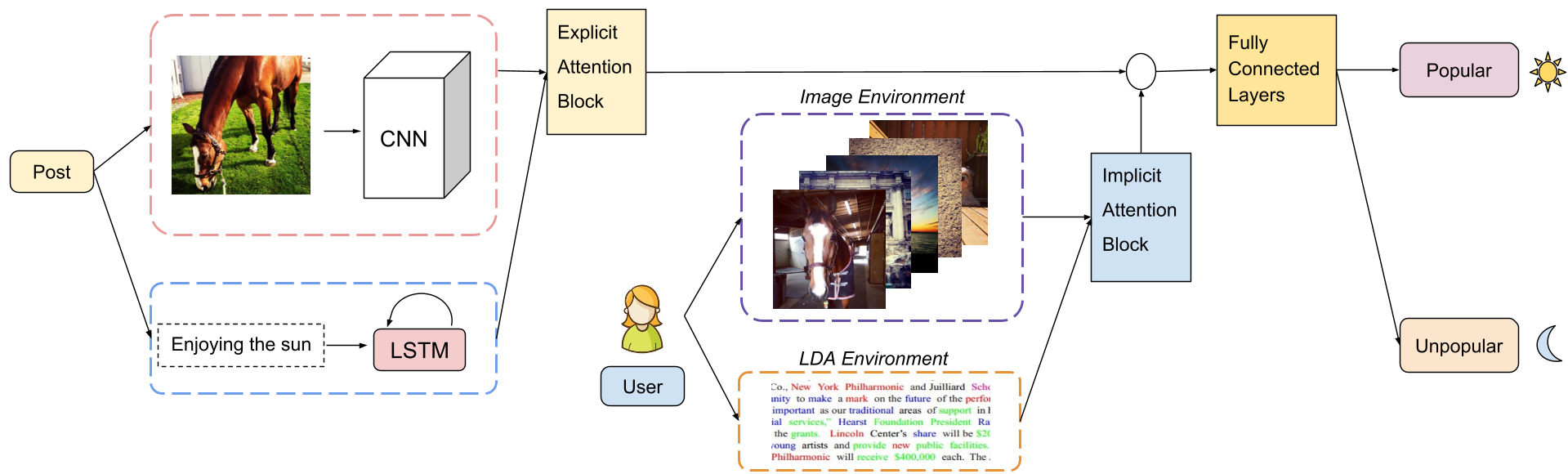 Figure 2: The overview of the Dual-Attention model showing the separation between explicit post-features and implicit environment features.
Experiments: What Actually Works?
The team crawled 60,785 Instagram posts from 441 users. Here is what the data revealed:
- Text > Image: Interestingly, the "Single Textual" model (Acc: 66.46%) outperformed the "Single Visual" model (Acc: 58.34%). Captions provide more reliable sentiment cues for popularity than pixels alone.
- The Power of Environment: Adding the "User Environment" (Env) boosted the F-measure from 69% to over 72%. It proves that who is posting is just as important as what is being posted.
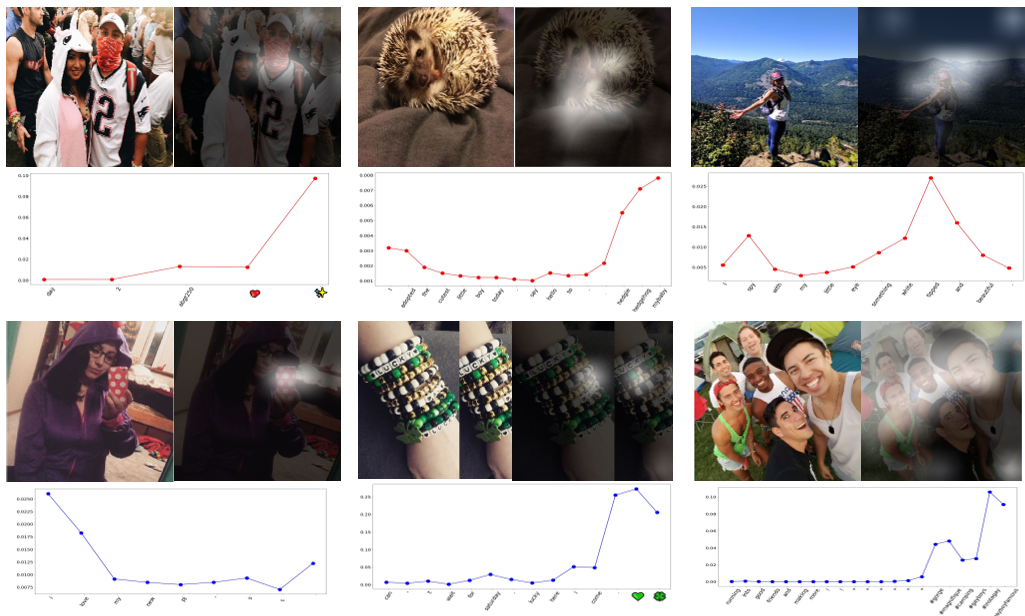 Table 1: Performance comparison showing the Dual-Attention model's superiority across all metrics.
Visualizing "Popularity Zones"
The researchers used attention maps to see which parts of an image drive "likes."
- High Value: Concrete objects like human faces, specific accessories (bracelets), or pets.
- Low Value: Flat backgrounds and cluttered advertisements.
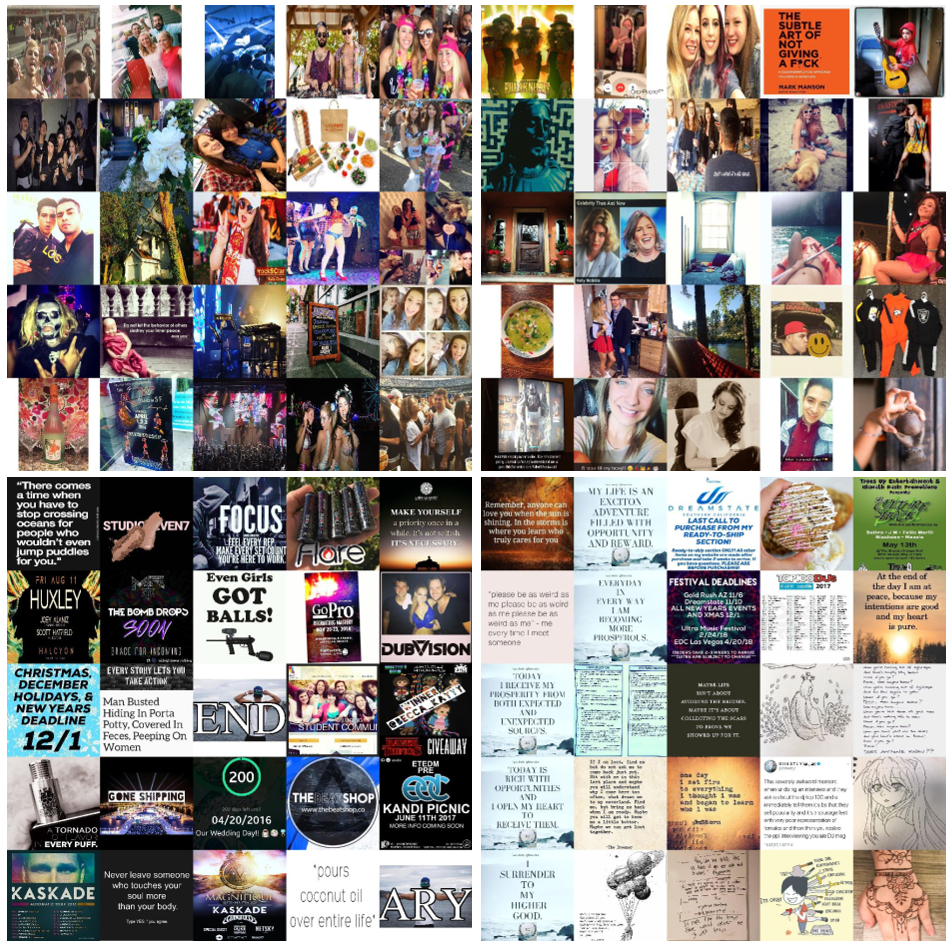 Figure 7: Clustering reveals that Group Photos and Selfies have a much higher popularity ratio compared to Text Posters or Food shots.
Deep Insights: The "Like" Statistics
Through K-means clustering and frequency analysis, the study provided a roadmap for engagement:
- Avoid the "Food Trap": Statistically, words like "coffee," "dinner," and "breakfast" appeared more frequently in the unpopular bottom 25%.
- Embrace Timeliness: Words describing time ("weekend," "year," "day") and positive attributes ("amazing," "beautiful") dominate popular posts.
- The Emoji Boost: Specific emojis (hearts, stars, clover) have a measurable correlation with higher engagement rates.
Critical Analysis & Future Work
While the Dual-Attention model is robust, it relies on LDA—a traditional topic modeling method. Modern LLMs (Large Language Models) could likely refine the "Topic Environment" further. Additionally, the paper notes that future models should incorporate temporal features (seasons, time of day) and location data to provide truly 360-degree guidance for aspiring influencers.
Takeaway: To become Instagram famous, don't just post "good" content—post content that is "uniquely better" than your own average, and pay more attention to your caption than you might think.