
Instagram Addiction: The Linear Path from "Likes" to Lower Self-Esteem
Instagram Use as a Multimedia Platform for Sharing Images and Videos: Links to Smartphone Addiction and Self-Esteem
This study investigates the behavioral links between intensive Instagram use, smartphone addiction, and self-esteem among Spanish adults. Using a sample of 389 users and structural equation modeling (SEM), the research identifies age and time spent as critical predictors of problematic digital consumption.
TL;DR
A new study from the University of Granada reveals a troubling pipeline in digital behavior: intensive Instagram use is a direct gateway to smartphone addiction, which in turn significantly diminishes self-esteem. By analyzing 389 adults, researchers found that users aged 18–21 are at the highest risk, and that daily usage exceeding two hours marks the tipping point into problematic territory.
Background: The Smartphone as a "Pocket Computer"
The evolution of mobile telephony from simple communication tools to ubiquitous multimedia hubs has created a double-edged sword. In Spain—one of the world's leading countries in internet usage hours—the government has officially included "addiction to new technologies" in its Action Plan on Addictions. This paper aims to quantify the specific role Instagram plays in this psychological ecosystem.
Problem & Motivation: Why Instagram?
Unlike general internet surfing, Instagram relies on a high-frequency feedback loop of "Likes," "Stories," and "Follows." This creates a unique form of social comparison. Users don't just use the app; they perform their lives on it. The researchers hypothesized that this specific multimedia interaction is the primary engine driving broader smartphone dependency and damaging the user's perception of self-worth.
Methodology: Mapping the Digital Mind
The researchers combined three established academic scales to create a holistic view of the user:
- SMIS: Measuring the intensity and emotional commitment to Instagram.
- SAS-SV: Screening for uncontrolled smartphone use.
- RSES: Measuring overall self-worth.
The Structural Model
The core of the methodology lies in the Structural Equation Model (SEM), which allowed the team to see how these variables interact as a system rather than in isolation.
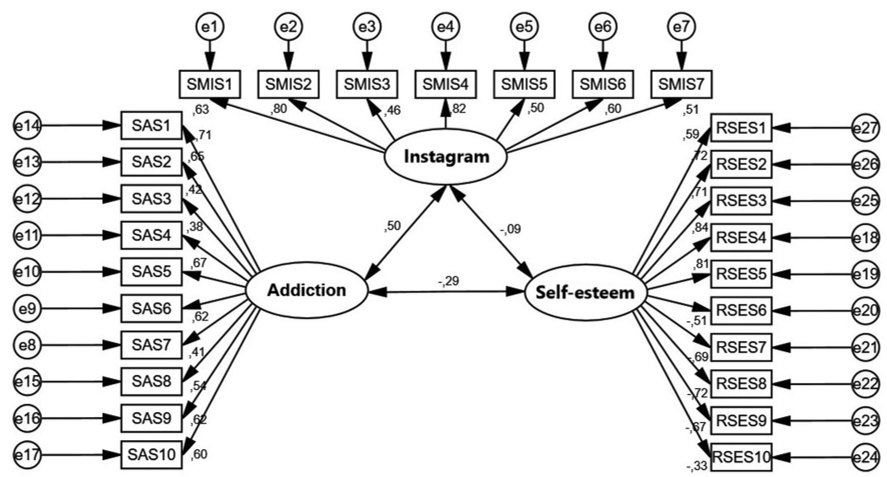 Figure 1: The SEM illustrates the strong path from Instagram Intensity to Addiction, and the subsequent negative impact on Self-Esteem.
Key Results: Age and Time are the Deciding Factors
The data suggests that problematic usage isn't universal—it is highly sensitive to socio-demographic markers.
- The 2-Hour Threshold: Usage beyond two hours daily was linked to a sharp increase in addiction scores and a decrease in self-esteem.
- The Age Gap: Younger users (18–21) showed significantly higher intensity and addiction levels compared to those over 30.
- Employment & Education: Higher levels of education and being active in the workforce served as protective factors, correlating with lower addiction scores.
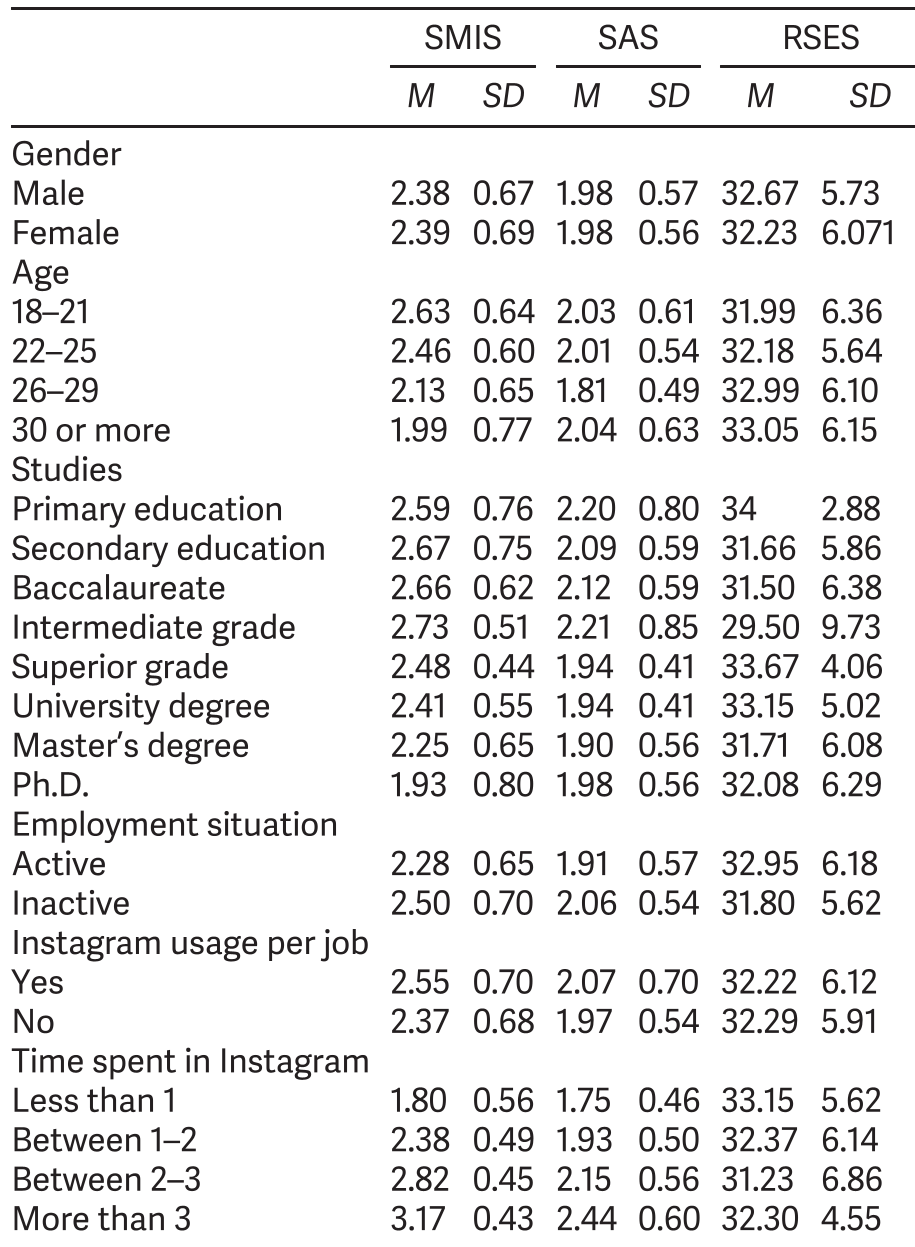 Table: Comparison of scores across gender, age, and employment status.
Critical Insight: The "Addiction Pipeline"
One of the most profound takeaways is that Instagram intensity does not directly destroy self-esteem in a vacuum (the correlation was non-significant at -0.091). Instead, it acts as a mediator. It first creates a behavioral addiction to the device (R=0.498), and it is this broader loss of control over one's daily life and digital habits that ultimately cascades into lower self-esteem (R=-0.290).
Conclusion & Future Outlook
The study confirms that Instagram is a primary driver of smartphone addiction among young adults in Spain. While the study is cross-sectional (a "snapshot" in time), it provides a clear warning for public health: digital well-being is not just about what we look at, but how long we stay tethered to the feedback loop.
Future Work should look deeper into "Passive vs. Active" usage. Does posting a selfie have the same psychological cost as scrolling through a thousand filtered images of others? As the platform shifts toward video (Reels), the addictive potential may only increase.