
Instagram Dependency: Untangling the Web of Smartphone Addiction and Self-Esteem
Instagram Use as a Multimedia Platform for Sharing Images and Videos: Links to Smartphone Addiction and Self-Esteem
This study investigates the intensive use of Instagram and its correlation with smartphone addiction and self-esteem among 389 Spanish adults. Using a structural equation model (SEM), it identifies a significant positive correlation between problematic Instagram use and smartphone addiction, which in turn adversely affects self-esteem.
TL;DR
In a world where "scrolling" has replaced "strolling," a new study from the University of Granada reveals the psychological cost of our digital habits. By analyzing 389 Spanish adults, researchers found that intensive Instagram use directly fuels smartphone addiction, which subsequently acts as a gateway to lower self-esteem. If you spend more than two hours a day on the app, you are statistically entering the "problematic use" zone.
Problem & Motivation: The Ubiquity Trap
Smartphones have evolved from simple communication tools into "pocket computers" that offer instant gratification and social validation. In Spain—ranking fifth globally in mobile internet usage—the government has officially recognized technological addiction as a public health priority.
The authors argue that Instagram’s unique multimedia nature—focused on "likes," "stories," and followers—creates a high-stakes environment for Social Comparison. While previous studies have looked at social media in isolation, this paper aims to bridge the gap by testing the "linear progress" from app usage to device addiction, and finally to internal psychological health.
Methodology: A Multi-Scale Approach
The research team utilized a triad of standardized metrics to measure the digital psyche:
- SMIS (Social Media Intensity Scale): Adapted specifically for Instagram to measure commitment and problematic engagement.
- SAS-SV (Smartphone Addiction Scale): A 10-item short version to assess uncontrolled device usage.
- RSES (Rosenberg’s Self-Esteem Scale): The gold standard for measuring overall self-worth.
The Structural Equation Model (SEM)
The brilliance of this study lies in its use of SEM to visualize the "flow" of psychological impact. Instead of just saying "these things are related," the model demonstrates how one behavior (Instagram use) reinforces another (Addiction), which then erodes the user's perception of self.
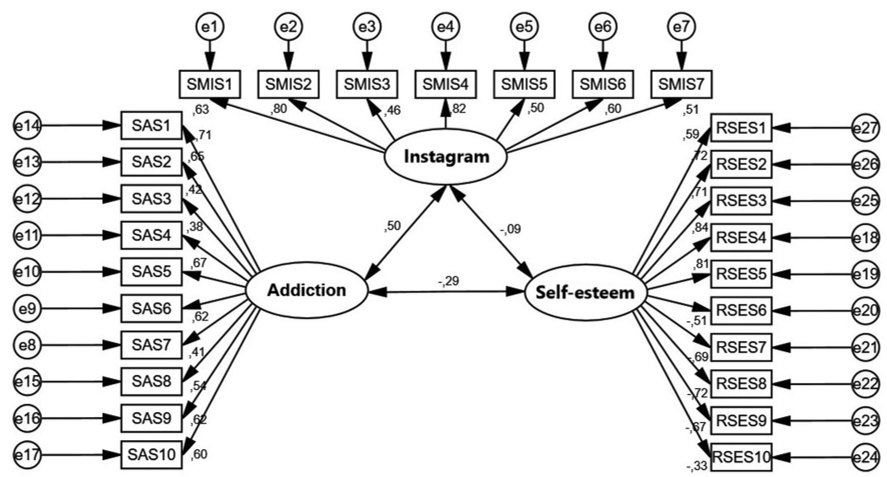 Figure 1: The SEM illustrates the strong path (0.498) between Instagram use and addiction, and the inverse relationship (-0.290) between addiction and self-esteem.
Key Findings: Age and Time are the Enemies
The data suggests that digital vulnerability is not evenly distributed:
- The 18-21 Bracket: This group represents the highest risk for both intensive Instagram use and smartphone addiction.
- Employment as a Buffer: Users who are currently employed or have higher educational degrees (Ph.D.) tend to show more controlled usage patterns.
- The 2-Hour Threshold: Spending more than 120 minutes daily on Instagram is the "tipping point" where scores for smartphone addiction increase significantly.
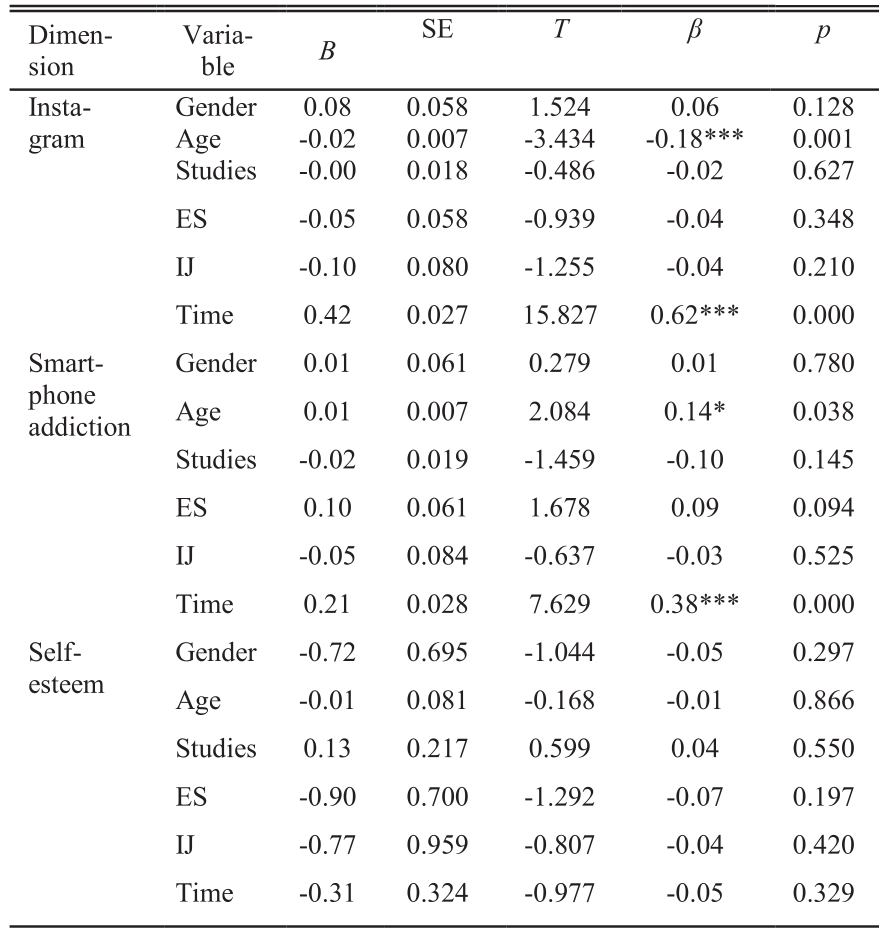 Table: Regression coefficients highlighting age and time as the only statistically significant predictors (p < 0.001) for usage intensity.
Critical Insight: The Absence of "Direct" Harm
Interestingly, the study found no significant direct correlation between Instagram use and self-esteem. This suggests that simply using the app doesn't make you feel bad about yourself; rather, it is the addictive pattern of usage—the loss of control over the smartphone—that eventually degrades self-esteem.
This is a vital distinction for the industry: the problem isn't the content (images/videos) as much as it is the compulsive delivery mechanism.
Conclusion & Future Work
The study concludes that intensive Instagram use is a precursor to a wider behavioral addiction. While the findings are limited by their cross-sectional nature (they show a snapshot, not a lifetime change), they provide a clear warning for the "digital native" generation.
Future research must evaluate whether specific platform features—like the removal of visible "like" counts or "infinite scroll" mechanics—can mitigate these addictive pathways. For now, the takeaway is clear: your self-esteem might just depend on your ability to put the phone down after the first hour.