
Unveiling the Hidden Pulse of Politics: How Co-Commenter Networks Define Instagram’s Ideological Battleground
Unveiling Community Dynamics on Instagram Political Network
This paper presents a study on community dynamics within Instagram political networks using a novel probabilistic backbone extraction method. By analyzing millions of comments from Brazil and Italy during electoral periods, the authors reveal how co-commenter structures mirror political leanings and evolve over time.
TL;DR
Instagram has evolved from a photo-sharing app into a critical arena for political warfare. Researchers from the Federal University of Minas Gerais and Polytechnic of Turin have developed a statistical "backbone" extraction method to cut through the noise of millions of comments. Their findings? Political communities are significantly more unstable than "General" interest groups (like sports or music), with interaction patterns that peak violently during elections and collapse immediately after.
The Noise Problem in Social Graphs
Analyzing Instagram is a data scientist's nightmare. Unlike Twitter, where "Retweets" provide a clear signal of endorsement, Instagram interactions primarily happen in comment sections. If two people comment on the same post by a major politician, does it mean they are part of the same "community"?
Probably not. If a post has 100,000 comments, thousands of people will "co-comment" purely by chance. This creates a "hairball" graph where everything is connected to everything, and traditional community detection algorithms (like Louvain) fail to find meaningful clusters.
Methodology: The Statistical Backbone
To solve this, the authors moved beyond raw "What" (who commented) to "How Likely" (is this interaction significant?).
1. The Null Model
The team built a generative model that assumes users behave independently. It factors in:
- User Engagement: How active is this specific commenter?
- Post Popularity: How many total comments did the post receive?
2. Backbone Extraction
By comparing real-world data against this "Null Model," they filtered out the "background noise." They only kept edges between users who co-commented more frequently than the 95th percentile of the expected random distribution.
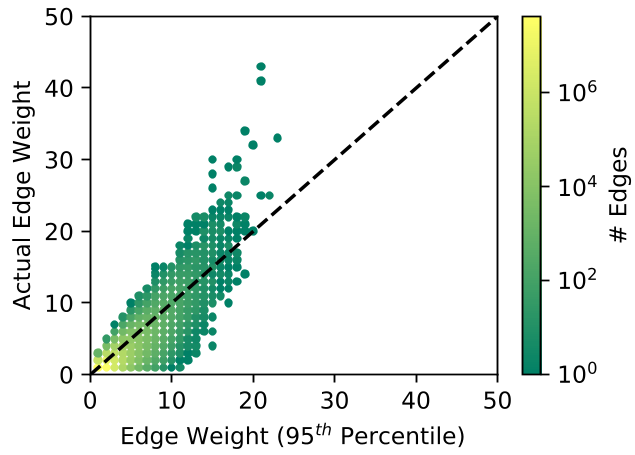 In Figure 2a, we see that while most co-comment weights are 1, it is the outliers—the weights that deviate from the diagonal in Figure 2b—that form the meaningful backbone of the network.
Key Insights: Politics vs. The World
1. Political "Blur" vs. General "Clarity"
In categories like Music or Sport, communities are "clean." If you follow Italian cooking influencers, you likely belong to a stable, well-defined cluster. In politics, however, the lines are blurred. The researchers found "bridge" commenters who interact across opposing political poles (e.g., commenting on both left-wing and right-wing posts), often to engage in heated debate or "trolling."
2. The Polarization Heatmap
The study used heatmaps to show how communities center around leaders. In Brazil, the "Bolsonaro" clusters were massive and highly concentrated, yet split into sub-communities based on topics (e.g., religion vs. economy) or timing.
 The dendrograms (top of the heatmap) remarkably reconstruct the political spectrum of each country based solely on user commenting behavior.
3. Temporal Volatility
Using Normalized Mutual Information (NMI), the authors tracked how these communities changed over 10 weeks.
- Persistence: During elections, about 50-60% of users remained active week-to-week.
- The Post-Election Drop: Once the ballots were cast, interest plummeted. Political communities are "event-driven" and transient compared to the "interest-driven" and stable communities of the General category.
Critical Analysis & Conclusion
This work transcends simple sentiment analysis. It reveals the infrastructure of the debate.
Takeaway: The "Backbone" methodology is a powerful lens for platform moderators and researchers. It can distinguish between organic social groups and potentially coordinated groups (units that always move together across different posts).
Limitations: The study focuses on public profiles. A significant portion of political discourse has shifted to "Dark Social" (private groups, DMs), which remains invisible to this type of crawling. Furthermore, the "bridge" commenters were identified but not qualitatively analyzed—are they healthy "cross-pollinators" of ideas, or simply aggressive trolls?
Future Outlook: As AI-driven botnets become more sophisticated, backbone extraction like this will be essential to identify non-random interaction patterns that signify coordinated influence operations.