
The Mechanics of Gov 2.0: Beyond the Efficiency-Legitimacy Divide
19059_The institutional and social network perspectives of government 2.0 adoption.
This paper investigates the adoption of "Government 2.0" (social media and Web 2.0 technologies) by government agencies by integrating Institutional Theory and Social Network Perspective. It identifies how innovation characteristics and organizational network positions mediate institutional pressures to drive S-curve diffusion patterns.
TL;DR
Why do some government agencies dive head-first into social media while others wait for a mandate? This paper argues that Government 2.0 (Gov 2.0) adoption is driven by a complex interplay of Institutional Theory (the push for social standing) and Social Network Dynamics (the flow of info and influence). Moving beyond simple "efficiency" arguments, the authors show how the very nature of Web 2.0—its interactivity and peer-production—accelerates institutional pressure.
The Problem: The Inadequacy of Dichotomies
Historically, academic literature split adopters into two camps:
- Early Adopters: Motivated by technical and economic efficiency.
- Late Adopters: Motivated by social legitimacy (doing it because everyone else is).
However, in the era of Gov 2.0, this split is blurry. The rapid diffusion of tools like Twitter or Facebook within government suggests that legitimacy and efficiency are often sought simultaneously. Furthermore, prior work ignored how the structure of networks—who talks to whom—channels the information that sparks adoption.
Methodology: A Multi-Lens Framework
The paper proposes that institutional forces (Mimetic, Coercive, and Normative) do not act in a vacuum. They are filtered through the characteristics of the technology and the position of the agency within a network.
1. Innovation Characteristics as Amplifiers
- Mimetic Forces (Mimicry): Because Web 2.0 is inherently interactive, agencies mimic peers to reduce uncertainty in a highly connected environment.
- Coercive Forces (Pressure): Digital-native generations expect "private sector" levels of service. When citizens use Web 2.0 to solve problems (like locating Katrina victims) before the government does, it creates massive pressure for agencies to catch up.
- Normative Forces (Professional Standards): The shift from a "need to know" to a "need to share" culture represents a new professional norm in public administration.
2. The Power of Network Structure
The authors identify four structural properties that dictate when and why an agency adopts:
- Cohesiveness: Dense networks foster trust and shared norms, making adoption safer but also potentially creating "unified resistance."
- Structural Equivalence: Agencies in similar roles tend to imitate each other to maintain competitive standing.
- Centrality: Central agencies have first-row seats to new innovations but may be risk-averse due to high visibility.
- Structural Holes: Agencies that bridge different groups have more autonomy to decide how and when to adopt.
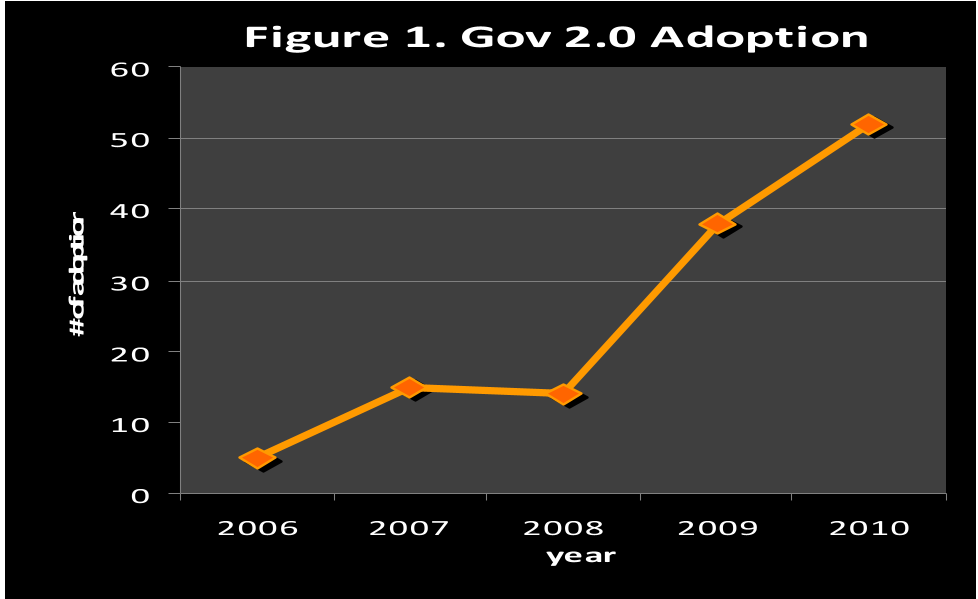 Figure 1: Exponential growth of social media adoption in US agencies, highlighting the "tipping point" around late 2008 following major policy directives.
Experimental Insights: The US Case Study
By analyzing the adoption timelines of US agencies from 2006 to 2010, the paper highlights a clear S-curve. The slow climb from 2006 to 2008 suggests an "efficiency-seeking" phase. The explosive growth in 2009—coinciding with the Obama Administration’s Open Government Directive—illustrates a massive coercive and mimetic surge where adoption became a requirement for institutional legitimacy.
Critical Analysis & Conclusion
The core takeaway is that technology defines the pressure. The "interactivity" of Gov 2.0 isn't just a feature; it is an institutional force that makes government more vulnerable to (and dependent on) external stakeholders.
Limitations: The paper is primarily theoretical and based on early 2010s data. While the framework is robust, it does not account for modern challenges like algorithmic bias or the spread of misinformation on social media, which now heavily influences "legitimacy."
Future Outlook: For digital transformation leaders, the lesson is clear: Adoption isn't just about the "best" tool; it's about navigating the network. To move an organization forward, one must understand both the technical efficiency gains and the social prestige associated with being a "digital-first" entity.