
OSNs in Education: Bridging the Gap Between Social Connectivity and Instructional Rigor
Instruction over online social networks: Where does the platform lead?
This study investigates the instructional potential of popular Online Social Networks (OSNs) like Facebook and Friendster through a qualitative lens, combining network ethnography and phenomenology. It identifies OSNs as emergent communication spaces that facilitate knowledge construction and collaborative learning among "digital native" students and educators.
TL;DR
This research explores whether the magnetic pull of Online Social Networks (OSNs) can be harnessed for the classroom. While platforms like Facebook offer unprecedented connectivity and engagement for "digital native" students, the study reveals a significant tension between their social utility and the professional boundaries required for formal instruction.
Background Positioning
In the landscape of Educational Technology, this work sits at the intersection of Constructivism and Computer-Mediated Communication (CMC). It moves beyond viewing the internet as a mere repository of information, repositioning it as a social "simulacrum" where learning is a byproduct of human interaction.
Problem & Motivation: The Engagement Paradox
The core challenge identified is the "Engagement Gap." Traditional educational software often feels "remote" to students, leading to the failure of various ICT waves. Conversely, OSNs are highly addictive and intuitive, yet they were never designed for pedagogy.
The researcher asks: Can we leverage the tools students already use without compromising privacy or professional distance?
Methodology: High-Touch Virtual Fieldwork
The study utilized Network Ethnography, involving deep immersion in virtual communities. The researcher didn't just observe; they participated, even documenting experiences within "Farmtown" (a Facebook game) and chatrooms to understand the lived experience of the informants.
OSN Application Comparison
The author analyzed the "Corporate Identity" and functional tools of the then-top platforms to see how their architecture supports (or hinders) instruction.
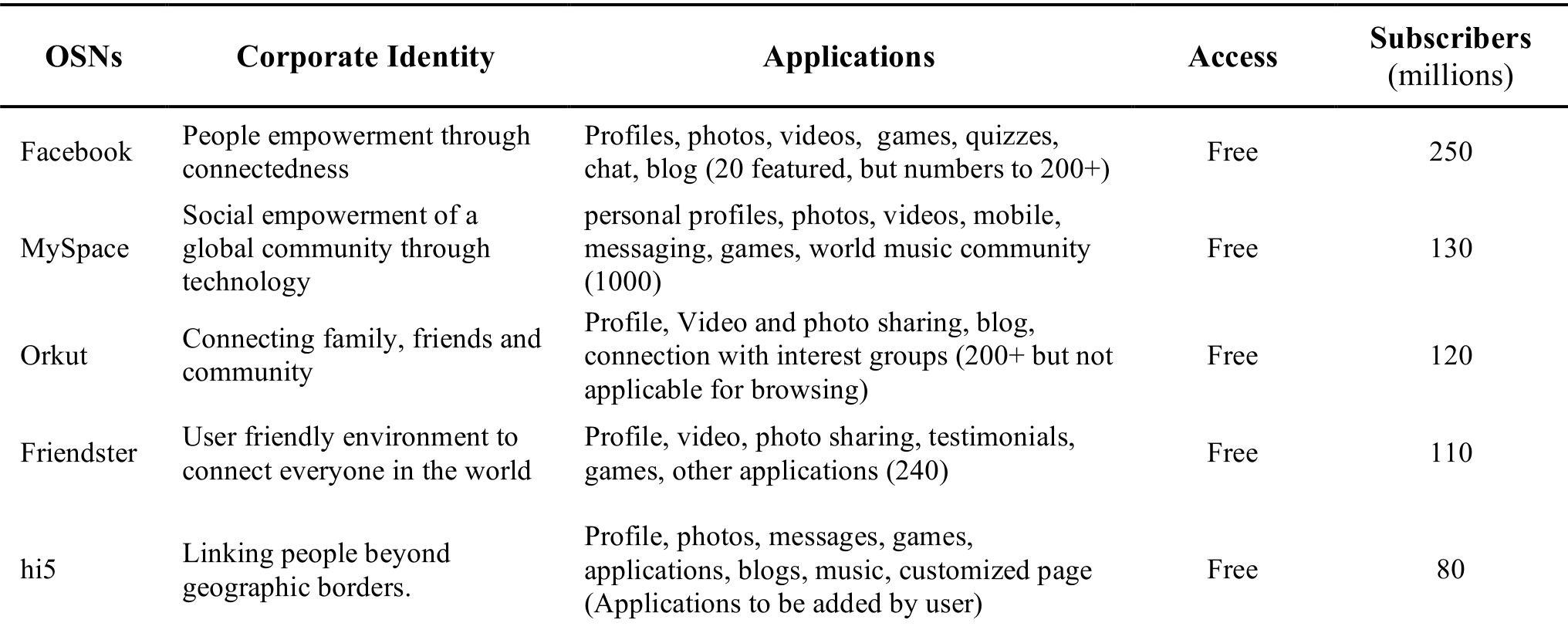
Core Findings: The Multi-Sectoral Perspective
The study highlights a fascinating divergence in how different stakeholders "construct" the meaning of OSNs:
- Students: View OSNs as a survival tool. Lack of an OSN presence makes one a "loser," and it is the primary venue for seeking homework help from peers.
- Teachers: See the potential for "reducing anxiety" in communication but are wary of "students peering into their personal lives."
- Parents: Remain the most cynical, viewing OSNs primarily as a distraction or a haven for "adult perverts."
Engaging Factors in Instructional Communication
The research identifies eight factors—including interactivity, efficiency, and popularity—that make OSNs a potent "scaffold" for learning (referencing Vygotsky’s Zone of Proximal Development).
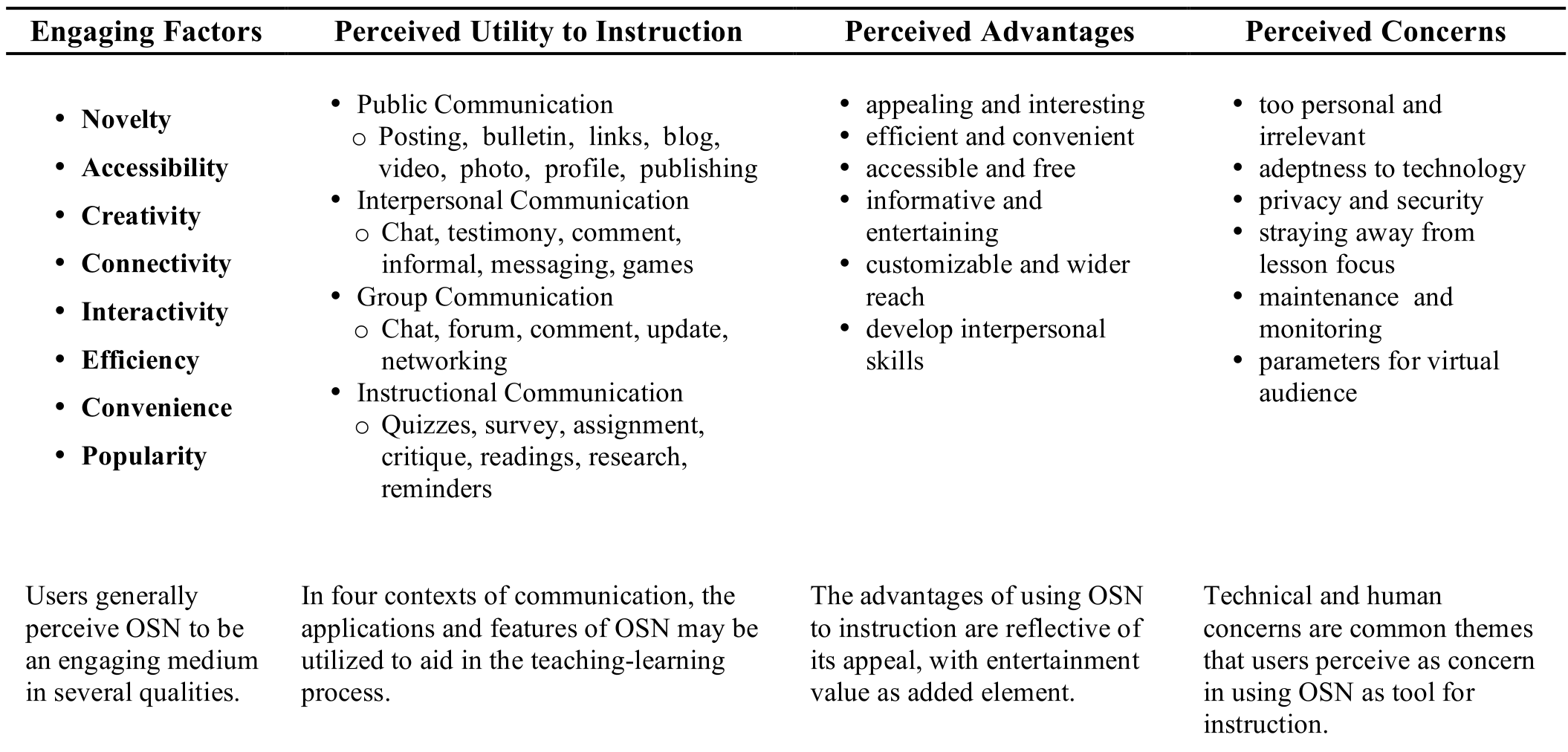
Critical Analysis & Conclusion
The study concludes that while OSNs are a "potent social communication space," they suffer from a "Control Fallacy." Educators cannot fully control the parameters of these platforms.
Key Limitations:
- Professional Distance: The "blurring of lines" between a teacher's private life and their professional persona.
- Functional Gaps: The inability of 2010-era OSNs to handle academic file-sharing efficiently (e.g., restricted to photos/text rather than documents).
- Security: The ever-present risk of data privacy and "straying from the lesson."
Future Outlook
The researcher suggests that instead of fighting the OSN trend, educators should seek or build "ICT innovations" that mimic the engaging interactive powers of OSNs while being purpose-built for learning. This prediction has largely come true with modern platforms like MS Teams or Slack-based classroom environments.
Takeaway: The platform leads where the user already is. Instruction must follow the student into social spaces, but with a critical, reflective eye on where the boundary lies.