
Beyond Passive Compensation: An Insurance-Based Game for Secure Crowdsourcing
An Insurance-based Incentive Mechanism for Mobile Crowdsourcing to Improve System Security
This paper proposes an insurance-based incentive mechanism for mobile crowdsourcing systems to enhance security. It utilizes a Stackelberg game model to motivate users to actively upgrade their security levels, reducing data loss and system-wide risks.
TL;DR
Mobile crowdsourcing often fails due to security fears; current systems try to pay users after they get hacked, which doesn't solve the root problem. This paper proposes a proactive Stackelberg game model that rewards users for being more secure and uses third-party insurance to protect the platform's bottom line. The result? A system where everyone—platform and users—is safer and richer.
Background: The Security Deadlock
Mobile crowdsourcing (think Uber, Waze, or MTurk) relies on a massive influx of data from individual users. However, "Security and Privacy" remain the biggest deterrents. If a user thinks their data will be stolen or their device compromised, they won't participate, no matter the reward.
Most existing research treats security as a cost to be reimbursed. But this is a "zero-sum" game: the platform pays for a loss that has already happened. The social welfare (total value in the system) doesn't grow; it just shifts around.
The Insight: Proactive Defense & Cyber-Insurance
The authors suggest two major shifts in thinking:
- Incentivize Upgrades, Not Just Participation: Instead of a flat fee, the reward function includes a security-based bonus factor: . This forces the user to choose: "Do I keep my costs low but risk a lower reward, or do I invest in better security software to unlock a higher payout?"
- Stabilizing the Platform with Insurance: Since data loss is stochastic, the platform faces volatile income. By paying a premium to an insurance company, the platform transfers the risk of "information loss," ensuring its utility depends on the average behavior of the system rather than individual failures.
Methodology: The Stackelberg Game
The researchers modeled this as a two-stage Stackelberg Game.
Phase 1: The Platform (Leader)
The platform decides the reward parameters (). It must find the "Goldilocks Zone"—rewards high enough to motivate users but low enough to maintain profitability.
Phase 2: The Users (Followers)
Users observe the rewards and calculate their optimal security level . They balance the cost of security software () against the potential bonus.

The paper uses Backward Induction to prove that a Nash Equilibrium exists. Specifically, they found that a user’s optimal security level is:
Experimental Validation
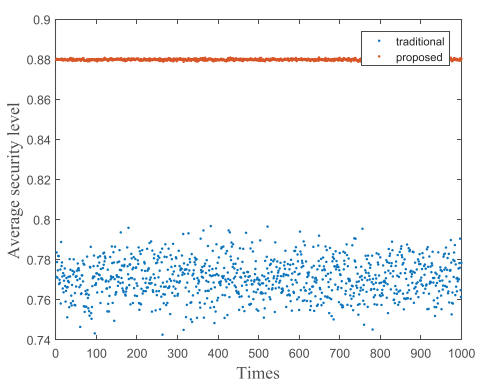
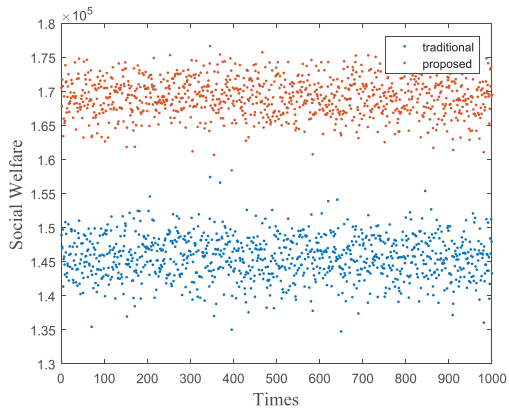
Using simulations with 1,000 users, the authors compared their "Bonus + Insurance" model against traditional "Reward-only" models.
Key Findings:
- Optimal Tuning: There is a unique peak for platform utility regarding parameters and . If the bonus is too high, the platform loses money; if too low, users don't secure themselves.
- The "Larger Cake" Effect: By making the whole system more secure, the total data loss decreases. This creates surplus value (Social Welfare) that allows both the platform and the users to have higher utilities simultaneously compared to traditional methods.
Critical Insight & Conclusion
The genius of this paper is not just the game theory, but the economic alignment of security. By making security a "product" that users can sell back to the platform via a bonus, it moves security from an IT headache to a financial asset.
Limitations: The model assumes users are rational actors who can perfectly calculate their utility. In real-world scenarios, "Human-in-the-loop" factors like varying technical literacy or irrational risk-taking might require more complex behavioral modeling.
Future Work: This framework could easily be extended to Edge Computing or Federated Learning, where participant "trustworthiness" is the primary bottleneck for scaling.