
Precise Social Architecture: An Integer Programming Approach to Hierarchical Community Detection
An integer programming approach and visual analysis for detecting hierarchical community structures in social networks q
This paper introduces a novel Integer Programming (IP) approach for detecting hierarchical community structures in social networks. By optimizing a tailored modularity measure () across multiple levels, it achieves superior partitioning logic compared to metaheuristics, specifically on the Zachary’s Karate Club and College Football benchmarks.
TL;DR
Researchers have developed a novel Integer Programming (IP) framework to uncover the "nested" layers of social networks. Unlike traditional "flat" clustering, this method guarantees optimal community partitioning across multiple hierarchical levels by maximizing a multi-level modularity objective. It successfully identifies complex sub-groupings in real-world data, such as university department structures, with higher precision than previous metaheuristic algorithms.
Problem & Motivation: The Limits of Heuristics
Most social networks aren't just one big group; they are organized like Russian nesting dolls—individuals form small cliques, which form departments, which form organizations. While many algorithms exist to find "flat" communities, hierarchical detection remains challenging.
The authors identify three fatal flaws in existing literature:
- Lack of Optimality: Most methods use metaheuristics (like GA or PSO) which are fast but don't guarantee the best possible partition.
- Rigid Capacity: Prior models often used fixed community sizes, leading to "unnatural" splits in small or large networks.
- Bounded Communities: Forcing an upper limit on the number of communities often blinds the model to the true social structure.
Methodology: The Hierarchical IP Model
The core innovation lies in the Objective Function, which extends Newman's classic modularity index. Instead of looking at one layer, it aggregates the quality of partitions across all levels .
Key Mechanism: Flexible Capacity Limits
The model introduces a dynamic capacity limit for links in a community at level : This ensures that as we move up the hierarchy (as increases), the "capacity" for communities to hold links grows, naturally allowing sub-communities to merge into larger super-communities.
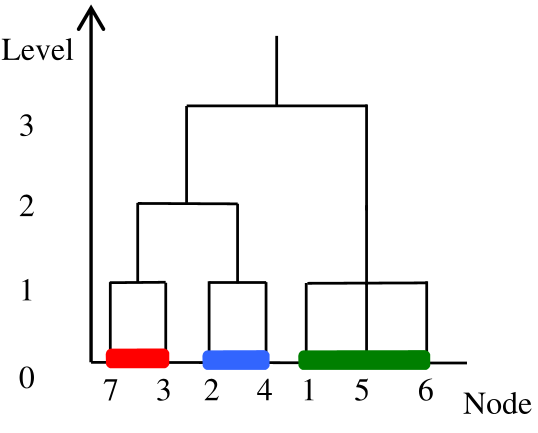 Figure 1: The hierarchical structure where level 0 represents individual nodes and level T represents the entire network.
The IP constraints ensure hierarchical consistency: if two nodes belong to the same community at level , they must stay together in the same super-community at level .
Experiments: Surpassing SOTA
The researchers tested their model on two classic benchmarks and a unique Facebook dataset.
1. Zachary’s Karate Club
While most models simply split the club into two (Coach vs. Owner), this IP approach revealed that each of those two groups further breaks down into two distinct sub-cliques. The score of 0.802 set a new standard for this benchmark.
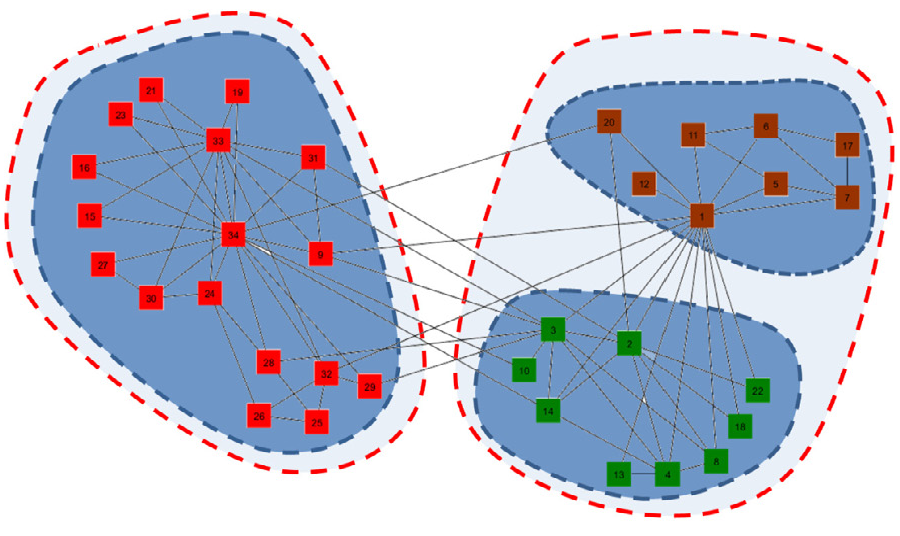 Figure 2: The dendrogram (top) and visual clustering (bottom) showing the refined multi-level split of the Karate Club.
2. Facebook Social Network Analysis
The most compelling evidence came from a network of 50 graduate students. By adjusting the "predetermined levels," the model successfully recovered:
- Level 1: Close-knit groups of friends.
- Level 2: Specific academic departments (IE, Statistics, PME).
- Level 3: The universities/backgrounds of the students (NCTU vs. NTHU).
Critical Insight & Conclusion
The power of this paper lies in its simplicity and exactness. By moving away from "black-box" heuristics and returning to rigorous mathematical programming, the authors provide a tool that doesn't just "guess" communities but "proves" their existence based on link density.
Takeaway: For moderately-sized networks where precision is more important than millisecond speed, Integer Programming is the superior choice for uncovering the deep, stratified reality of social interactions.
Future Outlook: The next frontier is applying this IP rigor to overlapping communities (where an individual belongs to two groups) and dynamic networks where relationships change in real-time.