
ISABELA: Bridging the Gap Between Digital Emotions and Physical Sensing in HiTLCPS
An Integrated Approach to Human-in-the-Loop Systems and Online Social Sensing
This paper introduces ISABELA, an integrated Human-in-the-Loop Cyber-Physical System (HiTLCPS) designed to monitor and assist users by combining physical IoT data, smartphone sensing, and Online Social Network (OSN) sentiment analysis. The system achieved successful field trials with university students, demonstrating the ability to correlate behavioral patterns from "social sensors" with academic performance.
TL;DR
The ISABELA platform represents a shift from "sensing things" to "sensing people." By integrating IoT environmental sensors, smartphone telemetry, and social media sentiment analysis (Twitter/Facebook), it creates a feedback loop that treats human psychological states as critical system inputs. Trials in Portugal and Ecuador proved that this multi-modal sensing can effectively distinguish between high and low-performing academic behaviors.
The Missing Link: Why Most IoT Systems Feel "Cold"
Traditional Cyber-Physical Systems (CPS) are designed to monitor machines or environments—think of a thermostat or a smart factory. However, they often ignore the most complex element in the environment: the human. These are "open-loop" systems that provide services but don't react to human emotions or intent. ISABELA addresses this by implementing a Human-in-the-Loop (HiTL) architecture where the human is the center of the control loop.
Methodology: The ISABELA Architecture
The system leverages the FIWARE European ecosystem, using specialized "Generic Enablers" (GEs) to handle the heavy lifting:
- ORION Context Broker: Acts as the "brain," managing real-time data entities.
- IDAS GE: Handles communication with IoT boxes (sensing noise, light, Temp).
- Sentiment Analysis (SA) Module: A custom-built engine that parses Facebook and Twitter posts to extract valence and arousal, mapping them to the Russell circumplex model of affect.
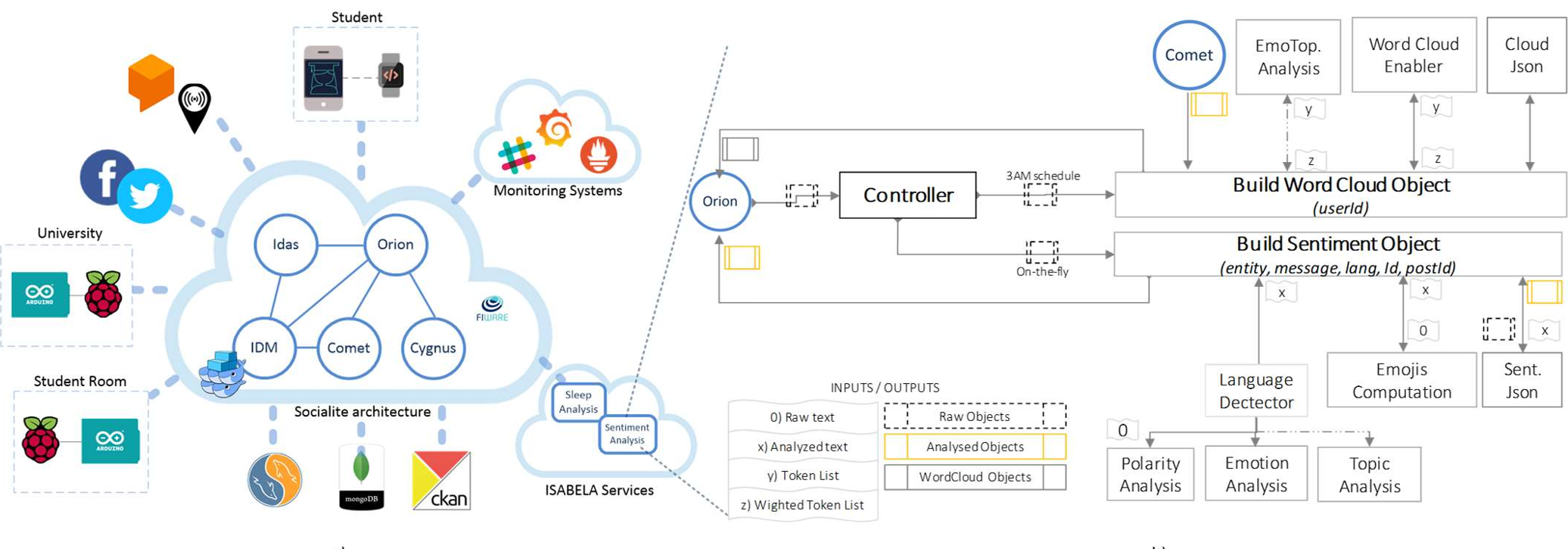
The methodology is unique because it treats social media not just as a communication tool, but as a "Social Sensor" that captures context-aware transitions in user mood that physical sensors would miss.
Experiments: Decoding Student Success
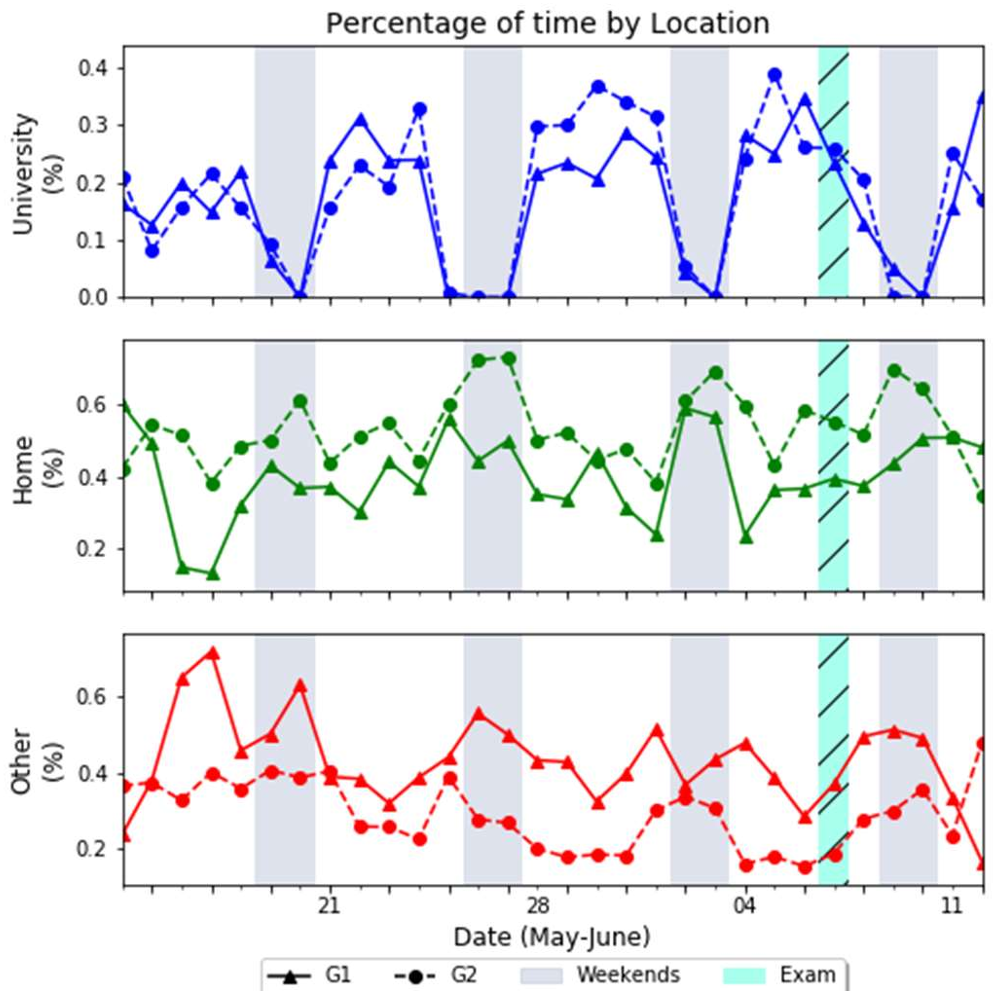
The researchers conducted intensive month-long trials with students in Ecuador. They divided students into two groups based on exam performance: Group 1 (Low Grades) and Group 2 (High Grades).
1. The Geometry of Success (Location)
The data showed that high-performing students followed a "sinusoidal" pattern of university attendance, peaking two days before exams and then retreating to "Home" for deep study. In contrast, lower-performing students spent significantly more time in "Other" locations (non-home, non-uni) even during the exam week.
2. Digital Sociability vs. Focus
Interestingly, "sociability" via SMS and calls was a strong predictor of behavior. Group 2 (High performance) showed a sharp 50% drop in SMS activity right before exams, whereas Group 1 showed an increase, suggesting a failure to regulate social distractions during critical study periods.
Critical Analysis & Conclusion
ISABELA succeeds in proving that unobtrusive sensing (passive smartphone data) is enough to build a remarkably accurate profile of a user’s lifestyle and potential risks.
Takeaway: The future of the "Socially Interactive Internet" lies in the fusion of physical IoT and digital footprints. If a system knows you are stressed (via Social Media) and that you are in a noisy environment (via IoT Box), it can proactively intervene via a chatbot to suggest a change of scenery.
Limitations: While powerful, the system relies on users granting permissions to sensitive social media and location data. Future iterations must strengthen the anonymization techniques (like the hashing used in this study) to maintain user trust while scaling to larger populations.