
Unified Privacy: Bridging the Gap Between Centralized Convenience and Distributed Security
An integrated framework for enhancing privacy in online social networks
This paper proposes an integrated framework for Online Social Networks (OSNs) that combines the user-friendly interface of centralized platforms like Facebook with the privacy controls of Distributed OSNs (DOSNs). It leverages Ciphertext-Policy Attribute-Based Encryption (CP-ABE) and Cloud Service Providers (CSP) to decouple personal data from the social network provider.
TL;DR
The dominance of Centralized Online Social Networks (OSNs) like Facebook comes at the cost of user privacy, while Decentralized OSNs (DOSNs) often fail due to poor performance. This paper introduces an integrated framework that uses Ciphertext-Policy Attribute-Based Encryption (CP-ABE) to host encrypted data on the Cloud while maintaining the familiar social features of traditional platforms.
The Privacy Paradox in Social Media
Current social media users are trapped in a binary choice. On one hand, centralized platforms offer seamless experiences but treat user data as a commodity for targeted advertising and third-party exploitation. On the other hand, distributed platforms (P2P) offer privacy but burden users with massive storage requirements and slow speeds—unsuitable for mobile devices.
The authors identify a critical gap: Users want privacy, but they aren't willing to sacrifice the "Look and Feel" or the efficiency of modern apps.
Methodology: High-Level Security via CP-ABE
The core innovation lies in the use of Ciphertext-Policy Attribute-Based Encryption. Unlike standard encryption where a message is for a specific person, CP-ABE allows the owner to set a policy.
- The Logic: "Only people with the attributes (Friend AND Coworker) can view this album."
- The Workflow:
- User registers with an OSN (for social links) and a CSP (for data storage).
- User encrypts data with specific policies and uploads it to the Cloud.
- The OSN profile only contains hyperlinks to the encrypted data.
- Peers request access; if their attributes match the policy, they receive the decryption key.
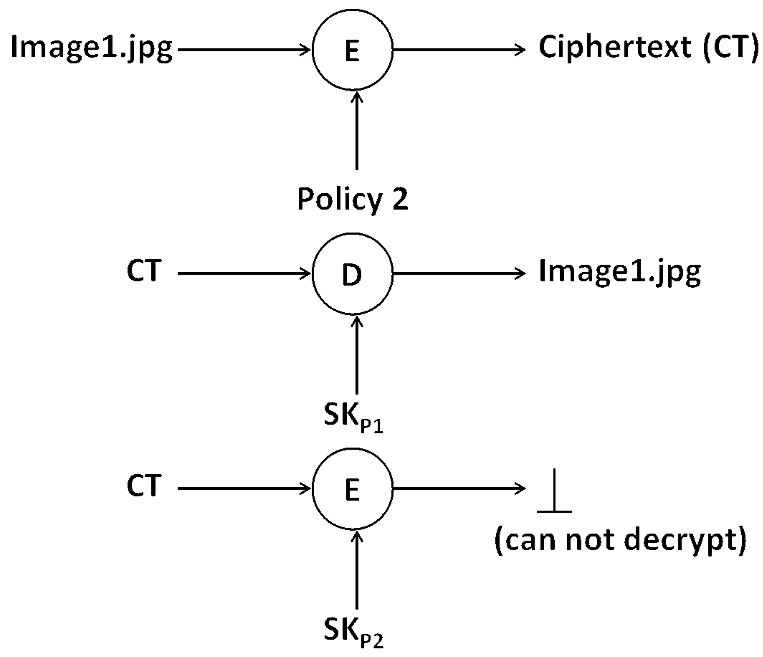 Figure: The process of uploading and sharing encrypted data via an integrated framework.
Architecture Analysis
The paper breaks down the architecture into manageable layers:
- Identity Verifier: The OSN provider verifies that you are who you say you are.
- Data Vault: The Cloud Service Provider stores the heavy lifting (videos/images) in an encrypted format.
- Access Control: The CP-ABE logic ensures that even if the Cloud or the OSN is hacked, the data remains unreadable without the proper attribute-based key.
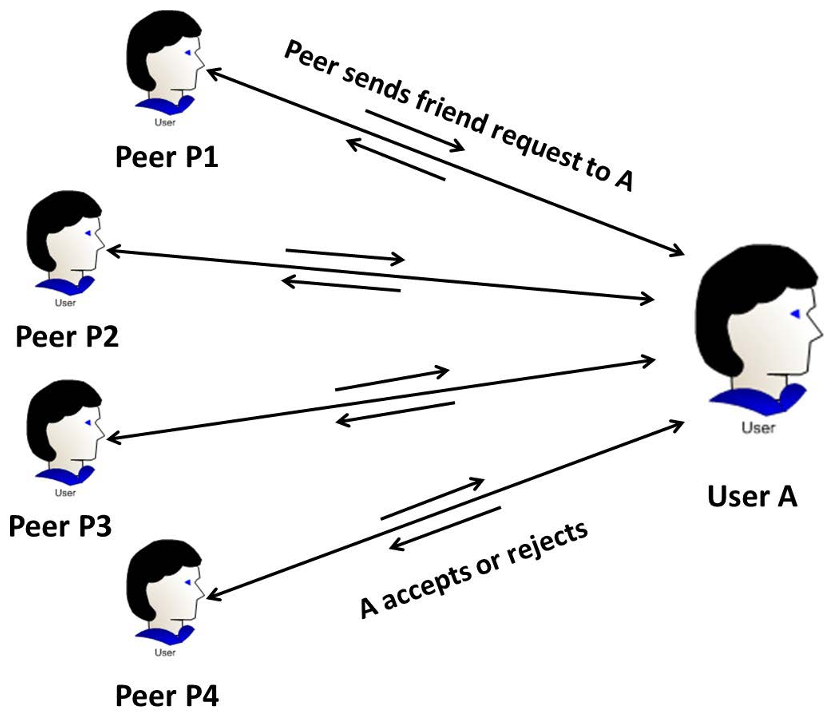 Figure: Decryption logic where Peer P1 (satisfying the policy) gains access while P2 is denied.
Experimental Insights & Advantages
While this 2013 paper focuses on the framework's conceptual design, its implications for contemporary privacy-enhancing technologies are profound:
- Storage Efficiency: By utilizing Cloud storage, it solves the "Bulky Data" problem of P2P networks.
- Cross-Platform Portability: Since the data resides in a neutral Cloud, a user wouldn't need to re-upload photos when moving from one OSN to another; they simply point to the existing Cloud link.
- Third-Party Safety: External apps (games/quizzes) can no longer scrape private data without satisfying the explicit cryptographic policies set by the user.
Critical Analysis & Conclusion
Takeaway
The paper successfully argues that decoding the privacy problem doesn't require deleting Facebook; it requires moving the "Keys to the Kingdom" (the data) to a vault controlled by the user, while the OSN remains just a "Window" to view that data.
Limitations
A notable challenge not fully addressed is Key Revocation. In an attribute-based system, if a "Friend" becomes an "Ex-Friend," revoking their access to previously shared encrypted data is computationally expensive and complex. Additionally, the reliance on a single Cloud Service Provider introduces a new point of failure, albeit one that cannot read the data.
Future Outlook
This work paved the way for modern "Personal Data Stores" and "Zero-Knowledge" social architectures. As regulation like GDPR tightens, the industry is moving closer to this integrated vision where the platform is separate from the data.