
IHFILE: Scaling Financial Literacy via Cloud Computing and Social Network Analysis
An Integrated Home Financial Investment Learning Environment Applying Cloud Computing in Social Network Analysis
This paper introduces IHFILE, an Integrated Home Financial Investment Learning Environment that leverages cloud computing (Hadoop/MapReduce) and Social Network Analysis (SNA) to provide a scalable, interactive platform for individual investors. It bridges the gap between financial education and real-time market simulation by processing millions of nodes and links to identify investor behaviors.
TL;DR
Individual investors often find themselves at a disadvantage due to lack of information and analytical tools. This paper presents IHFILE, a sophisticated learning environment that harnesses Cloud Computing (Hadoop) and Social Network Analysis (SNA) to transform financial education. By simulating real-market scenarios and analyzing investor interactions at scale, the system provides a robust framework for improving financial decision-making.
The Gap Between Retail and Institutional Investors
In the modern financial landscape, information is the primary capital. However, individual investors struggle with two main issues:
- Complexity: Traditional financial software is often too rigid or expensive for personal use.
- Scalability: Analyzing social sentiments and interactions involves millions of data points (Micro-blogging updates), which traditional single-server architectures cannot process efficiently due to I/O bottlenecks.
Methodology: The Fusion of Cloud and Social Graphs
The research team proposes an architecture that is both educationally sound and technically scalable.
1. The Educational Framework (IHFILE)
The system is divided into five core modules designed based on classic investment theory:
- Personal and Enterprise Investment Modules: Simulating individual and professional trading.
- Derivatives and Risk Management: Teaching hedging and quantitative risk control.
- Asset Management: Focus on portfolio optimization.
2. Cloud-Backend with Hadoop
To handle the massive influx of data from social interactions, the authors utilized the Hadoop ecosystem:
- HDFS (Hadoop Distributed File System): Solves the storage bottleneck by distributing 64MB data blocks across multiple nodes with triple redundancy.
- MapReduce: Enables parallel processing of complex calculations, such as user clustering and centrality metrics, across a cluster of servers.
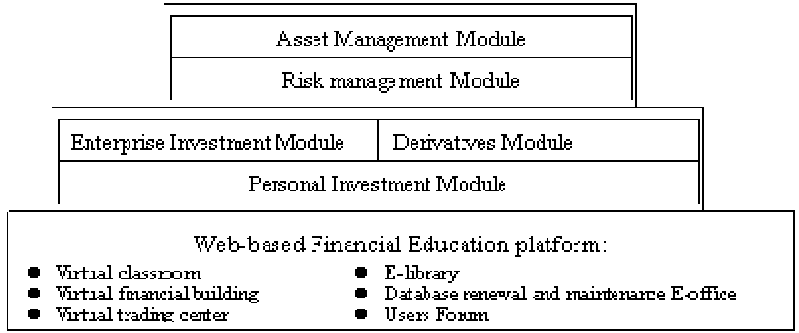 Fig 1: The framework of IHFILE includes a web-based financial education platform and five theory-based modules.
Understanding Investor Networks
The "Secret Sauce" of IHFILE lies in how it analyzes the social network of users to identify "Influencers" and "Behavioral Clusters."
- Centrality Analysis: Uses Degree Centrality to find users who post the most valuable or frequent investment instructions.
- Citation Analysis (PageRank): Adapts Google’s algorithm to rank users based on the quality of their "Hyper-links" or interactions, effectively identifying authority figures in the financial community.
- User Clustering (K-Means): Groups investors based on similarities in their behavior, allowing for targeted educational interventions.
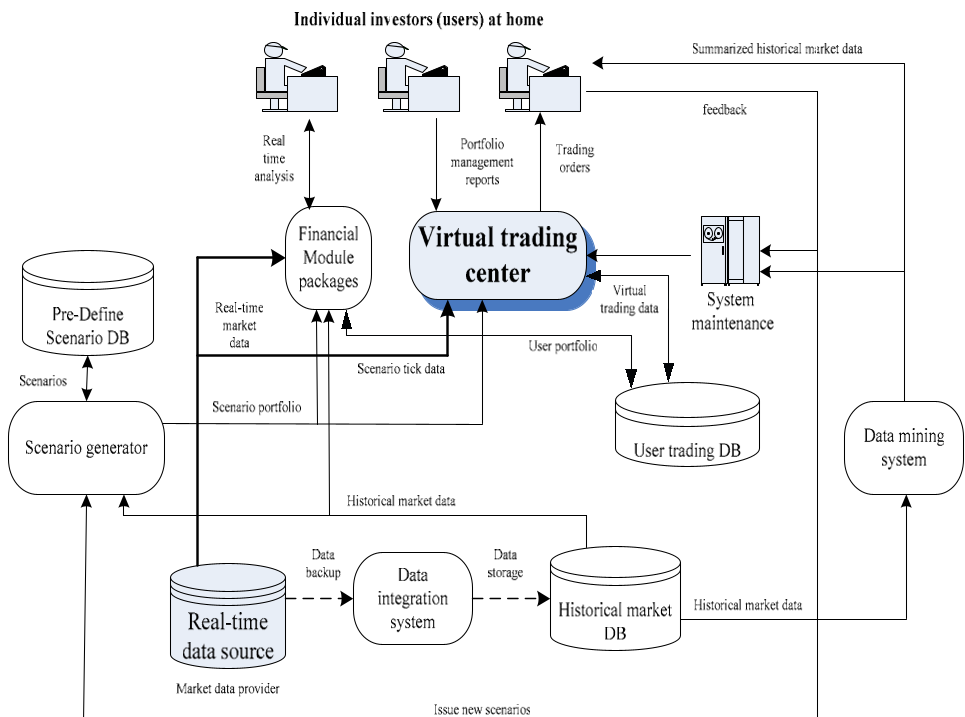 Fig 2: System components and operating flows demonstrating the real-time FMSG and virtual trading execution.
Experimental Insights
The study demonstrates that traditional Message Passing Interfaces (MPI) were limited by hard disk reading speeds (approx. 75MB/s). By shifting to a cloud-based paradigm, IHFILE achieves linear scalability—meaning the system’s capacity grows proportionally with the addition of new hardware.
Furthermore, the Financial Market Scenario Generator (FMSG) allows users to experience "situated cognition," where learning happens within a social framework rather than in isolation. This constructivist approach ensures that the knowledge gained is practical and applicable to real-market volatility.
Critical Insight & Conclusion
While this paper provides a groundbreaking look at merging cloud infrastructure with financial pedagogy, its reliance on K-Means for clustering is a double-edged sword: while efficient, it may struggle with the non-linear, high-dimensional nature of modern social data.
Takeaway: The future of fintech education lies in integrated environments. We are moving away from simple "trading simulators" toward "social intelligence platforms" that help investors decipher the wisdom—or the madness—of the crowds through distributed computing.