
Beyond the Screen: An Integrated Approach to Mapping Real-World Social Networks
An integrated method for social network extraction
The paper introduces an integrated framework for social network extraction, combining Web-mined data, user-registered links, and physical face-to-face interactions. The authors developed a conference support system that builds a multi-layered network consisting of Web links, Know links, and Touch links.
TL;DR
Social networks are usually extracted from a single source—like LinkedIn or Twitter—but this creates massive blind spots. This paper proposes an integrated method combining Web mining (Web links), user registration (Know links), and physical proximity (Touch links) via IC cards to create a holistic, unbiased map of a community.
Background: The Bias of Single-Source Networks
In 2006, the Semantic Web was the "next big thing," and researchers realized that the Web of Trust was only as good as the underlying social graph. However, the authors identified a critical flaw in existing methodologies:
- The Authority Bias: Web mining (e.g., Google search co-occurrence) only finds famous people. If you're a student, you're invisible to the algorithm.
- The Sparsity Problem: Social Networking Services (SNS) rely on manual entry, which many users find tedious, leading to incomplete data.
- The Physical Gap: Digital networks often miss the spontaneous connections made in the real world at events or offices.
Methodology: The Three-Legged Stool
To bridge these gaps, the authors developed a system that integrates three distinct types of relationships, visualized as a unified social infrastructure.
1. Web Links (Automated Extraction)
The system uses a search engine to calculate the strength of relations between individuals based on their co-occurrence on web pages.
2. Know Links (Active Registration)
Typical of modern SNS, users proactively list who they know. This reflects a conscious "Web of Trust."
3. Touch Links (Physical Interaction)
The most innovative part of the 2006 setup involved "Information Kiosks" at a physical conference. When two attendees tapped their IC cards (name tags) on the same kiosk, the system recorded a "Touch link," signifying a face-to-face encounter.

Field Test: Analysis of Social Strata
The system was deployed at a large Japanese domestic conference. By analyzing the intersection of these three link types, the researchers discovered a "social hierarchy" of technology usage:
- High-Authority Users: They have massive Web link counts due to their fame but actually register relatively few "Know links."
- The Middle Class: These users are the most active in the system, registering the highest number of manual "Know links" to expand their visibility.
- Novices/Students: These users heavily favored "Touch links." They were the most active in meeting new people physically at the conference, using the technology to "break the ice."
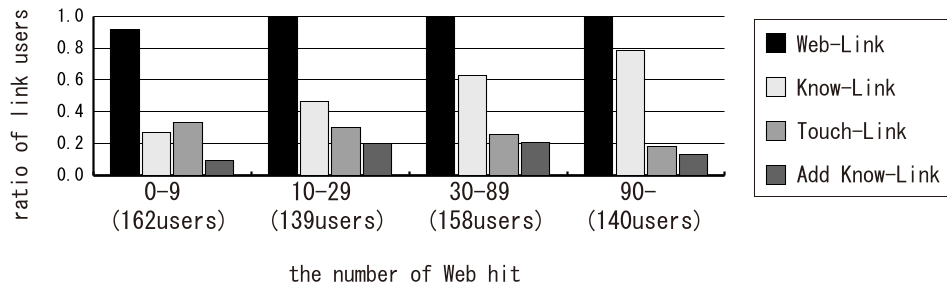 Figure: The correlation between paper authority (Web hits) and the type of links used.
Critical Insight & Future Outlook
This work was a precursor to the modern "Phygital" (Physical + Digital) integration. The methodology proves that diversity in data sources isn't just a technical preference; it's a social necessity. Without the "Touch links," the lower-tier or newer members of the community would be statistically invisible.
Limitations: The 2006 era relied on stationary kiosks—a "Touch link" required both people to go to a fixed point. Modern equivalents using smartphone-based BLE (Bluetooth Low Energy) or RFID have made this process much more passive and seamless.
Future Work: The authors suggest that these integrated networks should form the basis for recommendation engines and collaborative filtering, allowing people to find information not just by "what" they like, but by "who" they trust across both digital and physical domains.
Final Takeaway
If you only look at the Web, you only see the stars. If you look at the kiosks, you see the future of the community.