
IMSA: Beyond Words—Using Social DNA to Decode Microblog Sentiments
Integrated microblog sentiment analysis from users’ social interaction patterns and textual opinions
The paper introduces IMSA (Integrated Microblog Sentiment Analysis), a framework for inferring user-level sentiment on specific topics by combining textual analysis with social interaction patterns. It utilizes a novel Social Opinion Graph (SOG) and a relaxation labeling scheme to achieve state-of-the-art sentiment classification accuracy on Chinese microblogging platforms like Plurk and Facebook.
TL;DR
Microblogging platforms like Twitter and Plurk are goldmines for public opinion, but their brevity makes traditional sentiment analysis notoriously difficult. IMSA (Integrated Microblog Sentiment Analysis) breaks this barrier by looking not just at what people say, but who they interact with. By modeling users in a Social Opinion Graph (SOG) and using Relaxation Labeling, the system can accurately predict a user's stance even when their text is ironic or ambiguous.
The Problem: The Ambiguity of Brevity
Traditional sentiment analysis treats every post as an island. However, microblogging poses three unique challenges:
- Linguistic Noise: Short posts lack context and are filled with metaphors and irony.
- Domain Variance: Words change meaning drastically (e.g., "Pig" as a political slogan vs. an animal).
- Isolation: Text-only models ignore the "birds of a feather flock together" (homophily) principle of social networks.
The authors argue that a user’s overall sentiment is influenced by their social circle. If your close friends are consistently posting negative content about a candidate, there is a high statistical probability you lean that way too, even if your specific post is a neutral-sounding news link.
Methodology: The Social Opinion Graph (SOG)
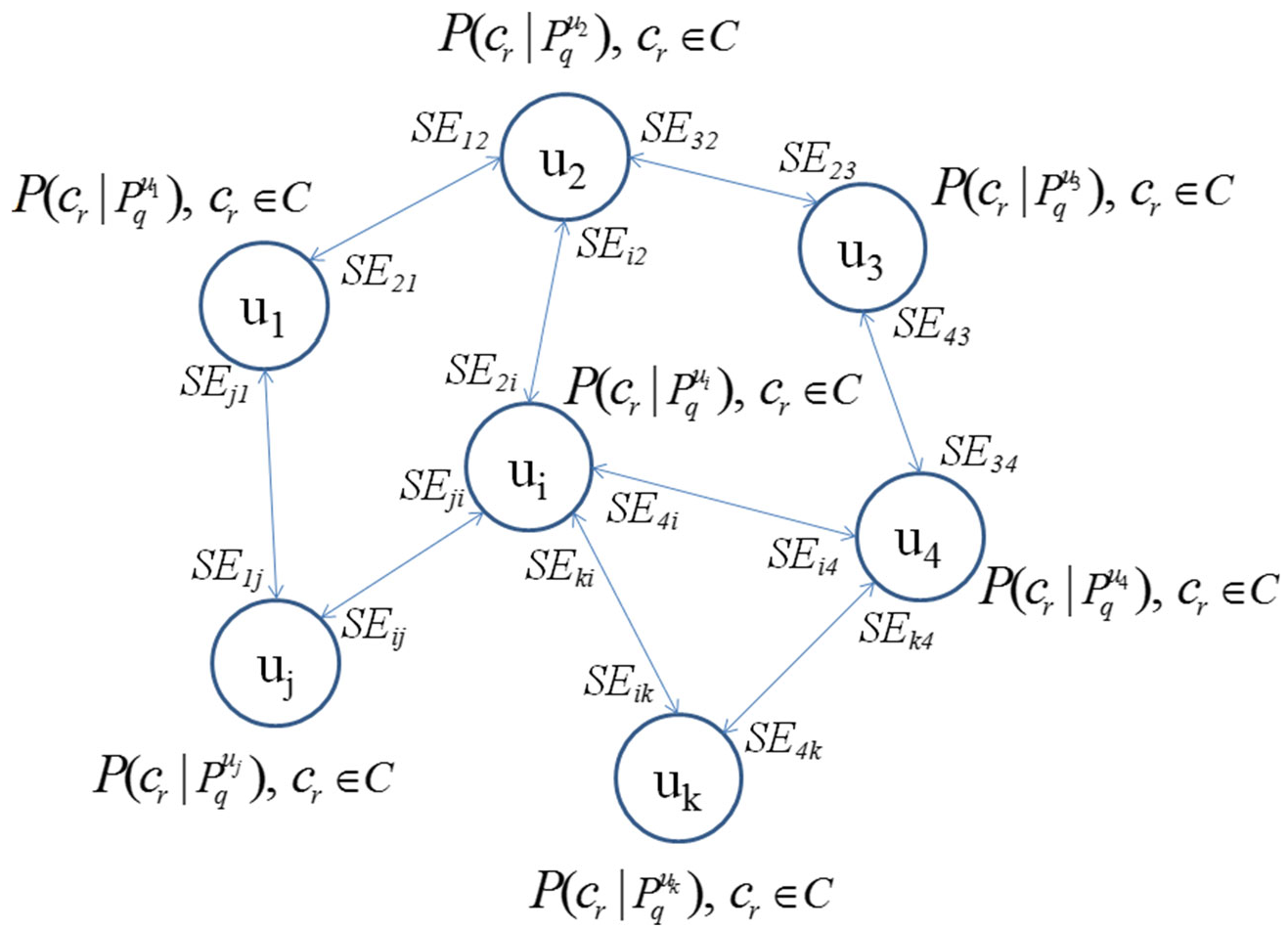
The core innovation is the Social Opinion Graph. Instead of a flat list of posts, IMSA builds a multi-layered network:
- Vertices: Represent unique users.
- Textual Opinions: Attached to each vertex as a collection of posts.
- Social Action Edges: Represent dynamic interactions like "Likes," "Replies," or "Shares."
- Social Enthusiasm ( ): A calculated weight representing the "strength" of influence one user has over another.
The Secret Sauce: Relaxation Labeling
The framework doesn't just run a classifier once. It uses an iterative process called Relaxation Labeling.
- First, it guesses a user's sentiment based on their text (using a Naïve Bayes TSC).
- Then, it looks at the Sentiment Guiding Matrix (SGM)—which maps how likely a "Positive" user is to influence a "Negative" friend.
- It updates the user's sentiment score by looking at their neighbors' scores, weighted by their Emotion Homophily Coefficients.
- It repeats this until the scores across the whole network stabilize.
Experiments: The 2012 Taiwan Election Case Study
The authors tested IMSA on a dataset of over 18,000 Chinese posts regarding candidates Ma Ying-jeou and Tsai Ing-wen.
Key Findings:
- Accuracy Boost: IMSA outperformed the baseline text classifier by roughly 10% for the "Tsai" theme and 6% for the "Ma" theme.
- Handling Irony: The paper highlights cases where users used positive words ("Hooray!") to mock candidates regarding price hikes. While text-only models failed (labeling them Positive), IMSA correctly identified the Negative sentiment by looking at the user's social context.

- Stability: Compared to previous graph-based methods (like Tan et al.), IMSA is far more stable when training data is scarce. This is crucial for real-world scenarios where labeling thousands of posts manually is impossible.
Critical Insight: The Power of Social Consistency
The most striking takeaway is the Sentiment Guiding Matrix. The study found that social interactions are surprisingly consistent. Even if a post's text is ambiguous, the frequency and type of interaction (e.g., a "Replurk" on Plurk) act as a reliable proxy for sentiment.
Conclusion
IMSA proves that in the age of social media, "content is king, but context is the kingdom." By integrating social topology with NLP, we can move past the limitations of short-text analysis.
Future Outlook: While this study focused on Chinese microblogs, the SOG model is platform-agnostic. Integrating this with modern Large Language Models (LLMs) could create a powerhouse for real-time political and brand sentiment monitoring.