
Beyond Friendship Links: An Integrated Approach to Political Affiliation Discovery
An Integrated Model for User Attribute Discovery: A Case Study on Political Affiliation Identification
The paper proposes an unsupervised integrated model for user attribute discovery, specifically targeting political affiliation identification. By combining user-user social links, interaction behaviors (agreement/disagreement), and topic-based feedback (stances) using Probabilistic Matrix Factorization (PMF), it achieves a 70.1% accuracy in identifying political parties on the CreateDebate dataset.
TL;DR
Researchers from SMU and Peking University have developed an unsupervised model that predicts a user's political party with high accuracy (over 70%) without looking at the text of their posts. Instead, the model focuses on behaviors: who you follow, who you argue with, and which controversial topics you support. By using Probabilistic Matrix Factorization (PMF), they solve the "data sparsity" problem common in niche social platforms.
The Problem: The Incomplete User Profile
Most current AI models try to figure out who you are by looking at what you say (Natural Language Processing) or who you know (Social Network Analysis). However, both have flaws:
- Context Gap: Knowing you are friends with Alice doesn't explain your stance on "Universal Health Care."
- The Sparsity Trap: On many platforms, users don't have thousands of followers. They are "singletons" floating in a sea of data, making traditional community detection (like the Louvain method) fail.
Methodology: The Power of Three Matrices
The core "Aha!" moment of this paper is that user identity is formed at the intersection of three behaviors. The authors represent these as three distinct matrices that are factorized into a shared latent space:
- User Social Matrix (S): Stable relationships (Friend vs. Foe).
- User Interaction Matrix (O): Dynamic, topic-specific engagement (Agreement vs. Disagreement in a specific thread).
- User Feedback Matrix (R): Stance-based opinions (Support vs. Oppose on topics like Abortion or Gun Control).
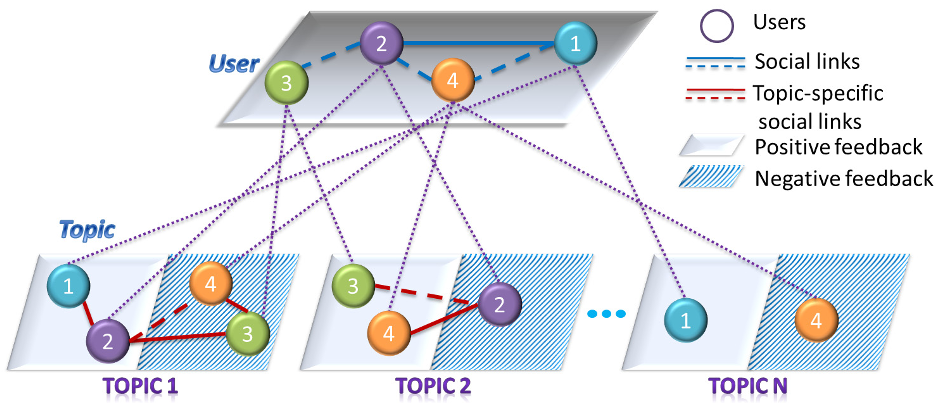
The Mathematics of "Birds of a Feather"
The model assumes that if two users have the same opinion on a controversial topic, their "latent vectors" (the mathematical DNA the model assigns them) should be similar. By minimizing the difference between the actual observed behavior and the dot product of these latent vectors, the model "learns" the hidden political leaning of each user.
Experiments and Results
The authors tested their model on data from CreateDebate.com, focusing on 1,773 users and 88 controversial debates.
Key Findings:
- The "Integrated" Edge: Combining all three matrices (Social + Interaction + Feedback) significantly outperformed models that only used one or two.
- Feedback is King: Interestingly, the "User Feedback" on topics was a much stronger predictor of political party than the "Social Network." In debate forums, users often interact with people they disagree with, which confuses traditional social algorithms but helps this integrated model.
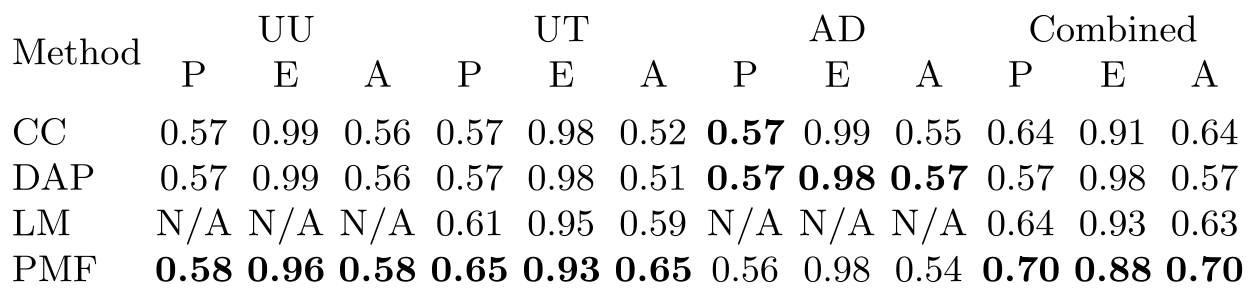
The table above shows that while Correlation Clustering (CC) and Louvain (LM) struggle with sparse data, the PMF approach maintains a high purity and accuracy (0.70).
Critical Insight: Why Does This Work?
The paper reveals a fascinating sociological truth: Our affinities are better defined by our disagreements than our friendships.
In the interaction network, the authors observed massive amounts of "red edges" (disagreements). While other models see this as "noise" or "fragmentation," this integrated model uses these disagreements to map out the "opposing camps" of the political landscape.
Conclusion & Future Outlook
This work provides a robust framework for User Attribute Discovery that is language-agnostic. It doesn't need to understand English or slang; it only needs to know the polarity of your actions.
Limitations: The model currently requires "controversial" issues to be manually aligned (e.g., knowing that being "Pro-Choice" aligns with one party). Future iterations could automate this using sentiment analysis to further reduce human intervention.
Takeaway for Practitioners: When building recommendation or profiling systems, don't just look at the "Follow" graph. The "Downvote" and "Stance" data often hold the missing pieces of the puzzle.