
ECHR-DB: Paving the Way for Reproducible AI in the Legal Domain
On Integrating and Classifying Legal Text Documents
The paper introduces ECHR-DB, the most exhaustive and unified dataset of European Court of Human Rights (ECHR) judgments. It provides an automated, open-source ETL pipeline and establishes baseline performance using 13 machine learning algorithms for binary legal outcome classification.
TL;DR
The intersection of Law and Artificial Intelligence has long been hindered by "messy" data and "black-box" pre-processing. This paper introduces ECHR-DB, a comprehensive, open-source dataset of European Court of Human Rights judgments. By providing a fully automated ETL (Extract, Transform, Load) pipeline and a benchmark of 13 ML algorithms, the authors achieve a staggering 96.44% micro-average accuracy in predicting case outcomes, setting a new gold standard for transparency and reproducibility in legal tech.
The "Messy" Reality of Legal Analytics
The legal domain is notoriously difficult for Machine Learning. It is characterized by "gray areas" of interpretation, non-classical logic, and semantic complexity. While repositories like the US Supreme Court (SCOTUS) exist, they often lack full textual justifications in a machine-readable format.
The authors point out a critical flaw in prior SOTA works: arbitrary data rebalancing. Previous researchers often used undersampling to create balanced datasets, which doesn't reflect the high class imbalance of real-world law (where certain articles are violated far more often than others). ECHR-DB addresses this by maintaining the true label distribution while providing the metadata necessary to handle imbalance via robust metrics like Matthews Correlation Coefficient (MCC).
Methodology: From Raw Text to Hierarchical Trees
The core innovation lies in the automated pipeline. Instead of simple flat-text extraction, the authors parse MS Word documents into a tree-based JSON structure.
1. The Hierarchical Extraction
Each judgment is decomposed into its procedural sections:
- Procedure: The formal background.
- Facts: The specific circumstances of the case.
- Law: The relevant legal arguments and citations.
- Operative Provision: The final decision.
 (Note: The above illustrates the complexity of the legal data being ingested by the ECHR-DB pipeline.)
2. Feature Engineering
The authors utilize a dual-feature approach:
- Descriptive Features: Metadata such as the decision body (judges involved), case law citations, and representatives.
- Textual Features: Normalized n-grams (up to 4-grams) to capture the "codified" and "standardized" language typical of judicial writing.
Experimental Battleground: 13 Algorithms Compared
The authors conducted a massive experimental campaign across 11 datasets (one for each major ECHR Article).
| Metric | Average Performance |
|---|---|
| Micro-Average Accuracy | 96.44% |
| Average Accuracy | 94.43% |
| Best Method | Linear SVC / Ensemble Extra Tree |
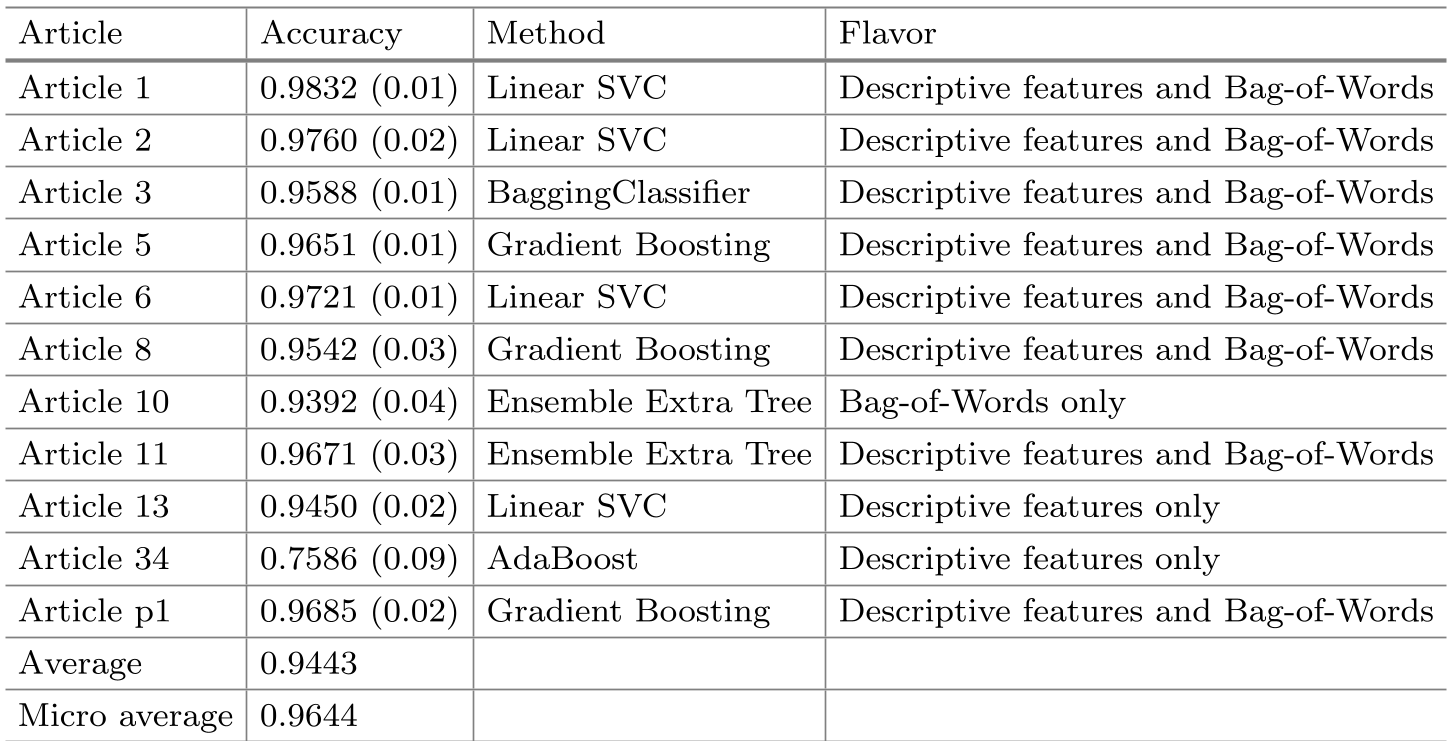 (Table 2: Best accuracy obtained per ECHR Article. Most articles exceed 95% accuracy.)
Key Insights from Results:
- Text is King: Textual features (BoW) almost always outperformed descriptive features alone. However, combining both usually yielded the best "flavor" of the model.
- The Underfitting Problem: As seen in the learning curves, the training and test errors remain relatively far apart even with maximum data. This suggests that the current "Bag-of-Words" approach is too simple (high bias).
- Consistency Matters: While Linear SVC provided the best peak results for specific articles, Ensemble Extra Tree was found to be the most consistent method across the entire corpus.
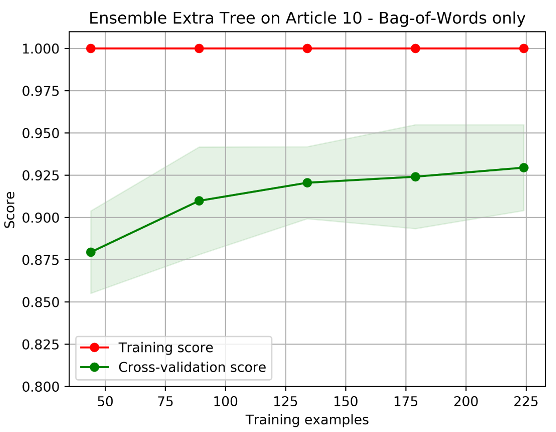 (Fig 2: Learning curves showing convergence but highlighting significant remaining bias.)
Critical Analysis & The Road Ahead
While the accuracy numbers are impressive, the authors are intellectually honest about the limitations. The Bag-of-Words model ignores word order and context, which are vital in legal nuances.
The Future of ECHR-DB:
- Advanced Embeddings: Replacing BoW with BERT or Long-form Transformers to solve the underfitting problem.
- Explainable AI (XAI): Moving beyond predicting "Violation vs. No Violation" to generating natural language justifications.
- Transfer Learning: Leveraging knowledge from one Article (e.g., Article 6 - Right to a fair trial) to improve predictions on Articles with fewer samples.
In conclusion, ECHR-DB isn't just a dataset; it’s a commitment to Data Governance in the legal field. By providing open-source scripts and a structured baseline, Quemy and Wrembel have provided the "Rosetta Stone" for future researchers to decode judicial reasoning using AI.