
LAO: Bridging the Gap Between Syllabus Design and Automated Assessment
Integrating the Learning Objectives and Syllabus into a Domain Ontology for Data structures Course
The paper introduces a framework for integrating course Learning Objectives (LOs) and syllabus content into a domain ontology specifically for Data Structures. It leverages Natural Language Processing (NLP) to extract concepts and Bloom's cognitive levels, facilitating the automated assessment of alignment between exam instruments and educational goals.
Executive Summary
TL;DR: This paper presents a systematic approach to digitizing the "Learning Objective (LO)" by embedding it into a Domain Ontology. By using Natural Language Processing to extract concepts and cognitive levels (Bloom's Taxonomy), the authors create a color-coded LO Annotated Ontology (LAO) that allows educators to visualize whether their exams truly reflect their teaching goals.
Academic Context: Positioned at the intersection of Ontological Engineering and Computer Science Education (CSE), this work serves as the critical first step toward building an automated framework for "Constructive Alignment"—ensuring that what we teach, what we intend to teach, and what we test are perfectly synced.
Problem & Motivation: The Subjectivity of Assessment
In higher education, instructors often have total freedom in designing Assessment Instruments (AIs). However, this freedom comes with a pitfall: subjectivity. Without a formal mechanism, it is nearly impossible to quantify if a final exam fairly covers the syllabus or hits the right cognitive depth (e.g., asking "Recall" questions when the goal was "Application").
Prior works focused on either curriculum visualization or simple keyword matching. The authors identify a "representation gap"—LOs are written in natural language, while syllabi are lists of topics. To automate alignment, we need a machine-readable "map" that connects these two.
Methodology: Building the LO Annotated Ontology (LAO)
The core innovation lies in the LO Annotator, which transforms a static domain ontology into a dynamic, multi-layered knowledge map.
1. The Domain Ontology Tree
The authors constructed a hierarchy for Data Structures using links like hasSubClass, hasOperation, and hasApplication. For instance, Stack is a subclass of Linear Data Structure and has operations like Push and Pop.
2. Information Extraction via NLP
The system processes LO text using:
- N-Grams: To find multi-worded concepts like "Huffman coding algorithm."
- Synonym Mapping: To bridge the gap between teacher-specific terminology and the formal ontology nodes.
- Cognitive Level Tagging: Using a dictionary of "Bloom's action verbs" (e.g., "Implement" Apply; "Describe" Understand).
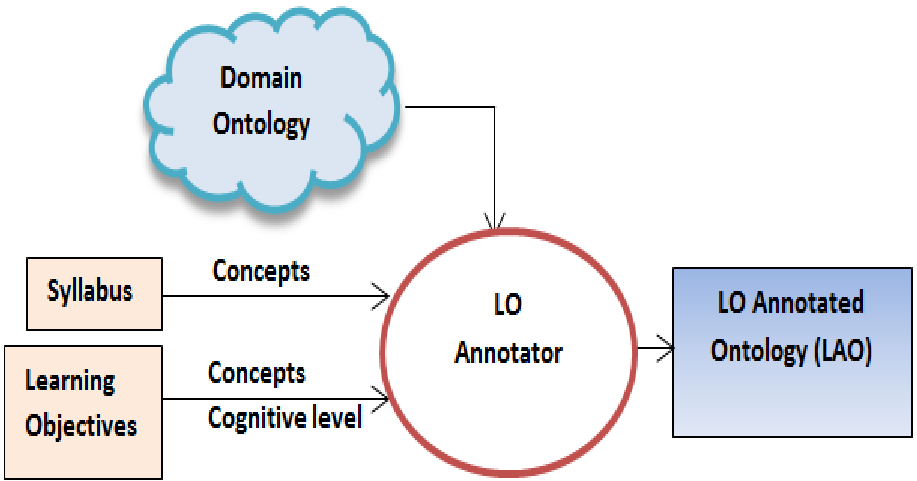 Figure 1: The systemic workflow of generating a LO Annotated Ontology (LAO).
3. The Mapping Logic (The "Why" it Works)
The authors solve the "Implicit Concept" problem by traversing the ontology. If an LO mentions "various operations on stacks," the system doesn't just look for the word "stack"; it follows the hasOperation link to include Push, Pop, and isEmpty.
Experiments & Results: Human vs. Machine
The framework was validated by comparing system-generated LAOs against those manually created by expert teachers with 5+ years of experience.
Key Performance Metrics:
- Accuracy: The system achieved a 90% average match rate with human experts.
- Coverage: Proved effective across 88 distinct nodes in the Data Structures domain.
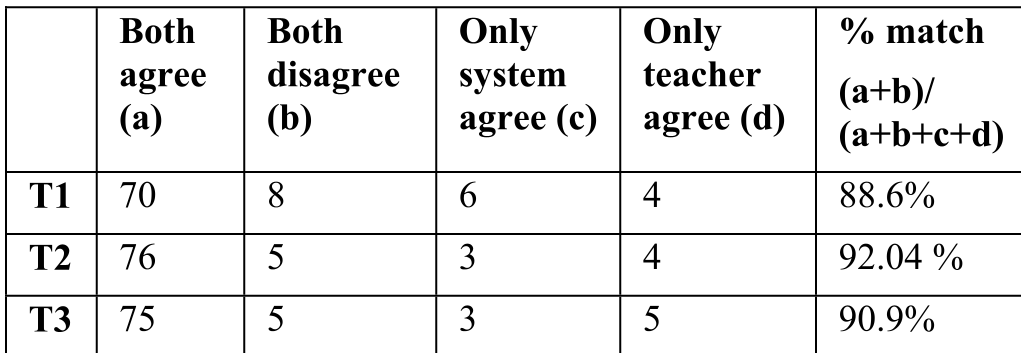 Table 1: Confusion matrix showing the high agreement (90%+) between system (AI) and expert teachers (T1, T2, T3).
Critical Analysis & Conclusion
Takeaways
The LAO provides a powerful visual diagnostic tool. A node colored Black (in syllabus) but not Red (no LO) immediately signals a "Dead Zone" in the curriculum—content that is taught but has no defined objective. Conversely, White and Red nodes suggest "Out-of-Scope" objectives that aren't supported by the syllabus.
Limitations
- Language Ambiguity: The system struggles with complex conjunctions (e.g., "Collision handling and resolution" might only link to "handling").
- Ontology Dependency: The system is only as good as the underlying ontology; creating a "rich enough" ontology for every subject remains a bottleneck.
Future Outlook
As we move into the era of LLMs, this work's logic of using ontologies as a "ground truth" for educational alignment is more relevant than ever. Future iterations could likely replace the rule-based NLP with Generative AI to handle the linguistic nuances that the current version struggles with.