
Facebook: The Invisible Bridge Between Online Clicks and Offline Life
Integrating online and offline community through facebook
This paper investigates how Facebook integrates online and offline community lives by examining social identity, engagement, and ties. Through a scenario-based interview study with 18 college students, the authors demonstrate that Facebook serves as a critical infrastructure for facilitating "proximal communities"—local interactions that blend digital and physical spaces.
TL;DR
Is social media killing our local communities? Contrary to the "crisis of community" narrative, this research proves that Facebook functions as a powerful reinforcement for real-world social structures. By analyzing 90 real-use scenarios, the authors reveal how the platform's features actively support the life cycle of offline events and help users manage a complex, multifaceted "social identity" that is deeply rooted in physical reality.
Academic Positioning: This work bridges the gap between traditional sociology (Social Identity Theory) and HCI, moving away from viewing the internet as a "virtual escape" toward seeing it as a "proximal community" enhancer.
The "Crisis of Community" Re-examined: Problem & Motivation
Since Robert Putnam’s famous critique of television, scholars have worried that technology alienates us from our neighbors. The fear was that time spent online is time stolen from the "public square."
However, the authors of this study argue that this is a false dichotomy. For college students—the "Facebook generation"—the distinction between "online" and "offline" is virtually non-existent. The real challenge is understanding how the affordances of a platform (like Wall posts, Events, and Photos) actually change how we see ourselves (Identity), how we participate (Engagement), and who we stay close to (Ties).
Methodology: The Scenario-Based Approach
To move beyond "how many hours do you spend on Facebook?", the researchers used a Scenario-Based Interview. 18 participants opened their actual Facebook accounts and walked through 5 recent activities in detail.
The Taxonomy of Digital Groups
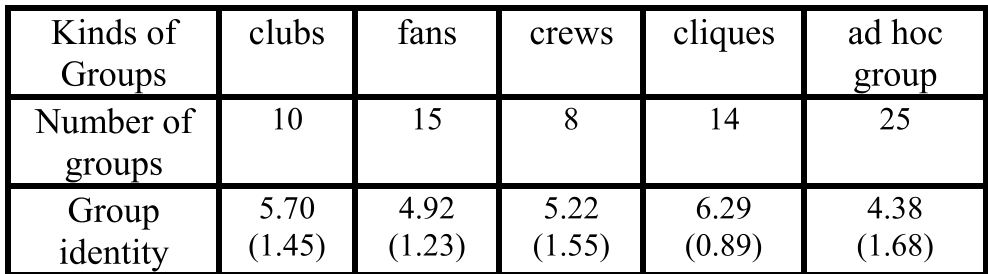
The researchers categorized social clusters into five types based on group identity strength:
- Cliques (Score 6.29): Close friends who hang out daily.
- Clubs (Score 5.70): Formal organizations like sports teams.
- Crews (Score 5.22): Goal-oriented working groups (e.g., class projects).
- Fans (Score 4.92): Supporters of performers or teams.
- Ad hoc Groups (Score 4.38): Temporary interactions triggered by shared news.
Core Insight 1: Social Identity is Dynamic
The study found that Facebook makes social identities visible. A single user might be a "drummer" in one post, a "network security student" in a group, and a "Yankees fan" in an event. Unlike early anonymous chatrooms (MUDs), Facebook identities are anchored in real-world names and social norms.
Core Insight 2: Facilitating the Life Cycle of Engagement
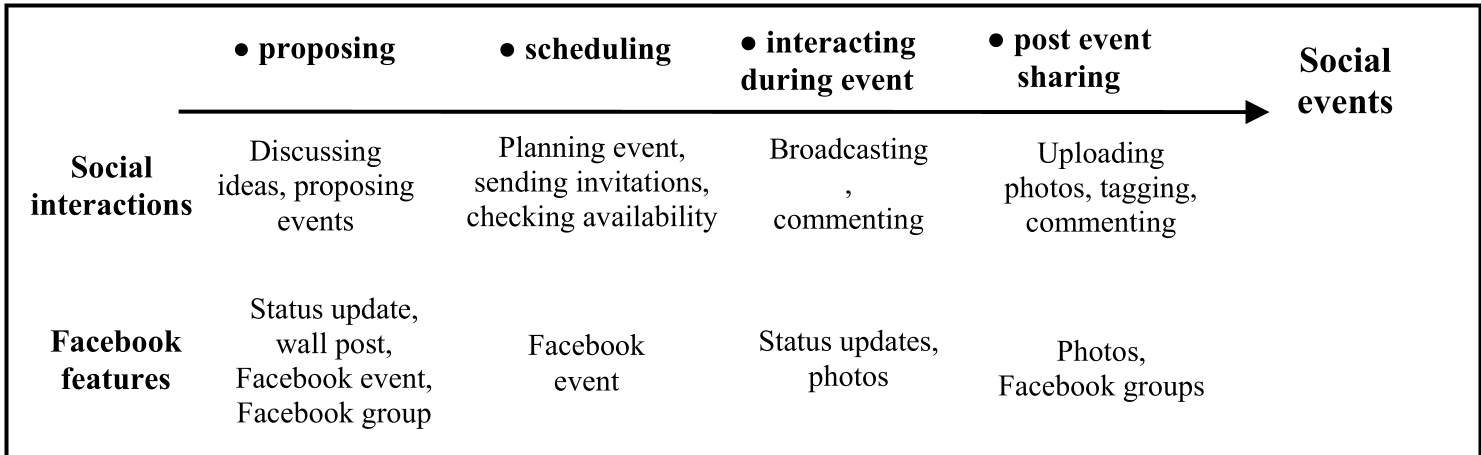
One of the most valuable findings is how Facebook supports the "full stack" of an offline social event. It isn't just about the party; it's about the buildup and the aftermath.
- Proposing: Spurring ideas via wall posts ("There's a concert in DC, we should go!").
- Scheduling: Using Facebook Events to manage attendance and logistics.
- Broadcasting: Real-time updates during the event (the precursor to "Stories").
- Post-Event Sharing: Photos act as "memory holders," reinforcing the group identity through tagging and commenting.
Core Insight 3: The Engineering of Social Ties
The research confirms that Facebook handles Strong Ties and Weak Ties differently:
- Strong Ties: The platform is "more than an alternative"—it becomes the centralized habit. Participants preferred Facebook messages over email because their close friends were always "there."
- Weak Ties: Facebook lowers the "interaction threshold." You can "like" a status of a distant acquaintance to maintain a connection that would have otherwise died out. This creates a "repository" of potential capital.
Critical Analysis & Conclusion
Takeaway
The study concludes that Facebook's primary function is facilitation. It doesn't create social ties from scratch; it provides the infrastructure to make existing real-world ties more resilient, visible, and manageable.
Limitations
- Demographics: The study focused exclusively on college students, a demographic where "local" and "social" are naturally highly integrated.
- Evolution of Tech: Conducted in 2011, the study precedes the era of algorithmic feeds and high-speed mobile video, which may have shifted the focus from "communities" to "content consumption."
Future Outlook
As we move toward "Metaverse" or "Spatial Computing" contexts, this paper reminds us that the most successful digital tools will not be those that replace reality, but those that enhance the proximal community—making our multifaceted social lives easier to navigate in the physical world.