
Breaking the Fake Review Cycle: Leveraging Social Networks for E-Commerce Trust
Integrating Online Social N etworl(s for Enhancing Reputation Systems of E-Commerce
The paper introduces a protocol to improve e-commerce reputation systems by integrating Online Social Networks (OSNs). It allows buyers to share authenticated, trustworthy reviews with their social circles using a tiered privacy-preserving mechanism (public, partially-public, and private).
TL;DR
Online shopping's biggest Achilles' heel remains the fake review. This paper proposes a structural solve: integrating your Online Social Network (OSN) with your shopping profile. By using cryptographic credentials to verify reviews from your actual friends, the system creates a "reputation 2.0" where trust is derived from real-world relationships rather than anonymous stars.
The Problem: The Anonymity Gap
Current reputation systems (like eBay’s or Amazon’s) rely on a simple calculation: . While mathematically sound, it is socially fragile. Anyone can create an ID and post a review.
- The Pain Point: You don't know who a reviewer is, so you don't know if you can trust them.
- Previous Limitations: Earlier attempts at "friendship annotations" required cumbersome manual credential swapping and lacked the ability to revoke access or protect privacy on a per-purchase basis.
Methodology: The "Circle of Trust" Protocol
The authors propose a protocol that shifts the burden of identity to OSNs (like Facebook), which already have robust friend-graphs and security (SSL).
1. Secure Credential Exchange
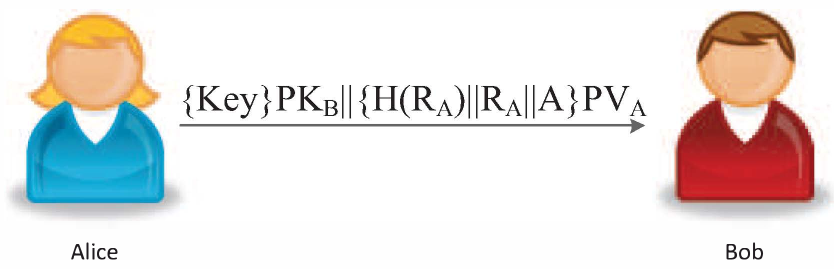
Before Alice can share a trusted review with Bob, they exchange keys. Alice generates a Secret Symmetric Key, encrypts it with Bob’s Public Key, and signs it. This ensures that only Bob can "unlock" Alice’s future trusted reviews.
2. The Three Pillars of Privacy
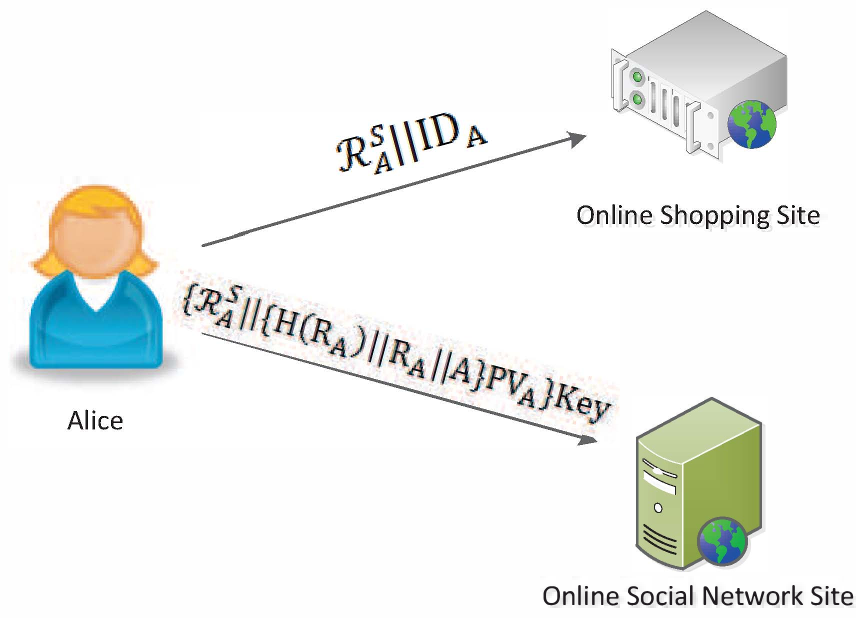
Recognizing that users don't want to share every purchase (e.g., medical supplies or personal items), the protocol offers three modes:
- Public: Review goes to the shop and Alice's OSN feed.
- Partially-Public: Encrypted using the Symmetric Key; only "Close Friends" with the key can decrypt and see it.
- Private: Review only goes to the shopping site; it is hidden from the social network entirely.
Experiments: Accuracy vs. Overhead
Implementing RSA and AES encryption naturally adds "lag." The authors tested this on a Windows 7 environment (Intel i-7) to see if the security cost was too high.
| Action | Avg. Time (ms) |
|---|---|
| Signature Generation | 174 ms |
| Public Key Encryption | 190 ms |
| Symmetric Decryption | 1 ms |
Insight: While the initial setup (Credential Exchange) takes nearly 800ms, the actual daily use (Review Retrieval) is near-instant (sub-50ms). This makes the system extremely viable for real-world application where users demand snappy interfaces.
Critical Analysis & Future Outlook
The "Word of Mouth" effect described by the authors suggests that this isn't just a security update—it's a marketing tool. If I see a close friend bought a specific camera and gave it 5 stars, I am exponentially more likely to buy it than if I see 1,000 anonymous 5-star reviews.
Core Limitations:
- Platform Centralization: The model assumes tight integration between an OSN and a Shop. In a competitive market, Meta (Social) and Amazon (Shop) may not want to share this data.
- The "Cold Start": Users must manually verify "Close Friends" to begin the credential exchange.
Conclusion: This paper provides a clear cryptographic roadmap for moving e-commerce away from "Blind Trust" and toward "Social Trust." By making reviews verifiable through the people we already know, we can finally extinguish the "fire" of fake reviews.