
Beyond Static Responses: Training Agents to Feel with Personality and Mood
Integrating Personality and Mood with Agent Emotions
The paper introduces EEGS, a computational emotion model that integrates personality and mood to generate believable agent emotions. By employing a supervised machine learning approach (Stochastic Gradient Descent) on human-validated data, it achieves a high average emotion intensity prediction accuracy of 78.1%.
TL;DR
Researchers have developed EEGS, a computational emotion model that uses Stochastic Gradient Descent (SGD) to predict emotion intensities with 78.1% accuracy. Unlike previous models that use "hard-coded" rules, this system learns how OCEAN personality traits and mood influence emotional output, making AI agents significantly more believable and human-like.
Background Positioning
While emotional AI is a well-established field, most models fall into two traps: they are either purely theoretical (based on fixed rules) or limited to simple "emotion classification" (e.g., is this agent happy or sad?). This paper moves the needle from what an agent feels to how much it feels, treating emotion as a continuous spectrum modulated by the agent's unique "character."
The Problem: The "One-Size-Fits-All" Emotion Crisis
Prior work in affective computing often ignores the fact that different individuals react to the same event differently. A "Conscientious" agent might feel deep reproach if a task is failed, while an "Agreeable" agent might feel mild disappointment. Current models lack:
- Empirical Grounding: Most are based on researcher assumptions rather than human data.
- Intensity Granularity: They can classify an emotion but can't accurately predict its strength (intensity).
- Integration: Personality and mood are often treated as distinct silos rather than interacting components of the emotional process.
Methodology: The EEGS Framework
The core innovation lies in the transition from logic-based rules to a supervised machine learning regression task.
Data Input and Architecture
The model processes a combination of three distinct feature sets:
- Appraisal Variables (): Based on the OCC (Ortony, Clore, and Collins) theory, these define how the agent evaluates a situation.
- Personality Factors (OCEAN): Openness, Conscientiousness, Extroversion, Agreeableness, and Neuroticism.
- Mood (): A representation of the agent's current internal state.

The researchers used a dataset of 517 entries derived from human surveys to train separate network links for each emotion type (Joy, Distress, Gratitude, etc.). This modular approach prevents "learning errors" where the features of one emotion bleed into another.
Experiments & Results
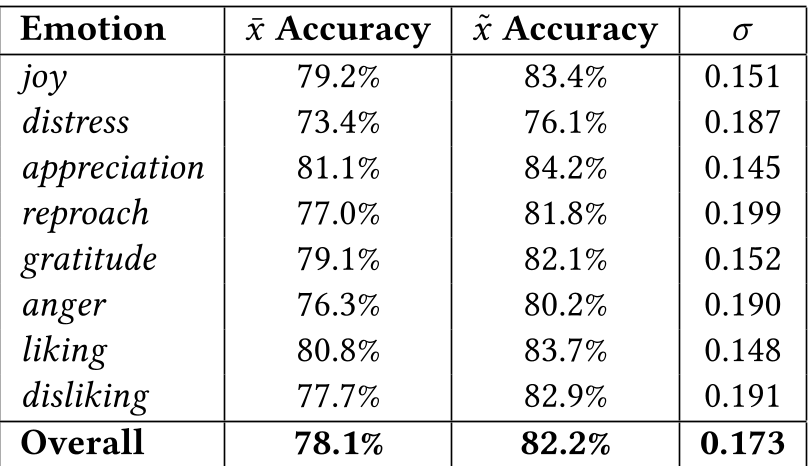
The researchers compared their regression approach against standard classification tasks. While classification accuracy usually plummets as you add more emotion categories (dropping to 27.9% for 12 classes in previous SOTA), the EEGS model maintained high stability.
| Emotion | Mean Accuracy () | Median Accuracy () |
|---|---|---|
| Joy | 79.2% | 83.4% |
| Appreciation | 81.1% | 84.2% |
| Gratitude | 79.1% | 82.1% |
| Overall | 78.1% | 82.2% |
Why This Matters
The standard deviation () across all emotions was remarkably low (avg 0.173), suggesting the model is consistently reliable across different emotional states. Whether the agent is feeling "Anger" or "Liking," the system predicts the intensity with similar precision.
Critical Analysis & Conclusion
Takeaway
The integration of personality and mood isn't just a "nice-to-have" feature; it is the mathematical bridge that allows agents to transition from being reactive machines to being believable characters. By training on human data, EEGS captures the "Inductive Bias" of human emotionality.
Limitations
- Dataset Size: With only 47 unique human respondents, the diversity of personality-emotion mappings might be limited.
- Complexity: Training a separate model for each emotion simplifies the process but may overlook the "blended emotions" that humans often experience.
Future Work
The authors suggest that this framework serves as a benchmark for future affective computing. The next step in this evolution will likely involve Deep Learning architectures that can model the temporal decay of mood and the complex interplay of conflicting emotions in real-time social interactions.
Paper Source: AAMAS '19: International Conference on Autonomous Agents and Multiagent Systems.