
Let’s Meet: Bridging the "Walled Gardens" of Social and Learning Worlds
Let's Meet: Integrating Social and Learning Worlds
The paper introduces a Semantic Web-based framework designed to integrate learners' social activities with formal educational environments. By utilizing an ontological user model (FOAF, GUMO, SIOC), it extracts data from "walled garden" social networks like Facebook to provide personalized peer recommendations for collaborative learning.
TL;DR
Is your Facebook persona helping your academic life? This paper proposes a Semantic Web framework that breaks down the barriers of "walled garden" social networks. By mapping social data into standardized ontologies (FOAF, GUMO), the system recommends collaborative learning partners based on a blend of social interests and academic similarities (like learning styles).
Background Positioning
In the landscape of E-learning, this work occupies the intersection of Social Computing and the Semantic Web. It moves away from "local ontologies"—which only work within one app—towards a shared, interoperable user model that views a learner as a holistic entity across both social and educational spheres.
Pain Points & Motivation: The Walled Garden Problem
The authors identify a critical disconnect: we learn everywhere, yet our "student data" lives in an LMS, and our "social data" lives on Facebook.
- Data Silos: Social networks use proprietary formats that aren't portable.
- Context Loss: A brilliant collaborator on a professional network like LinkedIn might be invisible to you in your university course.
- The "Walled Garden": Information is trapped behind APIs and privacy settings, preventing its use for legitimate educational growth.
The Insight here is that if we can map these disparate data points to a common "language" (ontologies), we can create a unified user profile that powers intelligent services regardless of where the data originated.
Methodology: The Semantic Glue
The core of the framework is an Ontological User Model. Instead of reinventing the wheel, the authors leverage established standards:
- FOAF (Friend of a Friend): To map basic personal info and social connections.
- GUMO (General User Model Ontology): To standardize varied user interests.
- LOCO (Learning Object Context Ontology): To store pedagogical data like learning styles (assessed via the Felder-Silverman Index).
The Recommendation Engine
The system calculates a Suitability Rank () for every friend in a user's social graph: Where represents similarity criteria (Interests, Group membership, Learning Styles, Affiliations) and is the weight assigned to each.
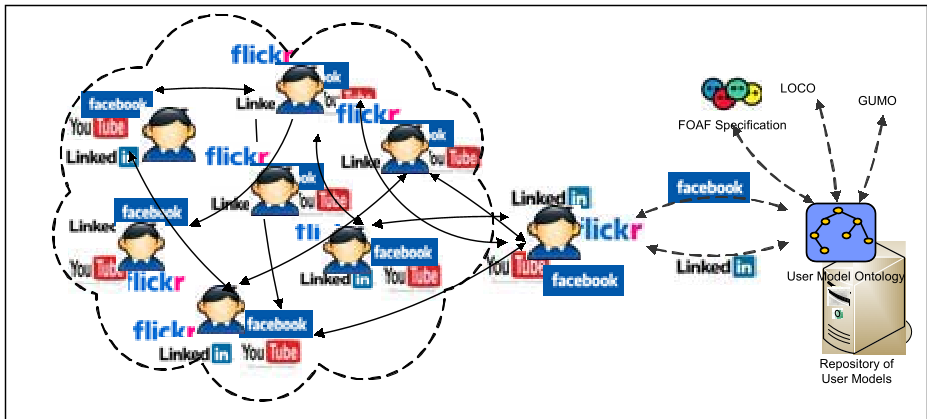 Figure 1: The architecture extracts data from Facebook, processes it through ontologies, and surfaces recommendations.
Experiments & Results
The prototype used a PHP-based server to fetch live Facebook data and combine it with a learning style questionnaire.
Key Findings:
- Interests Matter: The system used MySQL
MATCH-AGAINSTfor full-text search to find social overlap. - Transparency is Critical: Users were more likely to engage when they could see the "reasoning" behind a recommendation (e.g., "70% similarity in learning styles").
- The Sparsity Challenge: Because the database was new, only a small fraction of friends had complete profiles, leading to some "empty" recommendation slots.
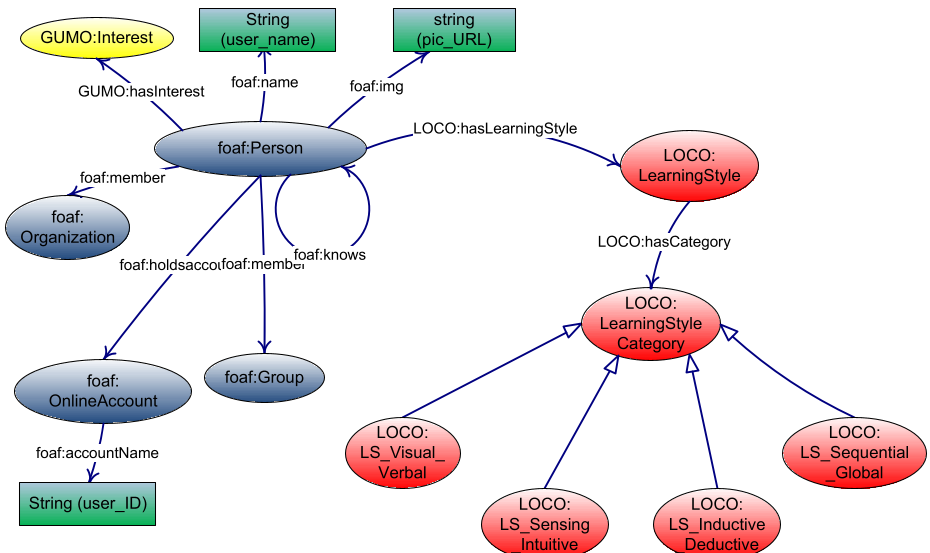 Figure 2: The detailed mapping of the User Model, showing how FOAF and GUMO interact.
Critical Analysis & Conclusion
Takeaway
The paper successfully argues that Social Semantic Web technologies are the key to personalized learning. By standardizing "who we are" online, we can turn casual social networks into powerful engines for peer-to-peer education.
Limitations
- Trust & Privacy: As noted in the evaluation, users are hesitant to accept academic partners based solely on an algorithm. Pure "data similarity" doesn't account for interpersonal chemistry.
- API Dependency: The "walled garden" is a moving target. Since the paper was written, API restrictions (like those from Facebook or LinkedIn) have become significantly stricter, making this type of extraction more challenging today.
Future Work
The authors suggest including Physical Location and Micro-blogging (Twitter) data. In today’s context, one might imagine integrating Real-time LLMs to synthesize a learner's "knowledge graph" directly from their social posts, bypassing the need for manual questionnaires like the ILS.