
Social-MF: Leveraging Peer Influence to Predict Academic Success in Intelligent Tutoring Systems
Toward integrating social networks into intelligent tutoring systems
This paper proposes "Social-MF," an integrated Intelligent Tutoring System (ITS) framework that leverages Social Matrix Factorization to predict student performance. By mapping educational data to Recommender System (RS) structures and incorporating social relationship matrices, the method achieves SOTA accuracy on real-world academic datasets.
TL;DR
Predicting student performance is a cornerstone of personalized education. While traditional Intelligent Tutoring Systems (ITS) treat learners as independent data points, this paper introduces Social-MF, a framework that treats learning as a social activity. By integrating student social networks (like classmates or friends) into a Matrix Factorization model, the researchers achieved superior accuracy in predicting grades and task outcomes across two large-scale datasets.
The Missing Dimension: Social Context in Learning
Current ITS architectures (Domain, Tutoring, and Student models) often fail to account for the "Social Influence" phenomenon. In a real-world classroom, if Student A and Student B are close friends or classmates, their performance levels are often correlated due to shared resources, peer pressure, or collaborative study.
Prior works used standard Recommender System (RS) techniques like Matrix Factorization (MF) to predict performance, but they viewed the "Student-Course" matrix as a vacuum. The authors argue that by ignoring the social graph, we lose a vital source of inductive bias that can help "smooth" predictions, especially for students with limited historical data.
Methodology: From Classmates to Latent Factors
1. The Mapping Strategy
The authors first bridge the gap between Educational Data Mining and Recommender Systems by defining a formal mapping:
- Student User
- Course/Task Item
- Grade/Mark Rating
2. Social Regularization
The core of the Social-MF approach is the modification of the latent factor learning process. In standard MF, we minimize the error between the actual grade and the predicted grade .
In Social-MF, a student's latent vector is no longer independent. It is influenced by their neighbors . The behavior is modeled such that a student's latent features should be close to the average of their social circle:
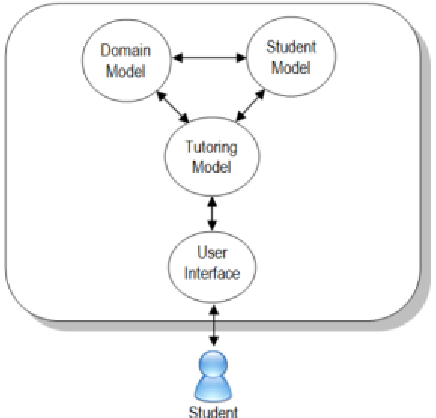 Figure 1: The standard ITS components where the Student-Model is enhanced via Social-MF.
3. The Objective Function
The model optimizes a loss function that balances three things:
- Prediction Accuracy: Minimizing the difference between predicted and actual grades.
- Overfitting Prevention: Standard Frobenius norm regularization .
- Social Consistency: A new term that penalizes the distance between a student's latent factor and the average factor of their friends.
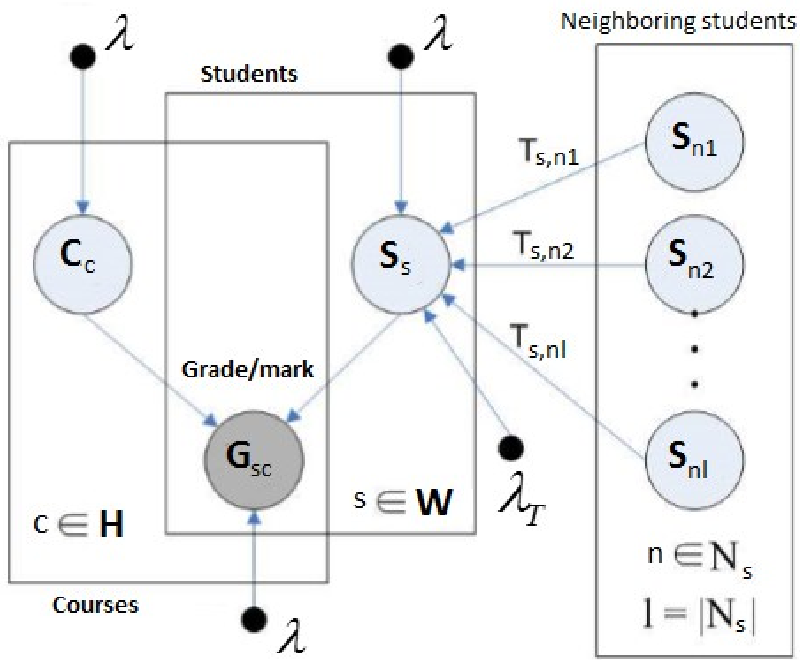 Figure 2: The graphical representation of how social relationships influence the Student/User latent factor W.
Experimental Validation
The authors tested the model on two distinct datasets:
- CTU Dataset: University grading data (4,017 students).
- ASSISTments Dataset: Web-based tutoring data (8,519 students).
SOTA Comparison
Social-MF was compared against baselines like k-Nearest Neighbors (kNN) and Biased Matrix Factorization (BMF).
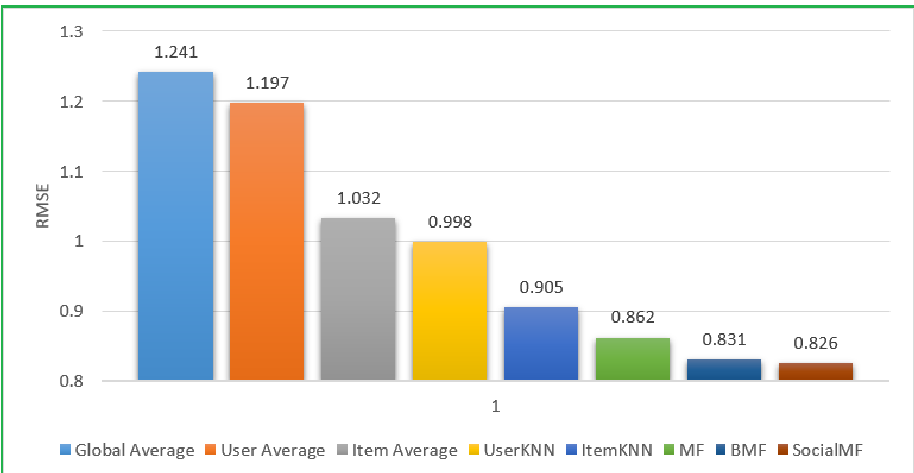 Figure 3: RMSE results across different methods. Social-MF consistently achieves the lowest error.
On the CTU dataset, Social-MF reached an RMSE of 0.826, significantly outperforming the Item-kNN (0.970) and even standard MF (0.835). The results prove that even a simple binary relationship matrix (1 if classmates, 0 if not) provides enough signal to refine the latent feature space of learners.
Critical Insight & Conclusion
The success of Social-MF highlights a shift in Educational AI: Learning is not a solo sport. By mathematically formalizing peer influence through social regularization, we can build ITS that are more "aware" of the student's real-world environment.
Takeaway for Practitioners: When building recommendation engines for education or e-learning, don't just look at the student's past grades. Look at who they are learning with. The social graph is a "free" source of data that can mitigate the cold-start problem and improve the precision of personalized feedback.
Future Work: While this paper focuses on static social matrices (friend/classmate), future research could incorporate dynamic social interactions (e.g., real-time forum discussions or collaborative problem-solving) to further refine these latent student profiles.