
Trust Meets Reputation: A Subjective Logic Approach to LBSN Recommendations
Integrating Trust with Public Reputation in Location-Based Social Networks for Recommendation Making
This paper introduces a novel recommendation framework for Location-Based Social Networks (LBSNs) that integrates Subjective Logic-based trust management with public reputation derived from opinion mining. The core method utilizes Trust Network Analysis with Subjective Logic (TNA-SL) to evaluate interpersonal trust and combines it with sentiment scores from external reviews to provide high-quality item recommendations.
TL;DR
In the rapidly expanding world of Location-Based Social Networks (LBSNs), the challenge isn't just finding information—it's finding trustworthy information. This paper proposes a framework that combines Subjective Logic (to model interpersonal trust) with Opinion Mining (to model public reputation), creating a recommendation engine that values both who you know and what the world thinks.
Positioning: This work serves as a foundational theoretical bridge between social network analysis and automated sentiment extraction, moving beyond traditional collaborative filtering.
The Problem: The Trust Gap in Social Streams
As platforms like Facebook and local-centric services (e.g., Rummble) grow, they face the "information overload" paradox. When a friend-of-a-friend recommends a hotel in Sydney, two questions arise:
- How much do I trust the source? (Interpersonal Trust)
- Does the item actually live up to the hype? (Public Reputation)
Existing systems struggle because they treat trust as a simple binary or a raw average, ignoring the uncertainty inherent in human relationships. Moreover, they often miss out on the wealth of "free-text" reviews available across the web.
Methodology: Subjective Logic & Opinion Mining
The authors' approach is dual-pronged, focusing on the "How" of trust calculation and the "What" of reputation extraction.
1. Subjective Logic (The Mathematics of Uncertainty)
Instead of a single probability, trust is represented as an opinion :
- Belief (): Evidence for trustworthiness.
- Disbelief (): Evidence against trustworthiness.
- Uncertainty (): The void where data is missing.
- Base Rate (): The prior bias when no evidence exists.
To handle complex networks, the paper uses Node Splitting to ensure that trust paths remain independent, preventing the "double counting" of evidence.

2. The Integrated Framework
The system extracts features from online reviews (e.g., "food," "service" for a hotel) and assigns sentiment orientations. This "Public Reputation" is then filtered through the lens of the user's "Trust Network."
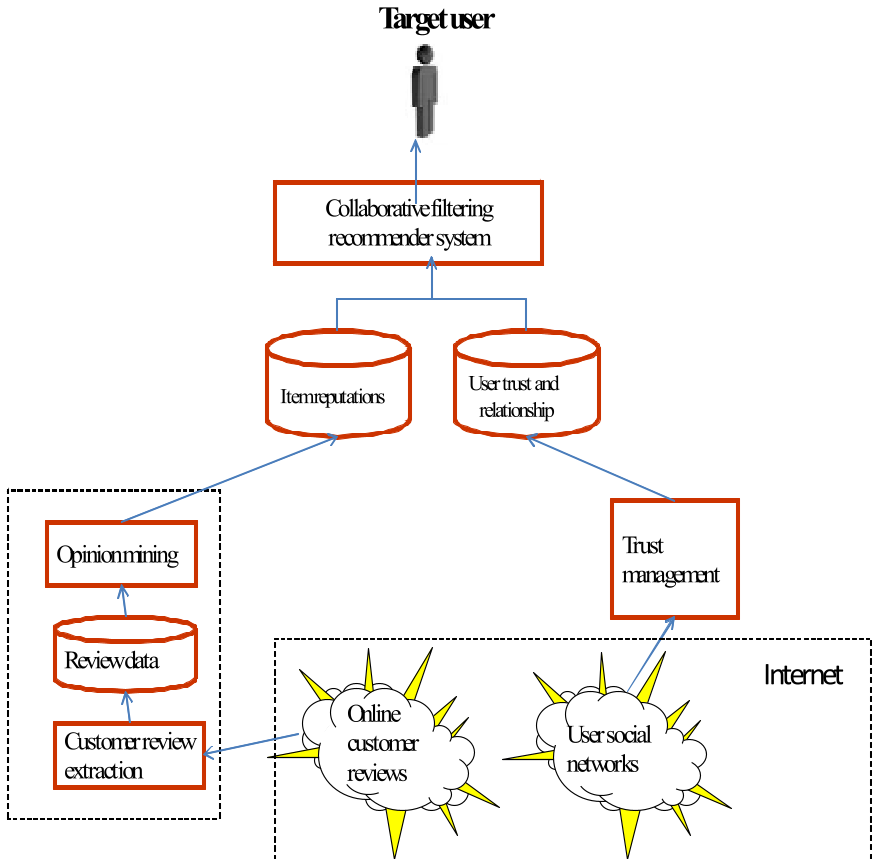
Deep Insight: Why This Works
The brilliance of using Subjective Logic lies in the Discounting () and Fusion () operators.
- Discounting allows trust to "decay" naturally as it moves along a chain (A trusts B, who trusts C).
- Fusion allows a user to "strengthen" their belief if multiple independent sources recommend the same item.
By mathematically formalizing these intuitions, the system can provide a recommendation that says: "We recommend this hotel because your trusted social circle likes it, AND the general public confirms its quality with high sentiment scores."
Critical Analysis & Future Outlook
While the paper provides a rigorous mathematical framework for trust, it acknowledges a gap in empirical validation. The proposed framework is "relevance-heavy" but requires a large-scale LBSN dataset to prove that this logic translates into higher user satisfaction compared to standard matrix factorization.
Key Takeaways:
- Hybridization is Key: Interpersonal trust and public reputation are two sides of the same coin; using either in isolation is suboptimal.
- Handling Uncertainty: In modern AI, explicitly modeling what we don't know (uncertainty) is as important as modeling what we do know.
Future Work: The logical next step is to replace the lexicon-based opinion mining with modern LLMs (Large Language Models) to capture more nuanced sentiment, while keeping the Subjective Logic core for trust propagation.