
EasyGo: Orchestrating Social Circles through Semantic Web Integration
Integration of Heterogeneous Web Services for Event-Based Social Networks
The paper introduces a Semantic Web-based framework to build Event-Based Social Networks (EBSNs) by integrating heterogeneous online data sources like StubHub and Ticketmaster. It leverages a Triple Store for information fusion and employs Latent Dirichlet Allocation (LDA) for personalized event and friend recommendations, implemented in a mashup application called "EasyGo."
TL;DR
"EasyGo" is a Semantic Web framework that harvests event data from fragmented online marketplaces (like StubHub and Ticketmaster) to build a unified social ecosystem. By integrating heterogeneous data into an ontology and using LDA-based topic modeling, it enables users to find theater, sports, and concert events, form purchase groups, and transition online interest into offline friendships.
Context & Motivation: The Fragmented Event Universe
Most event-based social networks are "walled gardens"—systems built from the top-down where you only see what the platform owner permits. However, the real world of events is messy and scattered across dozens of ticket vendors.
The researchers identified a critical gap: How can we allow users to self-organize social circles around any event on the web? The core challenge isn't just finding the events, but resolving the "Heterogeneity Conflict"—where one site lists a "Venue" and another a "Location," or one refers to "Taylor Swift" while another says "Taylor Swift featuring Ed Sheeran."
Methodology: The Semantic Glue
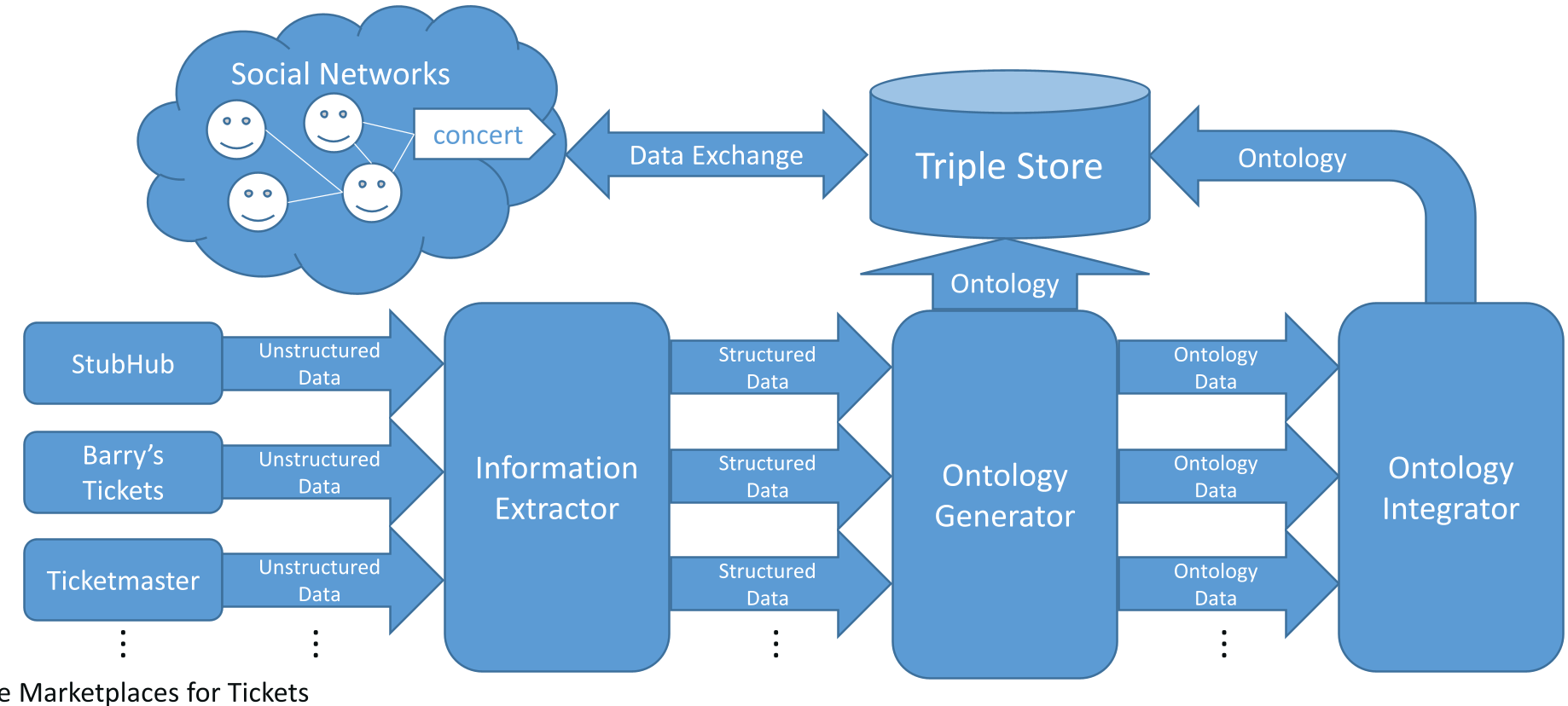
The authors propose a system architecture (Fig. 1) centered around a Triple Store, acting as the knowledge base for the entire social network.
1. Data Transformation (Karma & Scrapy)
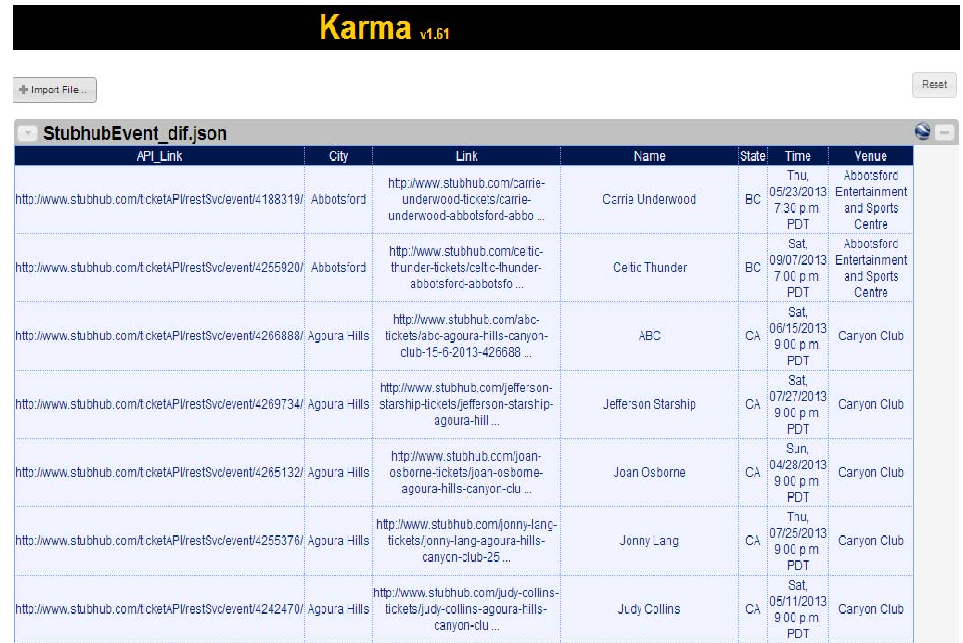
Using Scrapy for crawling and the Karma semantic tool, the system turns raw JSON/HTML data into structured RDF triples. This allows the system to treat a StubHub listing and a Ticketmaster listing as comparable semantic entities (Fig. 2).
2. The Hybrid Matching Algorithm
To solve the naming mismatch problem, the authors use a dual-weighted approach:
- Syntactic Similarity: Using Levenshtein distance to catch spelling overlaps.
- Semantic Similarity: Using WordNet synsets and Jaccard similarity to realize that "Venue" and "Location" mean the same thing.
For instance-level matching (identifying if two listings are the same concert), they apply the Smith-Waterman Similarity, which is robust for local sequence alignments—essential for catching artist names within long event titles.
Recommending Connection: The Role of LDA
Instead of just recommending friends based on mutual friends (the Facebook model), EasyGo uses Latent Dirichlet Allocation (LDA).
- Input: User profiles (extracted from Facebook) and event descriptions.
- Process: Topics are extracted as latent variables.
- Output: A recommendation score based on the Cosine Similarity between the user’s topic vector and the event’s topic vector.
Experimental Results & Application
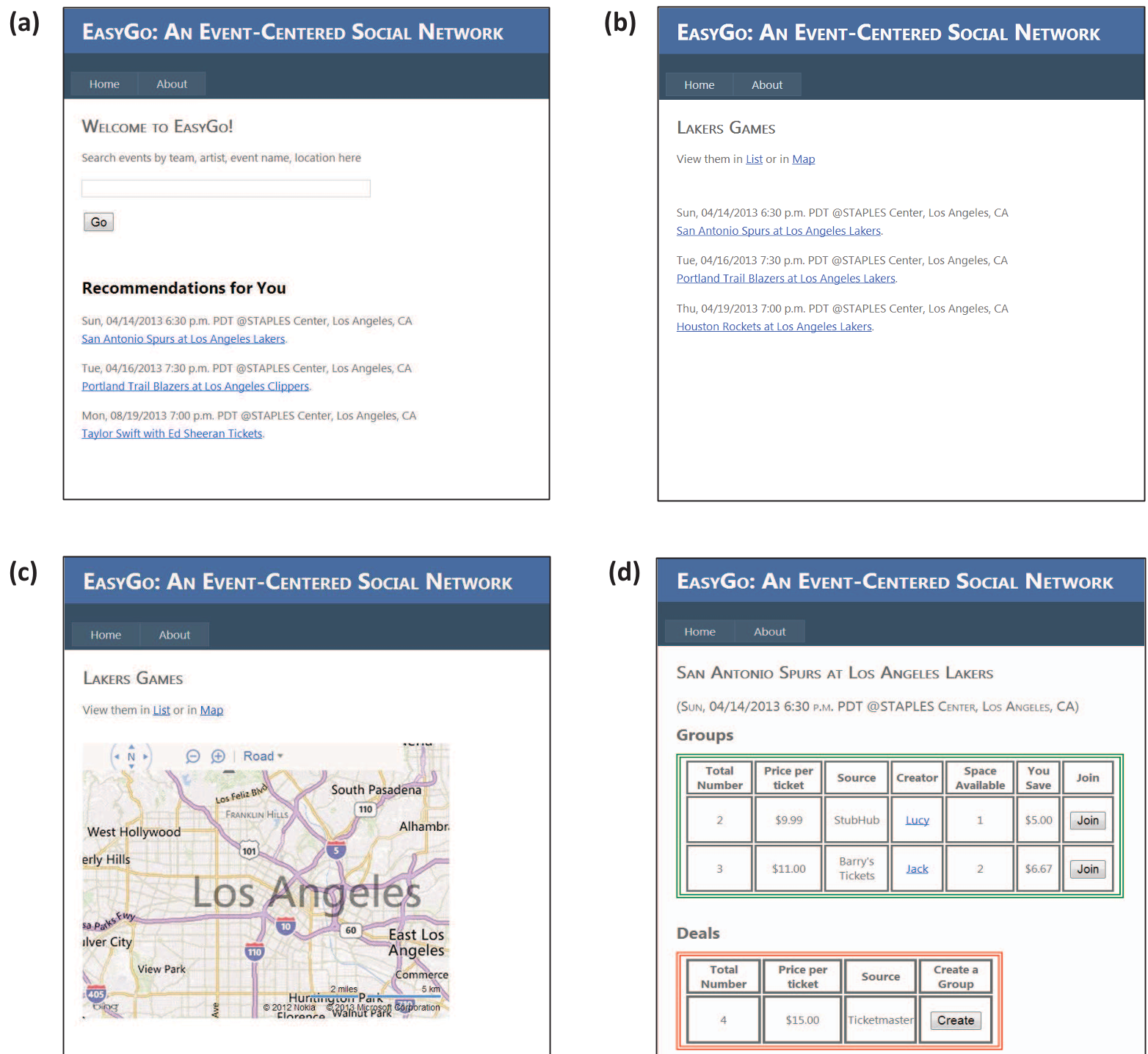
The framework was realized in the EasyGo web application. It successfully demonstrated that users could:
- Find the cheapest deals across multiple platforms.
- Join or create "Groups" to share delivery and service fees.
- Automate the formation of social ties before the physical event takes place.
Critical Insight & Future Work
The true value of this work lies in its Semantic Interoperability. By moving away from proprietary databases to a Triple Store, the "Social" part of the network becomes an emergent property of the data rather than a hard-coded feature.
Limitations: Currently, the ontology refresh rate is manual (once per day). In the high-stakes world of ticket sales, where prices fluctuate by the minute, this is a bottleneck. The authors' future plan to use machine learning to predict optimal update frequencies is a necessary evolution for this system to survive in a commercial environment.
Conclusion
EasyGo proves that the Semantic Web is not just a theoretical exercise for researchers—it is a powerful tool for data mashups that can drive real-world social behavior and economic savings.