
Beyond Citations: Bridging the Gap Between Digital Libraries and the Social Web
Integration and Warehousing of Social Metadata for Search and Assessment of Scientific Knowledge
The paper introduces the Scientific Resource Space (SRS), a unified framework designed to integrate traditional bibliographic data (citations, authors) with emerging "social metadata" (bookmarks, tags, likes). By leveraging a warehouse-based ETL process and on-demand acquisition, it achieves a consolidated view of scientific knowledge assessment across heterogeneous sources like DBLP, Mendeley, and Microsoft Academic Search.
TL;DR
The research landscape is moving beyond the h-index. This paper proposes the Scientific Resource Space (SRS), a platform that integrates traditional bibliographic records with "social metadata" (reads, tags, likes). By combining a robust Metadata Warehouse with a real-time On-demand Engine, the authors provide a unified lens through which researchers can discover and assess scientific contributions across fragmented platforms like Mendeley and Microsoft Academic Search.
The "Silo" Problem in Scientific Knowledge
Historically, evaluating a paper’s impact was simple: you counted citations. However, in the era of the Social Web, scientific "value" is generated long before a citation appears. Researchers discuss papers on blogs, bookmark them in Mendeley, and tag them on CiteULike.
The problem? These signals are locked in silos. A digital library knows about the venue but nothing about the social buzz; a social network knows who is "reading" the paper but lacks clean bibliographic metadata. This fragmentation creates an incomplete picture of scientific impact.
Methodology: The Socially-oriented SRS
The authors' core insight is that a "Scientific Resource" (be it a PDF, a dataset, or a blog post) should be the central node in a graph connected by both formal relations (citations) and social actions.
1. The Conceptual Model
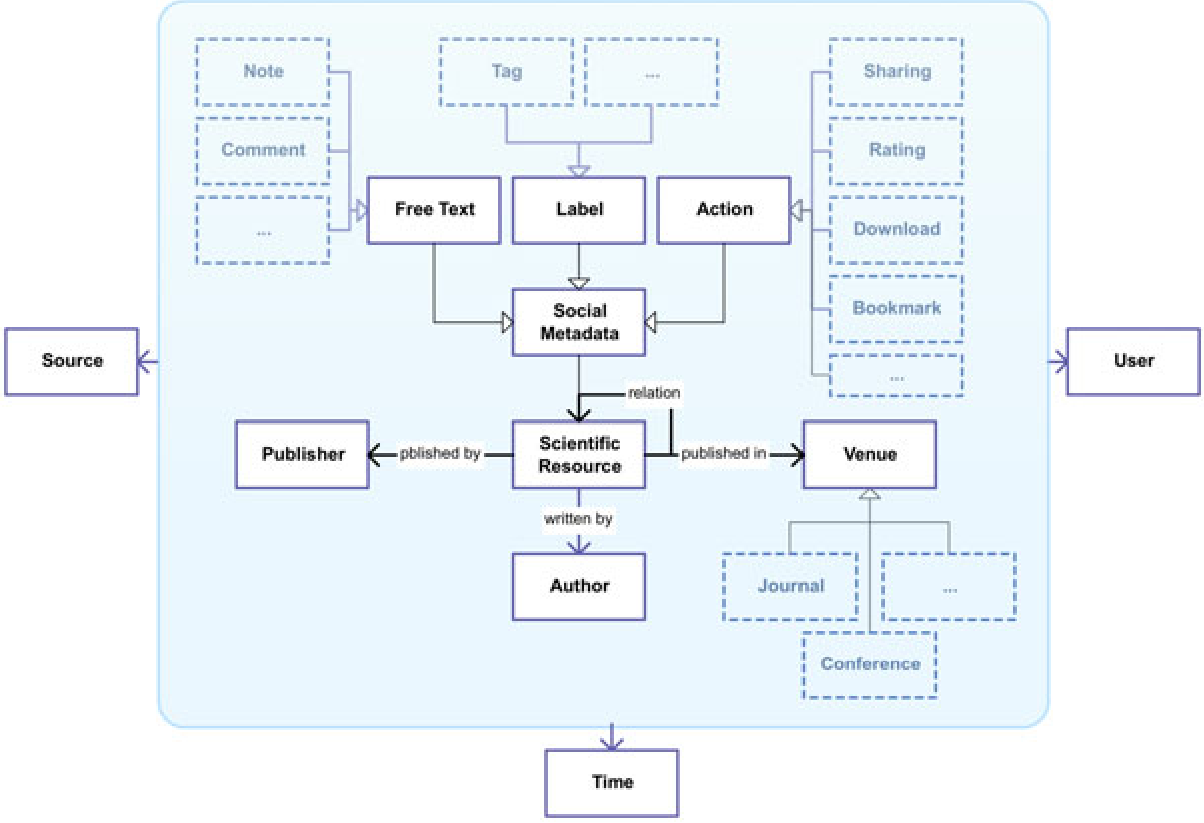
The model categorizes social data into three distinct types:
- FreeText: Unstructured comments and notes.
- LabelText: Classifications like user-generated tags.
- Action: Quantifiable behaviors such as "liking," "bookmarking," or "downloading."
2. Architecture: Warehouse vs. On-Demand
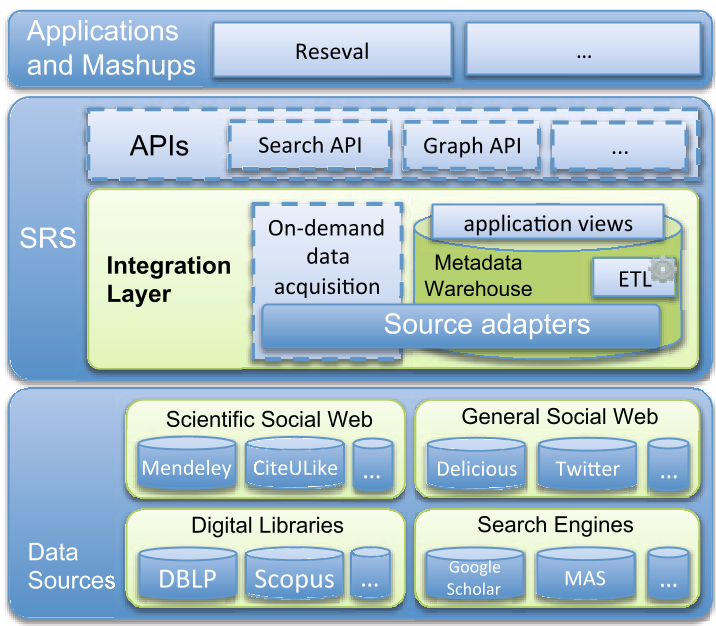
The SRS platform employs a hybrid integration strategy:
- The Metadata Warehouse: Follows a traditional ETL (Extract, Transform, Load) workflow. It gathers data, cleans it (deduplication is a major challenge here), and stores it in application-specific views for high-performance impact evaluation.
- On-Demand Acquisition: For tasks like metasearch, the system queries source APIs in real-time, mapping results to the SRS model on the fly. This ensures the data is "fresh," though it limits the complexity of the ranking algorithms.
Experimental Insights: Search Performance
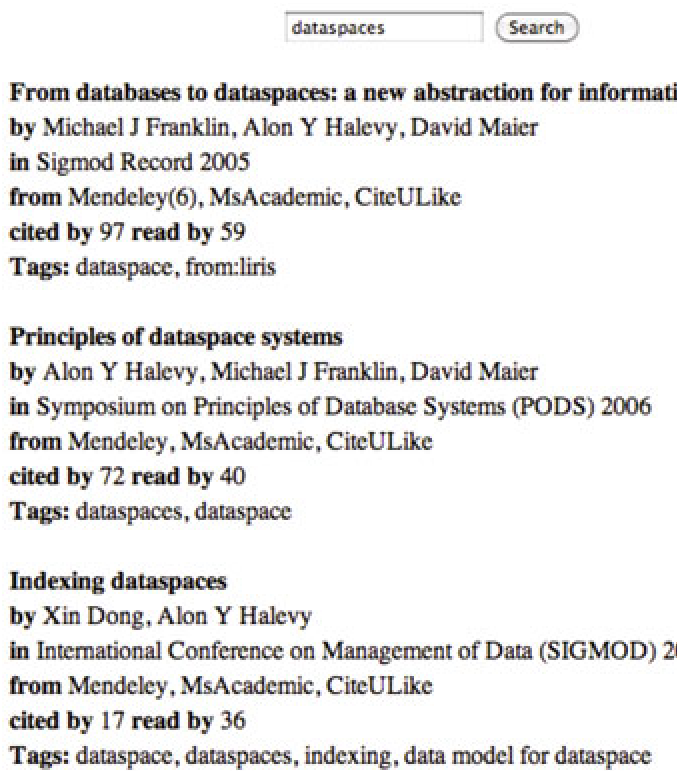
The authors validated their approach by building a metasearch prototype. When searching for highly-cited papers, they observed a "social amplification" effect.
- Result Merging: The system could identify that 6 entries in Mendeley and 2 in CiteULike referenced the same core publication.
- Data Augmentation: By merging these, a user sees the formal citation count (from MSAS) side-by-side with real-world usage (readership counts from Mendeley).
Critical Analysis & Conclusion
This work highlights a critical shift in Scientometrics. The value of the SRS lies in its ability to handle heterogeneity—reconciling the high-quality, human-curated data of DBLP with the "noisy" but high-volume data of Social Networking Services.
Limitations:
- Latency: Real-time integration (On-demand) is inherently slower than local warehouse queries.
- Algorithm Control: When using APIs, the system is at the mercy of the source's original ranking logic.
Future Outlook: The next frontier is the development of hybrid metrics. Imagine a ranking algorithm that weighs a "download" today as a leading indicator of a "citation" two years from now. The SRS framework provides the necessary infrastructure to make these predictive metrics a reality.