
IDKL: Breaking the Cycle of Failed Software Process Improvements through Double-Loop Learning
Integrative Double Kaizen Loop (IDKL): Towards a Culture of Continuous Learning and Sustainable Improvements for Software Organizations
This paper introduces the Integrative Double Kaizen Loop (IDKL), a multi-dimensional model that synthesizes Lean's Kaizen philosophy with organizational learning theories (Double-loop learning and Reflective Practice) for software organizations. Tested over three years with 231 participants, IDKL achieves SOTA-level operational improvements, including a 137% increase in Process Cycle Efficiency and a 46% reduction in Lead Time.
TL;DR
Software Process Improvement (SPI) often hits a wall because it treats cultural and social problems with rigid engineering tools. The Integrative Double Kaizen Loop (IDKL) model breaks this cycle by merging Lean’s continuous improvement (Kaizen) with organizational learning. Over a 3-year longitudinal study, this method didn't just "fix" processes; it tripled learning time and slashed lead times by nearly half by making "questioning the status quo" a daily reflex.
The "Sustainability Gap" in Software Engineering
Most software organizations treat improvement like a project: you run a "Kaizen Event," fix a bottleneck, and go back to work. But soon, the old habits creep back.
The authors identify a critical insight: Software development is a social-technical endeavor. Prior SPI attempts (like CMMI or Six Sigma) fail because they ignore the "Theory-in-Use"—the hidden mental maps that actually dictate how engineers behave. To fix the process, you have to fix the learning mechanism of the human beings running it.
Methodology: The Five Pillars of IDKL
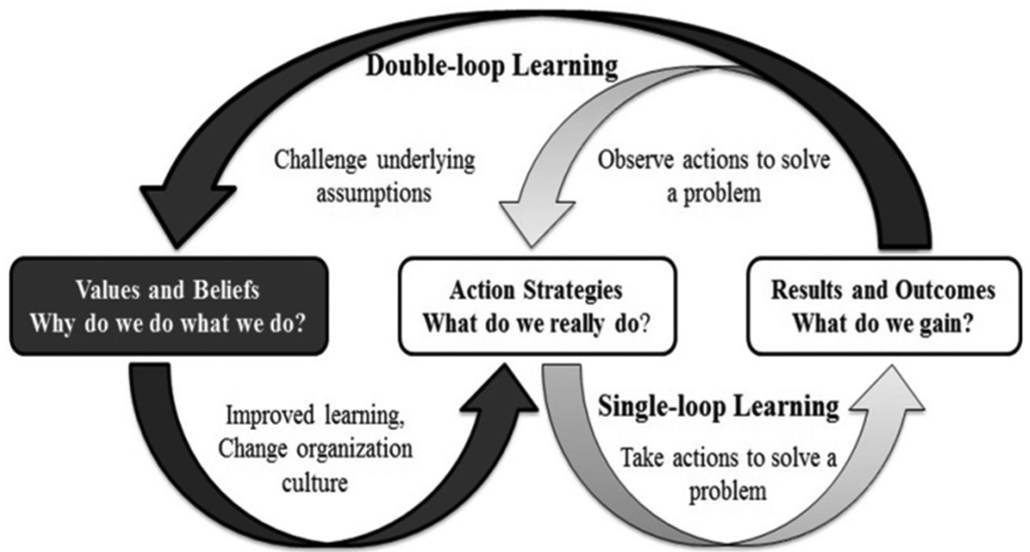
The IDKL model is not a simple checklist; it is a self-reinforcing loop designed to trigger Double-Loop Learning. While single-loop learning focuses on "doing things right" (fixing errors), double-loop learning asks, "Are we doing the right things?"
The Model Architecture
The IDKL integrates five critical components to ensure improvements stick:
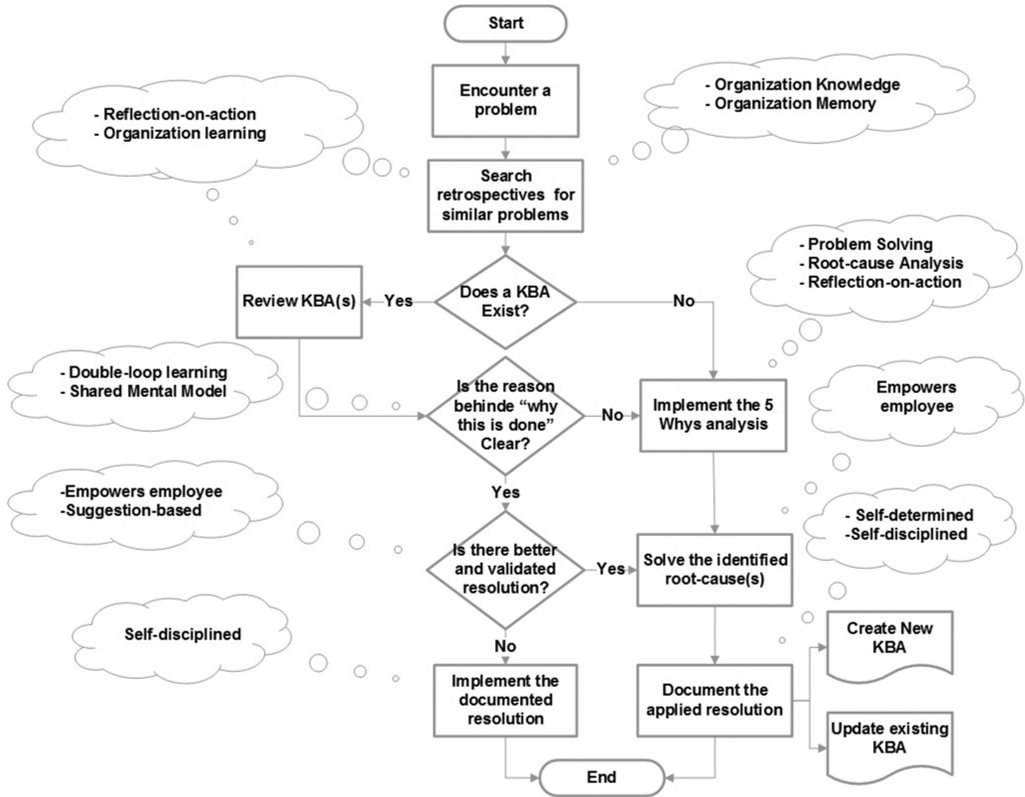
- Double-Loop Learning: Questioning the governing values and policies, not just the outputs.
- Reflective Practice: Using "Reflection-in-action" (thinking on your feet) and "Reflection-on-action" (post-mortems).
- The 5 Whys: A simple yet powerful tool to drill down to the cultural root cause of a failure.
- Self-Determined Standards: Replacing rigid top-down rules with Knowledge Base Articles (KBAs) that engineers update themselves.
- Evaluation via GQM: Using the Goal-Question-Metric approach to ensure data remains objective.
From "Fixing" to "Learning": A Real-World Shift
The paper details an enlightening case: a team struggling with slow response times in a Records Management System. Initially, the team tried to fix it with a "Search Guide" (Single-loop: "The users are doing it wrong"). Using the 5 Whys, they eventually questioned their own core tech stack—Apache Lucene—and realized the underlying technology itself was the mismatch (Double-loop: "Our assumptions about the tool were wrong").
Experimental Results: The Proof is in the Data
The study categorized teams into Beginners, Intermediates, and Advanced based on their maturity with the IDKL model. The results indicate that the "Ubiquitous Kaizen" approach far exceeds the benefits of temporary events.
Key Performance Gains:
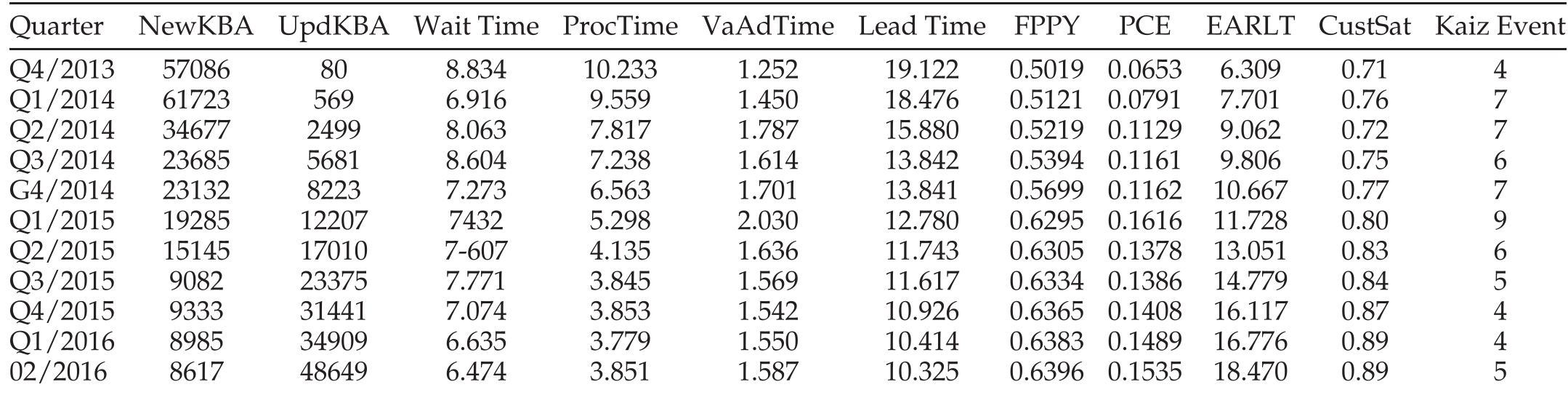
- Process Cycle Efficiency (PCE): Jumped from 6.5% to 15.4% (a ~137% relative increase).
- Lead Time: Reduced by 46%, accelerating value delivery to customers.
- Learning Habit: The average time spent learning/updating knowledge (EARLT) rose from 6.3 to 18.5 hours, proving the culture had shifted from "rushing to deliver" to "learning to excel."
The Causality Chain
Using Temporal Causal Modeling, the authors proved that the act of Updating KBAs (UpdKBA)—as opposed to just creating new ones—was the primary driver for improved yield and efficiency. This proves that maintaining and refining organizational memory is more valuable than simply accumulating it.
Critical Insight & Conclusion
The IDKL model suggests that the ultimate "standard" in software development is not a static document but a living organizational memory.
Takeaway for Tech Leaders: If you want sustainable improvement, stop mandating processes. Instead, empower your teams to question why your current policies exist, provide them with a structured way to capture "Aha!" moments (Reflective Practice), and measure success not just by features shipped, but by the health of your team's collective knowledge.
Limitations: The study acknowledges that the results might be influenced by context-specific factors of the host organization (ORGUS). Replicating these social gains requires high management buy-in and a psychological "safety net" for employees to challenge existing power structures.