
Decoupling Constraints: Efficient Integrity Validation in DL-Lite R Ontologies via Rewriting
Integrity Constraint Validation in DL-Lite $$_R$$ Based Ontology Using Rewriting
The paper introduces a novel integrity constraint (IC) validation framework for DL-Lite R based ontologies in social computing. It converts IC axioms into conjunctive queries and employs a query rewriting mechanism to reduce validation to efficient query evaluation over the ABox, achieving significant performance gains over traditional consistency-based methods.
TL;DR
In the realm of social computing and the Semantic Web, data "correctness" is often compromised by user-generated labels. This paper introduces an Integrity Constraint (IC) validation mechanism for DL-Lite R ontologies that uses Query Rewriting to enforce database-like constraints within the Open World logic of Description Logics. By converting constraints into reformulated conjunctive queries, it achieves a 100x speedup over traditional consistency-checking methods.
The Motivation: When Logic Meets Database Rigor
Description Logics (DL), the foundation of OWL, operate under the Open World Assumption (OWA)—if something isn't explicitly stated, it's considered "unknown" rather than "false." While great for the web, this is a nightmare for data integrity. If a WeChat group has a "max 500 members" rule, we need a Closed World Assumption (CWA) to say "if more than 500 are not found, it is invalid."
Existing solutions often fail in one of two ways:
- Expressivity vs. Reasoning: They introduce non-monotonic logic that breaks standard DL reasoners.
- The "Reasoning Gap": Methods like Tao et al. use SPARQL queries directly on the ABox, but they ignore the TBox (schema). If the schema implies a fact that satisfies a constraint, a simple SPARQL query will miss it and flag a false violation.
Methodology: The Power of Rewriting
The authors bridge this gap by transforming IC validation into a Conjunctive Query (CQ) answering problem.
1. Translation to UCQ
First, IC axioms (expressed in the highly expressive SROIQ logic) are translated into a Union of Conjunctive Queries (UCQ). Crucially, these queries use "Negation as Failure" (not). For example, a constraint saying "Every Professor must teach a Student" is transformed into a query looking for "Professors who do not teach anyone known to be a Student."
2. Query Rewriting (The Core Innovation)
To account for the TBox without performing full-blown reasoning during validation, the authors use Rewriting Rules. These rules take a query and a TBox , and produce a new query that encompasses all individuals that could satisfy the original query based on the schema's inferences.

The translation logic ensures that if the answer to the rewritten query over the ABox is empty, the Integrity Constraint is satisfied.
Experimental Performance
The authors evaluated their approach using the Lehigh University Benchmark (LUBM). The results highlight a massive disparity in efficiency:
- Consistency-based validation: Time complexity grows exponentially or cubically with data scale. For the
Onto4dataset, it took over 10,000 ms. - Rewriting-based validation (This paper): Validation time remained remarkably flat, staying under 100 ms even as the ABox size scaled to thousands of assertions.
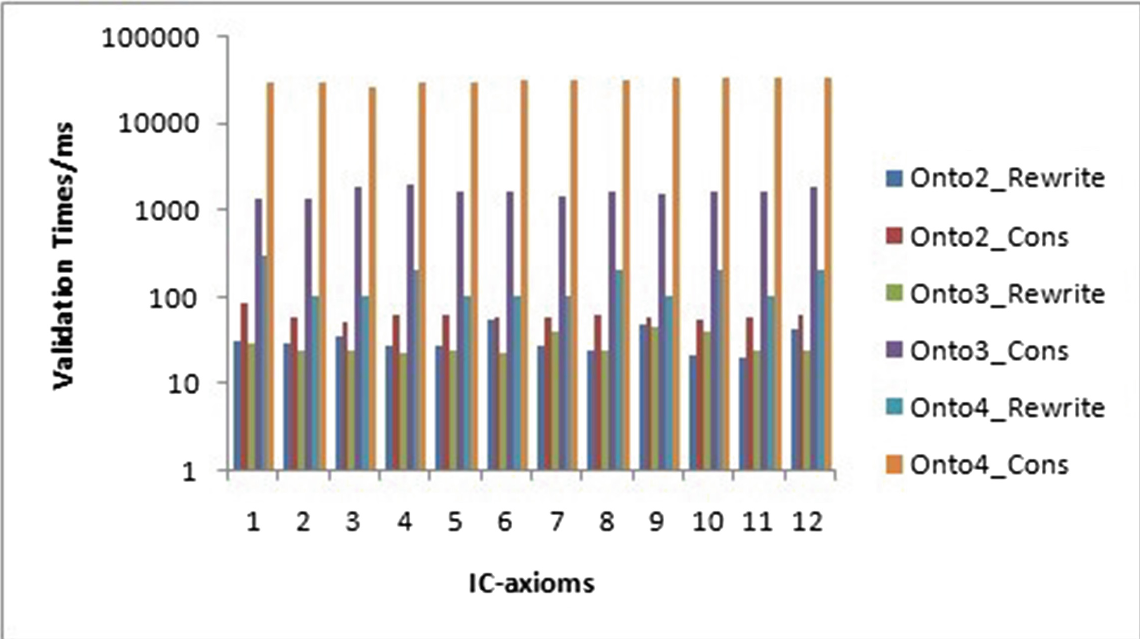 (Note: Figure 1 illustrates the efficiency gap where 'Onto Rewrite' significantly outperforms 'Onto Cons' across all datasets.)
Deep Insights & Critical Analysis
The brilliance of this approach lies in its computational economy. By moving the "reasoning" heavy-lift from the validation phase to a pre-processing rewriting phase, it allows the actual check to be performed by standard, highly-optimized Relational Database Management Systems (RDBMS).
Key Takeaways:
- Decoupling Is Key: By treating ICs as queries rather than logical axioms, we can maintain the standard DL reasoning for the domain while enforcing strict constraints for data quality.
- Scalability: This method is inherently more appropriate for "Social Computing" where data is massive and requires near real-time validation.
Limitations: The current framework focuses on DL-Lite R. While DL-Lite is perfect for data-intensive tasks, more complex ontologies (like those requiring recursion in the TBox) might result in very large rewritten queries, which could eventually impact performance.
Conclusion
This paper provides a robust bridge between the "flexible" Semantic Web and the "strict" requirements of data-centric social applications. By leveraging query rewriting, the authors have shown that we don't have to choose between logical inference and high-performance data validation—we can have both.