
AES: Maximizing ROI in Mobile Data Stream Mining through Adaptive Ensembles
Intelligent Adaptive Ensembles for Data Stream Mining: A High Return on Investment Approach
The paper introduces the Adaptive Ensemble Size (AES) algorithm, an extension of Online Bagging (OzaBag) designed for efficient data stream mining. By dynamically adjusting the number of base learners based on real-time memory fluctuations, AES achieves a high Return on Investment (ROI) and maintains state-of-the-art accuracy in resource-constrained environments.
TL;DR
In the world of online learning, the "more is better" philosophy regarding ensemble sizes often leads to diminishing returns and wasted memory. This paper introduces the Adaptive Ensemble Size (AES) algorithm. By linking ensemble size to memory consumption—a proxy for concept drift—AES provides a high Return on Investment (ROI), delivering competitive accuracy while drastically reducing the computational footprint.
Context: Why "Pocket" Mining is Different
The surge of "Pocket Data Mining" (Big Data on small devices) has shifted the focus from pure accuracy to resource efficiency. In environments like network traffic monitoring or telemedicine via mobile sensors, memory is a finite luxury. Previous SOTA methods like OzaBag or OzaBagADWIN typically rely on a fixed number of base learners, which creates a massive bottleneck when running on mobile hardware.
The Core Intuition: Memory as a Signal
The authors identified a critical physical intuition: Memory change is a bellwether for concept drift.
- In stable streams: Models (like Hoeffding Trees) reach a plateau in size because the data distribution is consistent.
- During concept drift: Models attempt to expand and create new splits to account for new data patterns, causing a spike in memory usage.
By monitoring these shifts, the AES algorithm treats memory utilization as a feedback loop to decide whether to spawn new base learners or prune existing ones.
Methodology: The AES Workflow
The AES algorithm extends the standard Online Bagging approach with a dynamic control logic:
- Initialize: Start with a baseline ensemble (e.g., 10 learners).
- Monitor: Capture the average memory size () of the ensemble in the previous window and compare it to the current size ().
- Adjust:
- If (Memory increasing): Add a new model to handle potential drift.
- If (Memory decreasing/stable): Remove a model to save resources.
- Bound: Maintain the ensemble within a safe range (e.g., 10 to 25 learners) to prevent total collapse or resource exhaustion.
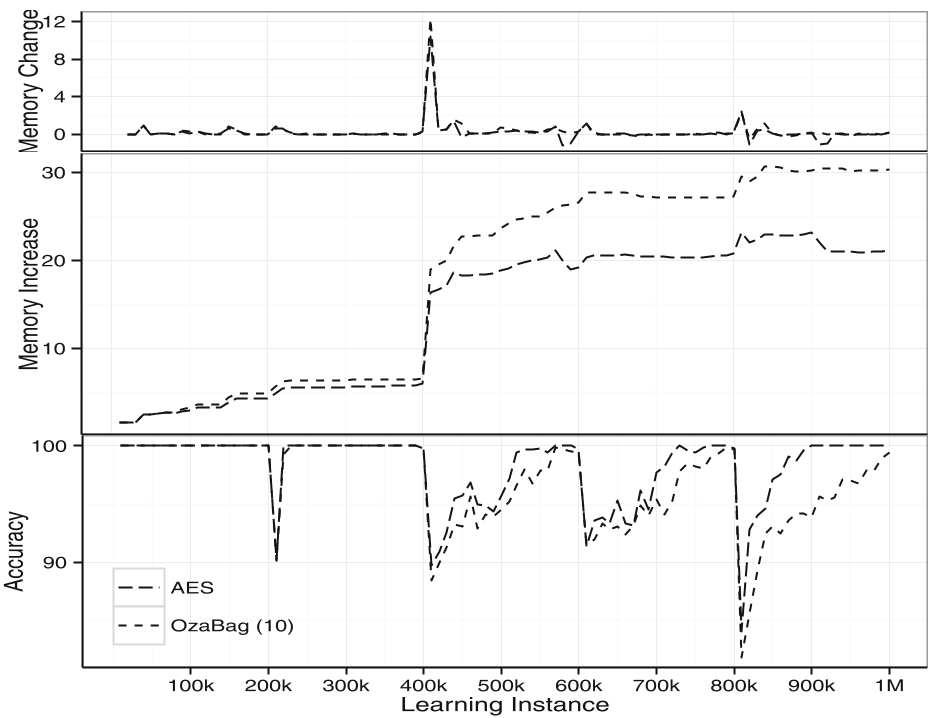 Fig 1: Evidence of memory spikes during induced concept drift at regular intervals.
Experiments: Performance vs. Efficiency
The researchers tested AES against standard OzaBag configurations across six diverse datasets.
1. The ROI Advantage
The most striking result is the ROI comparison. ROI is calculated as the change in accuracy divided by the computational cost (RAM-Hours). AES consistently achieved the highest ROI across all tests, often doubling or tripling the efficiency of static models.
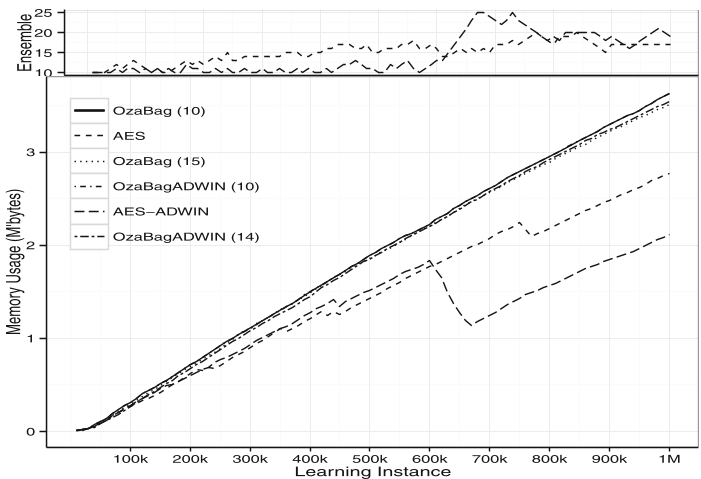 Fig 2: Memory Plot for KDD Dataset showing AES (Red) maintaining a significantly lower footprint than high-capacity ensembles.
2. Accuracy Retention
Crucially, this efficiency does not come at the cost of performance. As shown in the table below, AES (with an average size of ~14 base learners) performs on par with OzaBag configurations using significantly more resources.
| Dataset | AES Kappa | OzaBag (Default) | AES ROI | OzaBag ROI |
|---|---|---|---|---|
| KDD'99 | 88.64 | 88.04 | 1.72 | 0.65 |
| Poker | 89.05 | 88.72 | 4.02 | 2.23 |
| IMDb | 88.44 | 87.85 | 1.35 | 0.80 |
Deep Insight: Beyond Static SOTA
The real contribution of this paper is the move away from static hyperparameterization. In traditional ML, we choose an ensemble size (e.g., ) and hope it fits. In streaming data, the "optimal" size is moving. AES proves that a dynamic, heuristic-driven ensemble can outperform a brute-force ensemble by remaining agile.
Limitations and Future Outlook
While AES is efficient, it relies on memory usage as its primary signal. In environments with high stochastic noise, memory fluctuations might trigger unnecessary ensemble changes (false positives for drift).
Future research directions indicated by the authors include:
- Energy-Awareness: Measuring actual battery drain on mobile devices.
- Hybrid Strategies: Combining memory-based triggers with label-based change detectors (like ADWIN) for more robust drift identification.
- Seasonal Prediction: Using memory patterns to predict recurring future resource needs.
Conclusion
The AES algorithm offers a "High Return on Investment" approach that is essential for the next generation of IoT and mobile intelligence. It proves that by listening to the hardware (memory usage), algorithms can become better at learning the data.