
Intelligent Cache Pollution Attacks Detection: Defending the Edge with Adaptive HMM
Intelligent Cache Pollution Attacks Detection for Edge Computing Enabled Mobile Social Networks
This paper proposes an intelligent detection framework against Cache Pollution Attacks (CPAttacks) in edge-enabled Mobile Social Networks (MSNs) using Hidden Markov Models (HMM). By integrating content request rates and cache missing rates as dual-parameter states, the method effectively identifies both explicit and hidden attacks, achieving significantly higher detection ratios and lower error rates compared to conventional single-metric schemes.
TL;DR
Edge caching is the backbone of modern Mobile Social Networks (MSNs), but it's under threat from Cache Pollution Attacks (CPAttacks). This paper introduces a sophisticated detection framework using Hidden Markov Models (HMM) and Adaptive HMM (AHMM). By monitoring both request rates and cache missing rates, the system can unmask "Hidden" attackers who deliberately keep a low profile to avoid traditional detection.
The Evolution of the Threat: From Explicit to Hidden
In a standard MSN environment, edge devices use algorithms like LRU (Least-Recently Used) to cache popular content. Attackers disrupt this by flooding the cache with unpopular "trash" content.
- Level-1 (Explicit): Mass requests that spike the traffic. Easy to spot.
- Level-2 (Hidden): This is the real challenge. Smart attackers request unpopular content at low rates that blend in with normal traffic, silently "polluting" the cache and forcing legitimate users to fetch data from remote providers, increasing latency.
The authors argue that looking at Request Rate alone is no longer enough; we must also analyze the Cache Missing Rate to see the "hidden" damage.
Methodology: Seeing the Unseen via Dual-State HMM
The core innovation lies in treating the cache status as a hidden state that can be inferred from observable metrics. The authors define the observation as a 2D vector:
1. The HMM Framework
For stable environments, a continuous multi-dimensional Gaussian Mixture Model (GMM) is used within the HMM to model the probability distribution of these states.
(Note: The paper utilizes Algorithm 1 to perform EM-based parameter learning for the initial transition matrix and observation density .)
2. Adaptation to Dynamics (AHMM)
Social network traffic isn't static; it changes from day to night. Static HMMs would trigger false alarms. The Adaptive HMM (AHMM) uses a sliding window and a t-test method to check for statistical deviations. If the current environment shifts significantly from the trained model, the AHMM retrains itself on the fly.
Experimental Results: Precision Matters
The proposed scheme was tested against two major baselines: CRRDS (Request Rate based) and CMRDS (Miss Rate based).
- Detection Ratio: The HMM/AHMM approach consistently identifies more attacks across varying intensities (0.3 to 0.7). While single-metric schemes fail when attackers mask their behavior, the dual-metric approach catches the discrepancy.
- Error Ratio: False positives are minimized because the HMM learns the "normal" manifold of request patterns, rather than relying on a rigid threshold.
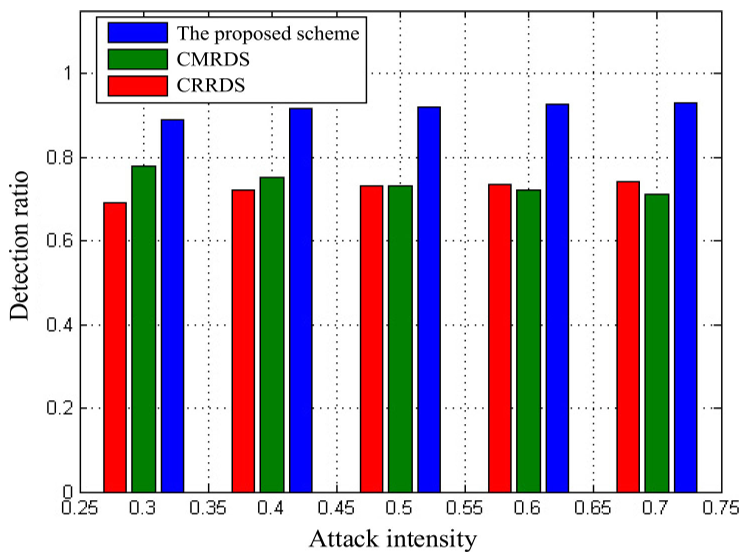 Fig 1. The HMM scheme achieves superior detection ratios compared to single-metric conventional models.
Critical Insight & Conclusion
The genius of this work is the physical intuition that Cache Pollution is at its heart a state-transition problem. Even if an attacker perfectly mimics the volume of a normal user, they cannot easily mimic the impact on the cache missing rate without requesting popular content (which would defeat the purpose of the attack).
Takeaway for Architects:
- Don't trust single metrics. Security at the edge requires cross-referencing performance metrics (Miss Rate) with traffic metrics (Request Rate).
- Adapt or Perish. In MSNs, "normal" is a moving target. Self-retraining mechanisms like AHMM are required for long-term deployment.
Future Outlook: The next frontier is mitigation—once detected, how do we surgically remove polluted content without dropping legitimate cold-start data? The authors point toward looking at "legitimate but unpopular" content as the next major classification challenge.