
The Intelligent Privacy Assistant: Bridging the Semantic Gap in Social Media Sharing
Intelligent Content-Based Privacy Assistant for Facebook
The paper introduces the Intelligent Privacy Assistant for Facebook, a proactive system that automates sharing permissions by analyzing the semantic content of posts. It leverages a novel Social Web Privacy Language (SWPL) and Named Entity Recognition (NER) to ensure sensitive information is only accessible to safe recipient groups.
TL;DR
Social media privacy is broken—not because we lack controls, but because the controls are too "dumb" to understand what we are posting. This paper presents a prototype that uses Named Entity Recognition (NER) and Answer Set Programming to read your Facebook posts, identify sensitive entities (Who, What, Where), and automatically suggest who should see them based on high-level logic.
The "Complexity vs. Utility" Privacy Paradox
Why do people share things they later regret? The authors argue that while Facebook provides fine-grained controls, the cognitive load required to use them is too high. Users must manually decide for every post which "list" or "circle" to include. Furthermore, standard controls are "content-blind"—they don't know the difference between a post about a generic activity and one containing a sensitive location or a private person's name.
Methodology: How the Assistant "Thinks"
The system moves beyond simple dropdown menus by introducing a pipeline that understands Social Context and Content Sensitivity.
1. The Semantic Pipeline (NER Ensemble)
To avoid the fragility of a single NLP model, the authors use an ensemble of NER tools (including Stanford and OpenNLP) via the GATE framework. They focus on the "Five W's" architecture:
- Who: People mentioned.
- Where: Locations.
- When: Dates/Times.
- What/Why: Activities and motivations.
2. Social Web Privacy Language (SWPL)
Traditional languages like EPAL weren't built for social graphs. SWPL allows users to write rules like: "Allow [Friends] to see [Activities] unless the [Location] is [Work]."
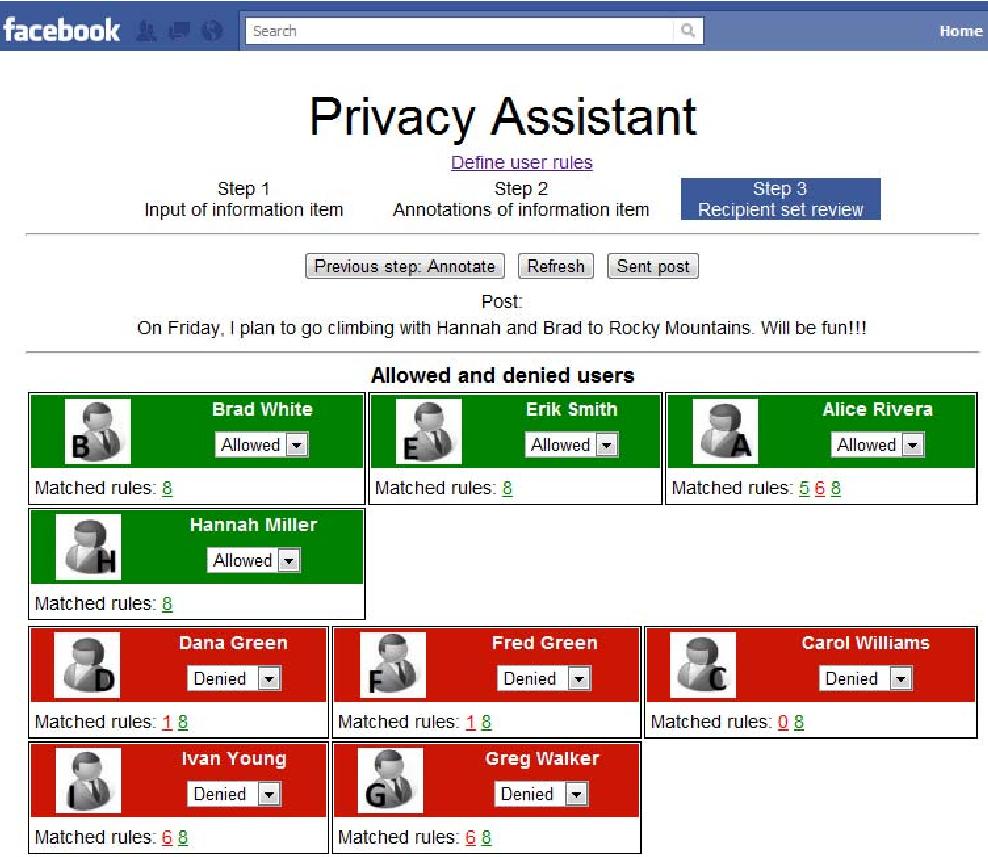 Figure 1: The Assistant's UI showing the recommendation of allowed (green) vs. denied (red) recipients based on post content.
3. Logic-Based Reasoning
The "brain" of the system is the DLV reasoner. Using Answer Set Programming, it can handle "non-monotonic reasoning"—meaning it can deal with exceptions to rules, which is exactly how human social boundaries work.
Experimental Validation
Testing social privacy is notoriously difficult due to a lack of public datasets (privacy about privacy!). The authors simulated a 10-node social network with 110 real-world status updates.
| Metric | Achievement |
|---|---|
| Correctly Allowed (Precision) | 95.2% |
| Correctly Denied (Recall) | 73.8% |
The higher "Allow" rate suggests the system is tuned to be user-friendly (avoiding false negatives that stop sharing), though the 73.8% denial rate indicates there is still a "leakage" risk where the NER might miss a subtle sensitive entity.
Critical Insight: Why This Matters Today
While this paper uses "classic" NLP (NER and ASP), the core philosophy is more relevant than ever in the age of Generative AI. The transition from "Manual Sorting" to "Policy-Based Intent" is the only way to scale privacy in an era where we share gigabytes of personal data daily.
Limitations & Future Work
- Subjectivity: One person's "sensitive" is another's "public." The authors acknowledge the need to learn policies from past behavior rather than forcing users to write code-like rules.
- Dataset Size: The 10-user trial is a "proof of concept." Real-world Facebook graphs with thousands of nodes would test the computational limits of the DLV reasoner.
Conclusion
The Intelligent Privacy Assistant proves that content-aware sharing is not just a luxury but a necessity for the future of the social web. By offloading the "who sees what" decision to an agent that understands the meaning of our words, we can finaly achieve the fine-grained privacy that platforms have promised but failed to make usable.