
Random Committee: Optimizing Real-Time Health Monitoring through Intelligent Feature Selection
Intelligent Decision Support for Real Time Health Care Monitoring System
The paper proposes an intelligent decision support framework for real-time healthcare monitoring using wearable sensors. By evaluating nine diverse classification algorithms (including J48, LMT, and Ensembles), it identifies the "Random Committee" model as the superior method for distinguishing between Normal and Abnormal medical states.
TL;DR
Researchers have developed a high-efficiency decision support system for hospital environments that monitors chronic patients via wearable sensors. By slashing the number of data features from 300 to just 6 and utilizing the Random Committee ensemble algorithm, the system achieves 95.03% accuracy and a near-perfect 0.984 ROC area, ensuring that medical emergencies are detected instantly with minimal false alarms.
Background & Motivation: The Data Deluge in WSNs
In modern healthcare, particularly for the elderly and those with chronic diseases, continuous monitoring is no longer a luxury—it’s a necessity. Wireless Sensor Networks (WSNs) provide a constant stream of vital signs (heart rate, blood pressure, etc.). However, the sheer volume of data is overwhelming.
The core challenge is dimensionality. In a typical hospital simulation involving 30 patients, researchers faced up to 300 simultaneous sensor readings. Processing every single data point in real-time is computationally expensive and introduces "noise" that leads to false alarms—the bane of any intensive care unit.
Methodology: From 300 Features to 6
The authors' approach revolves around a two-stage pipeline: Attribute Selection and Ensemble Classification.
1. Attribute Selection
Instead of feeding raw sensor data into the models, the researchers used an Attribute Evaluator with a Best First search method. This surgically removed redundant and irrelevant data, effectively identifying the 6 most predictive biomarkers (labeled as AK, CM, CP, CW, FJ, and KN in the study).
2. The Random Committee Advantage
The study compared nine base classifiers, including Decision Trees (J48), Logistic Model Trees (LMT), and Lazy learners (IBk). However, the standout was Random Committee.
- How it works: It’s a meta-classifier that builds an ensemble of base classifiers (like Random Trees) using different random seeds. The final prediction is an average of the individual estimates.
- The Intuition: Diverse "opinions" from multiple randomly initialized models reduce the variance that typically plagues single decision trees, making the system robust to the "jitter" often found in wearable sensor data.
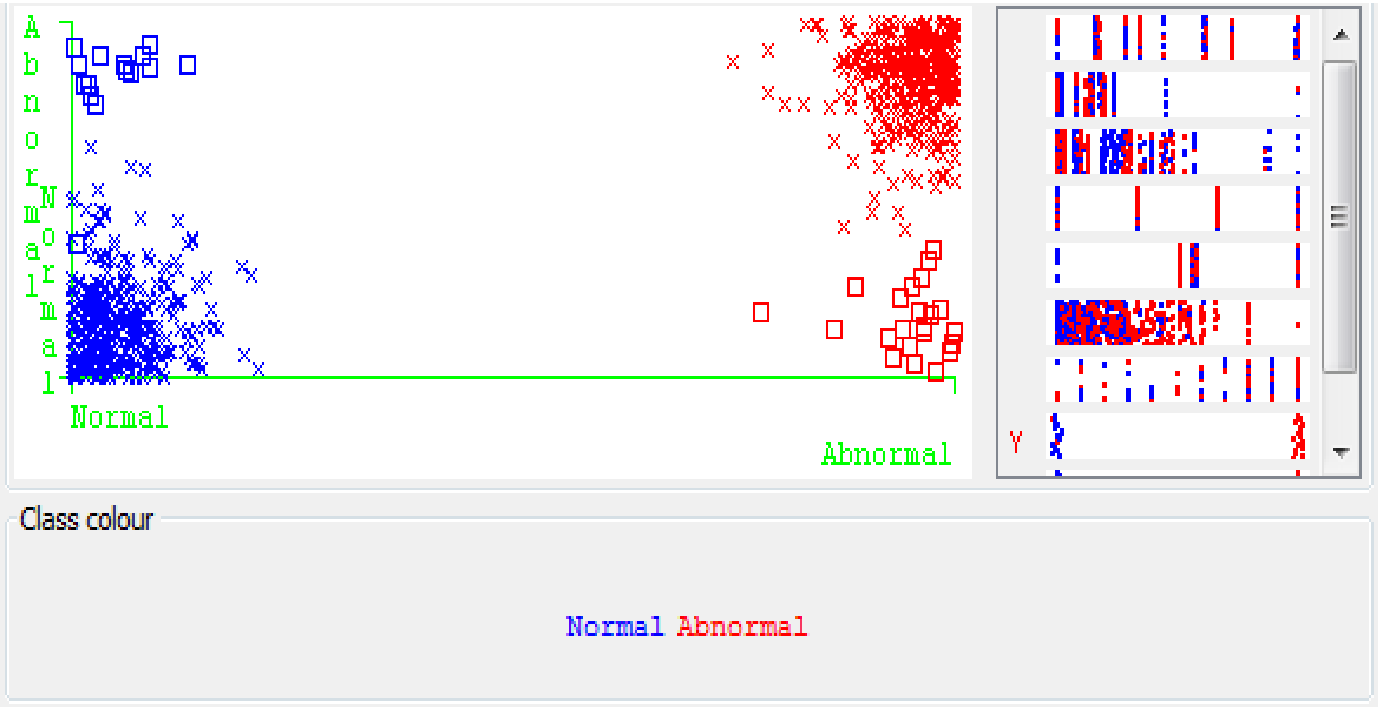 Fig 1. Classifier error visualization for Random Committee — effectively distinguishing Normal (blue) from Abnormal (red) states.
Experiments and SOTA Results
The framework was tested using a 10-fold cross-validation method on a simulated hospital dataset (modeled after Baraha Medical City).
Key Performance Metrics:
- Accuracy: Random Committee led the pack at 95.03%, followed closely by Random Forest (94.22%).
- Precision and False Alarms: The system achieved a precision of 0.957, meaning when the alarm sounds, it is almost certainly a genuine emergency. The false alarm rate was suppressed to a mere 3.8%.
- Reliability (ROC Area): The Random Committee achieved an Area Under the ROC curve of 0.984, indicating nearly perfect diagnostic separation between stable and critical patients.
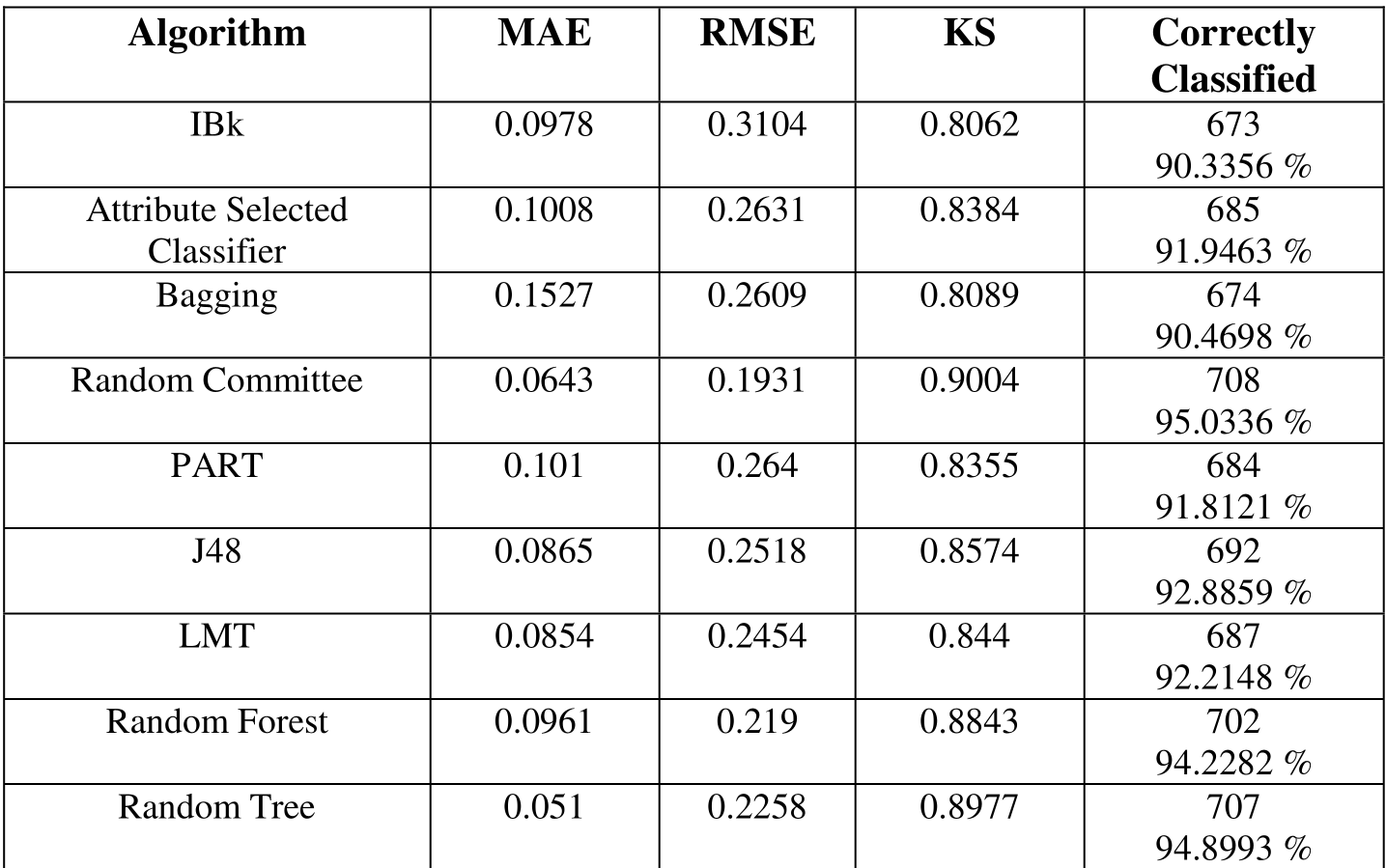 Table 1. Error metrics across algorithms. Note the superior Kappa Statistic and correctly classified instances for ensemble methods.
Critical Insight: Why Meta-Learning Wins
The study reveals an important trend: Simple classifiers (like IBk or J48) struggle with the inherent noise of physiological data. While IBk (Nearest Neighbor) is intuitive, it achieved the lowest accuracy (90.3%). By contrast, meta-learning algorithms like Random Committee provide an "Internal Regularization" effect. By combining several base models, the system filters out the idiosyncratic noise of individual sensors, focusing instead on the underlying clinical patterns.
Conclusion and Future Directions
The paper successfully demonstrates that "Less is More." By reducing the feature set by 98%, the researchers didn't just make the system faster—they made it more accurate.
Future Outlook:
- Hardware Integration: The next step involves deploying these lightweight 6-attribute models directly onto the Raspberry Pi or specialized wearable chips for "Edge Inference."
- Adaptive Learning: Future iterations could benefit from reinforcement learning to adapt the "Abnormal" threshold based on a specific patient's historical baseline, further personalizing healthcare monitoring.
Final Takeaway: For real-world IoT healthcare, the combination of aggressive attribute selection and ensemble meta-learning is the gold standard for creating reliable, real-time decision support systems.