
Ecoradar: Turning Environmental "Breath" into Intelligence for Human Counting
Intelligent Human Counting through Environmental Sensing in Closed Indoor Settings
This paper introduces a non-intrusive human counting system for closed indoor environments using environmental gas sensors (CO2, LPG, NO2, SO2) and weather parameters (temperature, humidity). By leveraging traditional machine learning and a custom CNN-based framework, the system achieves a 95% accuracy in estimating occupant counts even in unseen test scenarios.
TL;DR
Researchers have developed a way to count people in a room without using cameras or motion sensors. By monitoring changes in gases like Carbon Dioxide (CO2) and LPG alongside temperature and humidity, the Ecoradar system uses Deep Learning to achieve over 95% accuracy. This "hidden" sensing method is immune to visual tampering and works in total darkness.
Background: The Visibility Trap
In high-security zones—think bank vaults, armories, or private labs—traditional surveillance has a glaring weakness: visibility. If an intruder can see a camera or a PIR sensor, they can blind it, move it, or destroy it. Furthermore, light levels and privacy regulations often limit the effectiveness of vision-based AI.
The authors of this paper shift the paradigm from looking to sensing. By treating the indoor atmosphere as a data source, they detect the chemical "footprint" humans leave behind simply by breathing and existing.
The Problem & Motivation
Why is counting humans through gas so difficult?
- Low Correlation: While CO2 is a known proxy for occupancy, other gases like NO2 or SO2 have much weaker signals.
- Environmental Noise: Fans, air conditioners, and open windows create "spikes" and "drifts" in sensor data that can confuse standard algorithms.
- Data Scarcity: Unlike ImageNet, there aren't many massive datasets of "indoor gas levels with human ground truth."
Methodology: The Ecoradar Framework
The core of the work lies in a custom-built device and a sophisticated data pipeline.
1. The Hardware (Ecoradar)
The device integrates six gas sensors (CO, CO2, LPG, SO2, NO2, O3) and two weather sensors. Crucially, it was tested at low heights (ground level and 1m) to ensure it could be hidden under furniture while still effectively capturing gas diffusion.
2. Deep Learning Architecture
Moving beyond simple regression, the authors proposed a 1D Convolutional Neural Network (CNN). Unlike traditional machine learning that requires manual feature engineering, the CNN automatically learns the temporal relationships between different gas fluctuations.
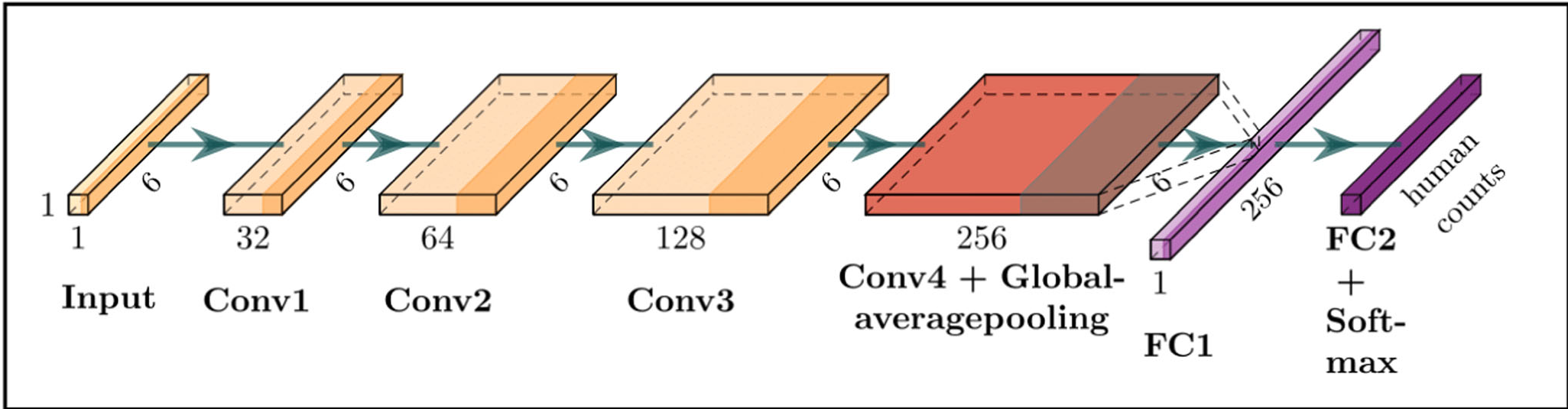
The model uses:
- 1x1 Kernels: To find relationships across different sensor channels at the same timestamp.
- Exponential Filter Scaling: Increasing from 32 to 256 filters to capture complex "fine-grained" features.
- Tanh Activation: Chosen over ReLU through rigorous hyperparameter tuning to better handle the specific range of normalized sensor fluctuations.
Experimental Results: Hidden but Highly Accurate
The system was tested across three different rooms with varying populations (up to 10 people).
SOTA Comparison
While traditional classifiers like Random Forest and IBK performed exceptionally well on localized data (99%), they struggled with generalization. The Deep Learning model proved its worth in "unseen" scenarios.

When trained on Rooms 1 and 3 and tested on the entirely unfamiliar Room 2, the model maintained a 95.7% accuracy. This demonstrates that the network isn't just "memorizing" one room's layout; it is learning a generalized biological signature of human presence.
The Privacy-Security Trade-off
The authors also verified that the device works equally well whether it is placed in plain sight or hidden behind objects. This confirms the system's utility for covert surveillance.
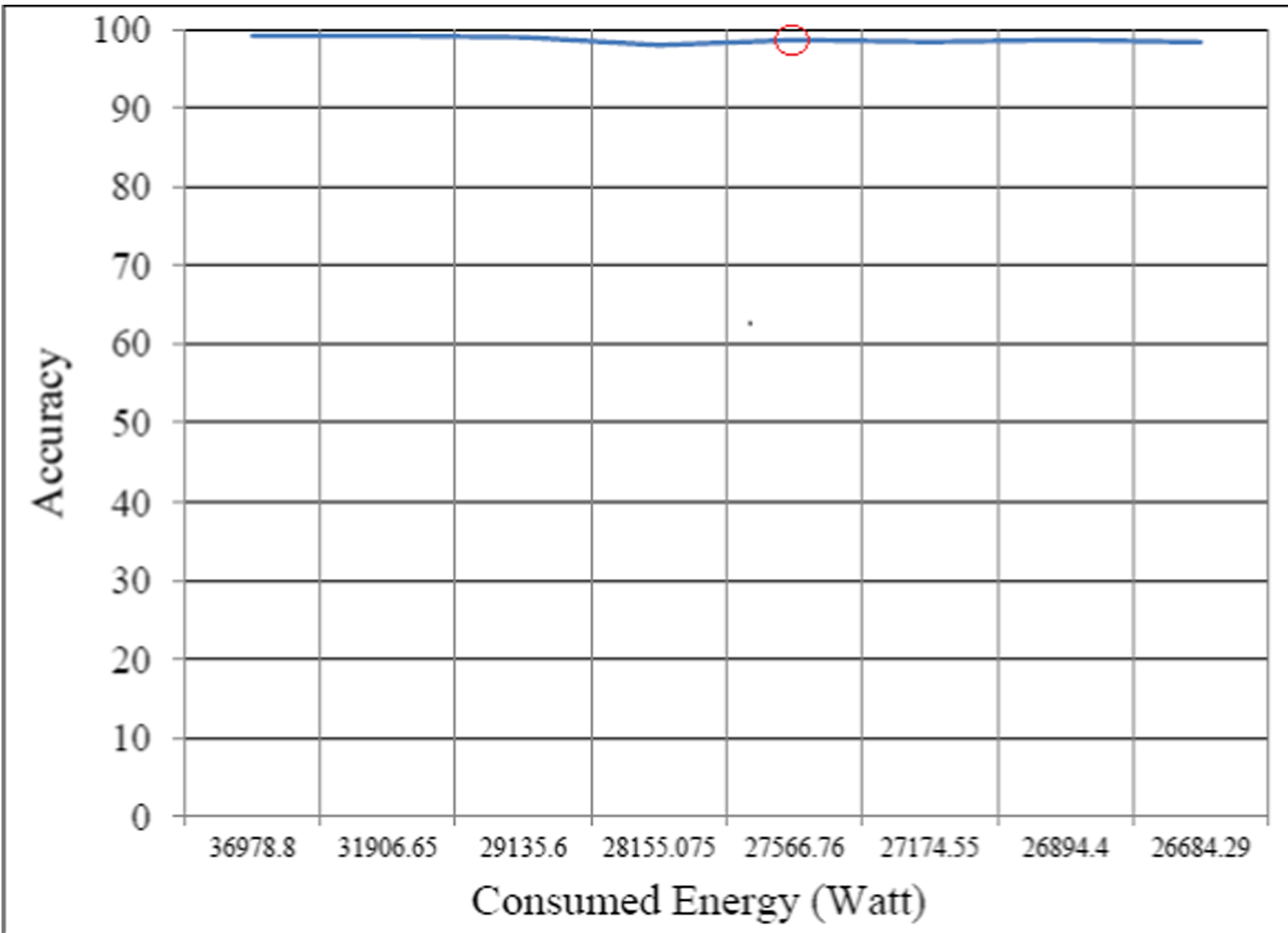
The confusion matrix shows nearly zero "high-error" counts (e.g., mistaking 1 person for 5), making it reliable for real-world security triggers.
Critical Insight & Conclusion
The true value of this research lies in its robustness to environmental constraints. By incorporating LPG and NO2—gases usually ignored in occupancy studies—the model gains multi-dimensional context that prevents false positives from simple things like a CO2 spike from a non-human source.
Limitations: The system currently works best in "closed" settings. As rooms become large (like hallways) or have high air exchange rates (open windows), the chemical signal dilutes.
Future Outlook: The next logical step, as noted by the authors, is the integration of Recurrent Blocks (LSTMs/GRUs) to capture the temporal flow of air, potentially allowing for even higher precision in open-plan offices or public transit hubs.
Summary Takeaway: Ecoradar proves that the air we breathe carries enough data to count us—offering a powerful, invisible tool for the next generation of smart, secure buildings.