
Intelligent IoT for Parkinson’s: Bridging the Gap Between Auditory Data and Disease Progression
Intelligent IoT Framework for Indoor Healthcare Monitoring of Parkinson’s Disease Patient
2020-09-03
Summary
Problem
Method
Results
Takeaways
Abstract
This paper proposes an intelligent IoT-based framework for remote indoor monitoring and progression analysis of Parkinson's Disease (PD). It combines a custom multi-priority communication scheduling algorithm with an XGBoost-based machine learning model to track PD progression using auditory biomarkers, achieving superior precision over existing benchmarks.
## TL;DR
Parkinson’s Disease (PD) is becoming a global pandemic with massive healthcare costs. This paper presents an end-to-end Solution: an **IoT framework** that schedules critical health data with sub-15ms latency and an **XGBoost machine learning model** that predicts disease severity using nothing but voice recordings. By achieving a significantly lower Mean Absolute Error (MAE) than previous SOTA models, this work paves the way for "at-home" clinical-grade monitoring.
## The Motivation: Moving Beyond the Clinic
Clinical diagnosis of PD is often a "snapshot" in time, failing to capture the daily fluctuations of the disease. While biometric markers exist, collecting them at scale is a networking nightmare. Current systems struggle with:
* **Traffic Heterogeneity**: Mixing low-bandwidth vitals with high-bandwidth audio data.
* **Network Reliability**: High "blocking probabilities" in emergency health events.
* **Prediction Sensitivity**: Traditional models struggle to map subtle vocal tremors to the complex Unified Parkinson Disease Rating Scale (UPDRS).
## Methodology: The Two-Pillar Approach
### 1. The Priority-Aware IoT Framework
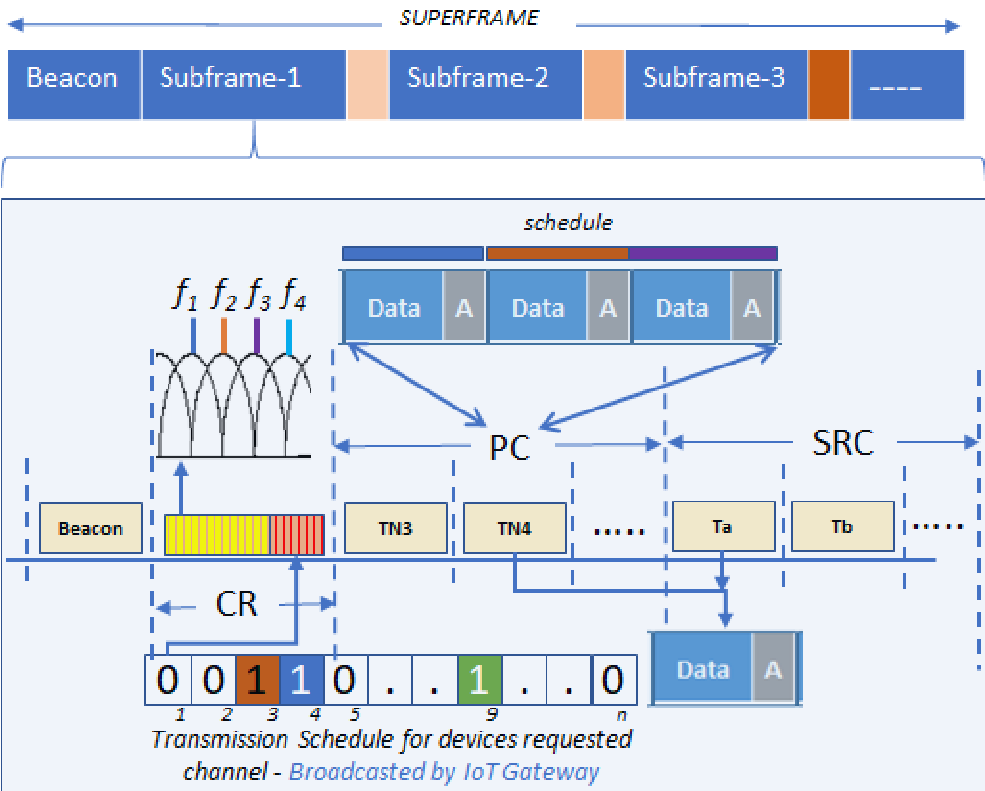
The authors designed a specialized **TDMA (Time Division Multiple Access)** structure. Unlike standard CSMA/CA which suffers from collisions, this framework uses **Superframes** divided into four specific slots:
* **Beacon**: Time synchronization.
* **Channel Request (CR)**: Where non-periodic sensors ask for access using unique orthogonal carriers.
* **Periodic Communications (PC)**: For vitals like heart rate.
* **Scheduled Requested Communications (SRC)**: For event-driven data.
### 2. Auditory Feature Engineering & XGBoost
The system extracts 16 **dysphonia measures**—including Jitter (frequency instability) and Shimmer (amplitude instability). These features are fed into an **Extreme Gradient Boosting (XGB)** regressor. The genius here lies in the loss function optimization, which reduces the deviation between the predicted values and the clinical "Ground Truth" (hospital-administered UPDRS tests).
## Results: Performance and Precision
### Networking Efficiency
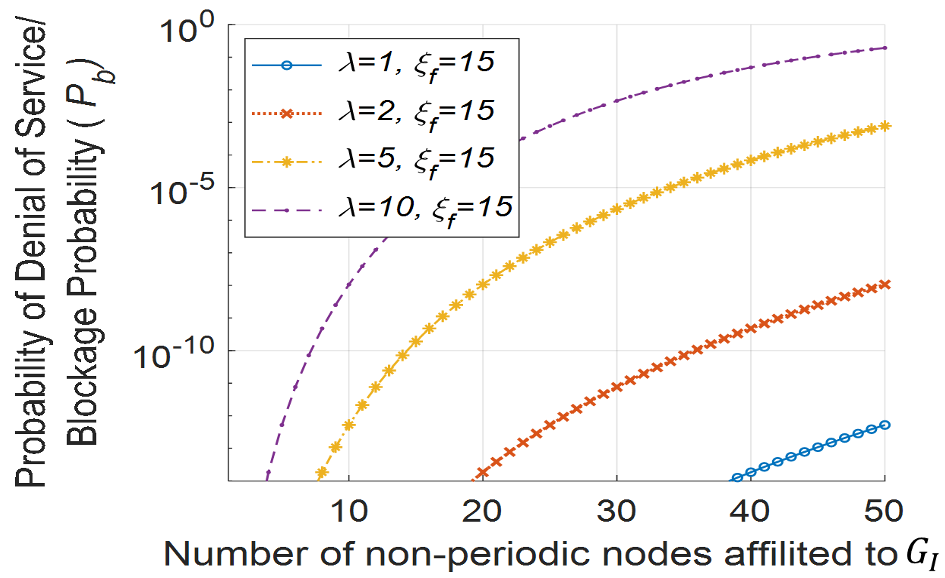
The system successfully handles up to **70 periodic nodes** while reserving 25% of the bandwidth for emergency bursts. For high-priority nodes, the average delay is suppressed to just **11ms**, meeting the strict requirements for emergency medical response.
### Clinical Accuracy
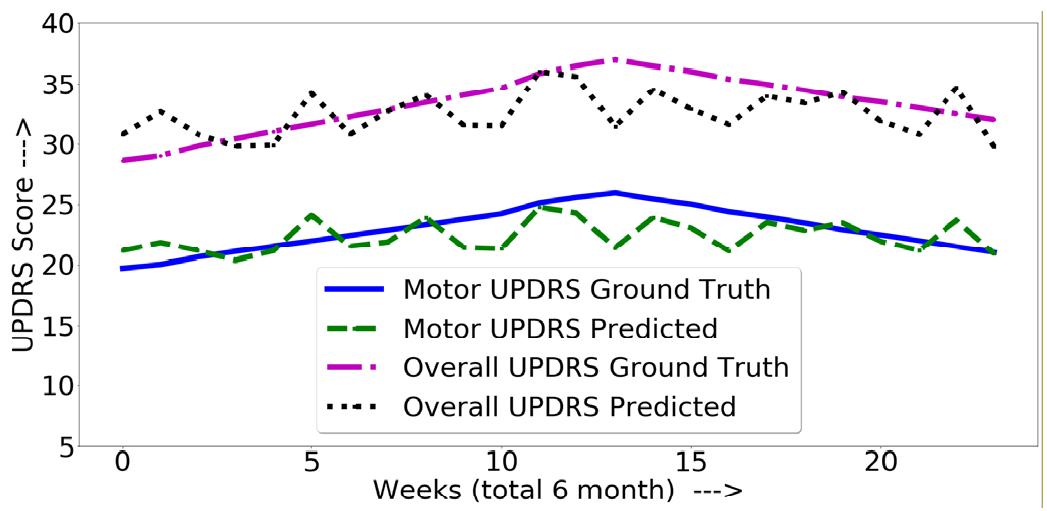
The XGB model achieved a **MAE of 5.09** for Motor UPDRS, a significant improvement over the baseline (Tsanas et al.). This proves that machine learning can "hear" the progression of the disease even when a human clinician might miss subtle changes.
## Critical Insight: Why it Works
Most IoT health studies fail because they ignore the physical layer of the network or use "off-the-shelf" ML models. This paper succeeds by:
1. **Physical/Link Layer Co-design**: Using orthogonal frequency bands to distinguish priority levels at the gateway.
2. **Algorithm Regularization**: Using XGBoost with specific L1/L2 regularization to prevent overfitting on the relatively small datasets (42 patients).
## Takeaway & Future Work
This work transitions PD care from "reactive" to "proactive." While the current focus is on voice, the architecture is designed for **Translational Learning**. Future iterations could integrate inertial sensors (accelerometers) to combine gait analysis with voice analysis, creating a 360-degree digital twin of the patient’s health.
---
*Keywords: IoT, Parkinson’s Disease, XGBoost, Remote Monitoring, UPDRS, Low Latency.*