
From Smart to Social: How Intelligent Painting Objects Redefine Children's Interaction in the SIoT Era
Intelligent Painting Based on Social Internet of Things
This paper introduces an "Intelligent Painting" device designed for children, built upon the concept of the Social Internet of Things (SIoT). It explores a human-object mixed social interaction model that integrates machine emotion and collaborative networking to transform traditional toys into "social things."
TL;DR
The Internet of Things (IoT) is evolving into the Social Internet of Things (SIoT). Researchers at Tsinghua University have developed an intelligent painting device that isn't just a tool, but a "social thing." By imbuing objects with human-like personalities (such as "naughty" or "lazy") and connecting them through emotional networks, the project allows children to "pick colors from the real world" and share them dynamically with parents and peers, turning digital data into emotional expression.
Problem & Motivation: The "Cold" Machine Problem
Current IoT devices are largely transactional—you give a command, and the machine executes it. This "machine-like" behavior lacks the nuances of human social dynamics. For children, who are highly sensitive to color and play, traditional painting tools and early smart toys fail because:
- Lack of Personality: They are perceived as static toys, not interactable companions.
- Isolation: Parents often cannot join the creative process if they are physically distant.
- Cognitive Barriers: Children find it hard to navigate complex interfaces to express their internal emotional states.
The authors' insight is that by applying Social Computing—which uses social theories to guide technology development—we can create objects that participate in human social networks as "pals" or "friends."
Methodology: The Three Models of Social Things
The paper breaks down the interaction into three core conceptual models:
1. The Emotional Link (Model I)
Instead of standard responses, objects display "human-like" traits. The device uses different LED patterns to mimic personalities:
- Naughty Way: The light flashes quickly or refuses to show the right color initially.
- Lazy Way: The light pulses slowly, mimicking a "yawn."
- Rebel Way: Showing the complementary color instead of the requested one.
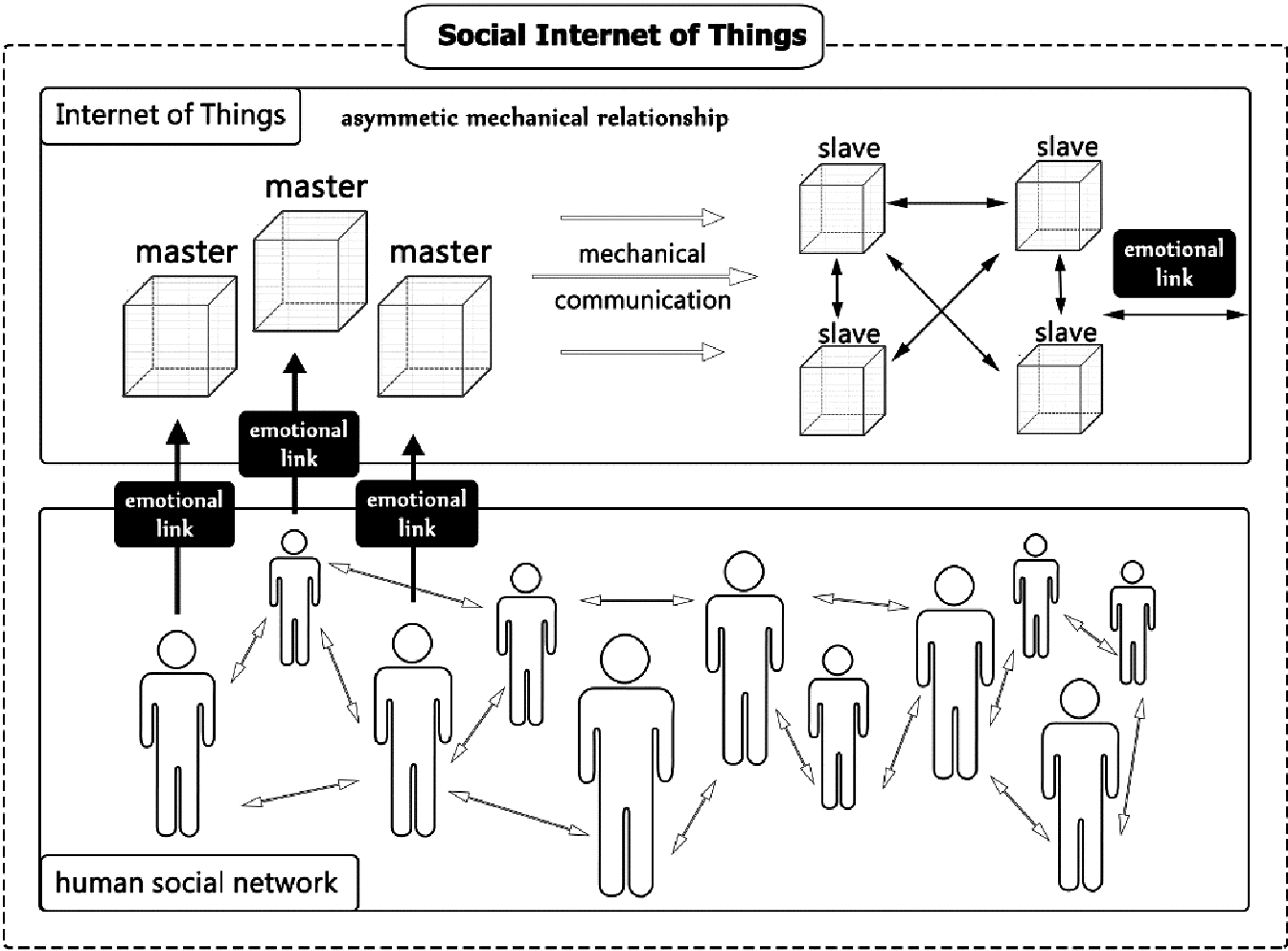
2. The Mixed Social Network (Model II)
This model integrates the rigid data network of machines with the emotional network of humans. When a child picks a color, it isn't just a hex code; it's a "feeling" that flows through the cloud to a parent's smartphone, allowing for a remote emotional exchange.
3. Master-Slave Social Coordination (Model III)
By using wireless communication (NRF), multiple children can use separate "color picking" sensors to influence a single "master" painting object. This encourages co-playing behavior, effectively using the object as a hub for human-to-human socialization.
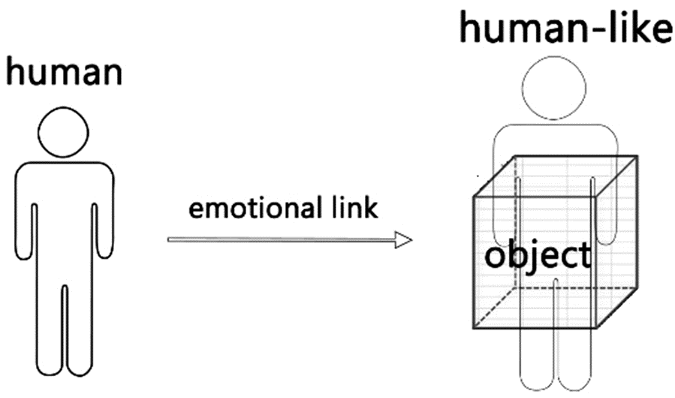 Above: Representation of the social link between humans and objects with emotion.
Implementation: "Superpower" Interaction
The authors implemented these models via an intelligent painting prototype. The "Superpower" interaction allows children to:
- Pick Color: Use a color sensor to "steal" a color from a real-world object (like an apple).
- Catch and Shoot: Using a natural user interface (NUI), children gesture to "grasp" the color and "shoot" it onto a target object, much like a superhero.
 Above: The hardware prototype for color picking and interactive display.
Experiments & Results: Validation of Emotion
The team tested the device with ten children and five parent-child pairs.
Key Findings:
- Attention Retention: Emotional modes like "Naughty" and "Passionate" significantly increased engagement compared to "Well-behaved" (standard) modes.
- Social Lubrication: The device acted as a "bond" for shy children, making it easier for them to communicate their inner feelings to parents via color choices.
- Collaborative Interest: Model III's co-painting feature naturally encouraged children to talk to one another, verifying that the object facilitates human-human communication rather than replacing it.
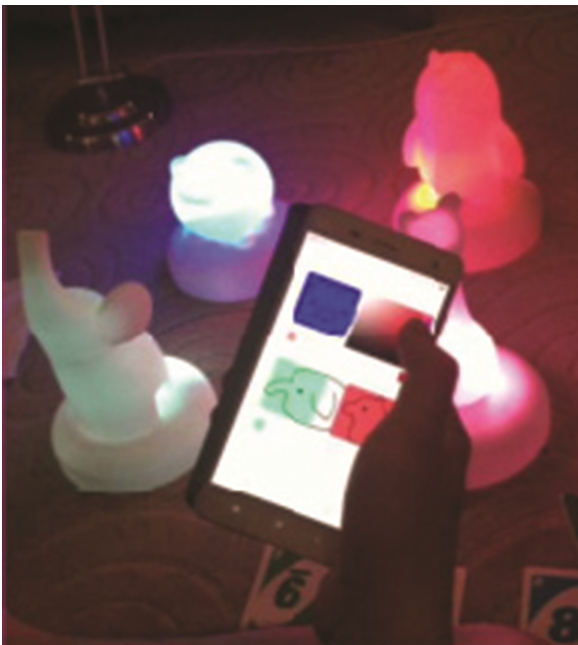 Above: Parent-child remote testing sessions.
Critical Analysis & Conclusion
Takeaway
This research shifts the focus of IoT from connectivity to sociality. It proves that the value of a "Smart Object" is not in its processing power, but in its ability to occupy a role in the human social hierarchy.
Limitations & Future Work
The authors honestly note that some emotional displays (like "Rebel way") can confuse children if not properly contextualized. Future work aims to make these objects even more autonomous—potentially detecting a human's sadness and "forming their own social networks" to provide comfort without direct prompting.
As we move deeper into the age of SIoT, the line between "tool" and "companion" continues to blur, with color and light becoming the new language of digital emotion.