
Intelligent Phishing Detection: Marrying Fuzzy Logic with Data Mining for E-Banking Security
Intelligent phishing detection system for e-banking using fuzzy data mining
This paper introduces an intelligent phishing detection system specifically for e-banking by integrating Fuzzy Logic with Data Mining classification algorithms. The model categorizes 27 phishing features into six criteria to accurately assess and rate the risk levels of suspicious websites.
TL;DR
Online banking fraud is a moving target. This paper presents a robust solution by combining the qualitative reasoning of Fuzzy Logic with the quantitative power of Data Mining. By analyzing 27 distinct phishing characteristics—from suspicious URLs to social engineering cues—the proposed layered model provides a granular risk score rather than a simple "Safe/Unsafe" binary, achieving classification accuracies up to 86.38%.
The "Fuzzy" Nature of Modern Scams
Traditional anti-phishing tools (like toolbars and blacklists) often fail because phishers are masters of ambiguity. A URL might be slightly too long, or a page might look mostly like a real bank. These are not "yes/no" variables; they are qualitative degrees of risk.
The authors identify that the average phishing site stays live for only 2.25 days, making static blacklists obsolete almost as soon as they are updated. The challenge is to build a system that can "think" like a security expert to catch brand-new, unseen attacks in real-time.
Methodology: The 3-Layer Fuzzy Inference System
The core innovation lies in treating phishing detection as a multi-criteria decision-making problem. The authors breakdown 27 components into six high-level criteria, organized into a hierarchical structure.
1. Feature Extraction & Weighting
The system doesn't treat all red flags as equal. It assigns weights based on empirical importance:
- Layer 1 (Weight 0.3): URL & Domain Identity (The most critical signal).
- Layer 2 (Weight 0.2 each): Security & Encryption; Source Code & JavaScript.
- Layer 3 (Weight 0.1 each): Page Style, Web Address Bar, and Social Human Factors.
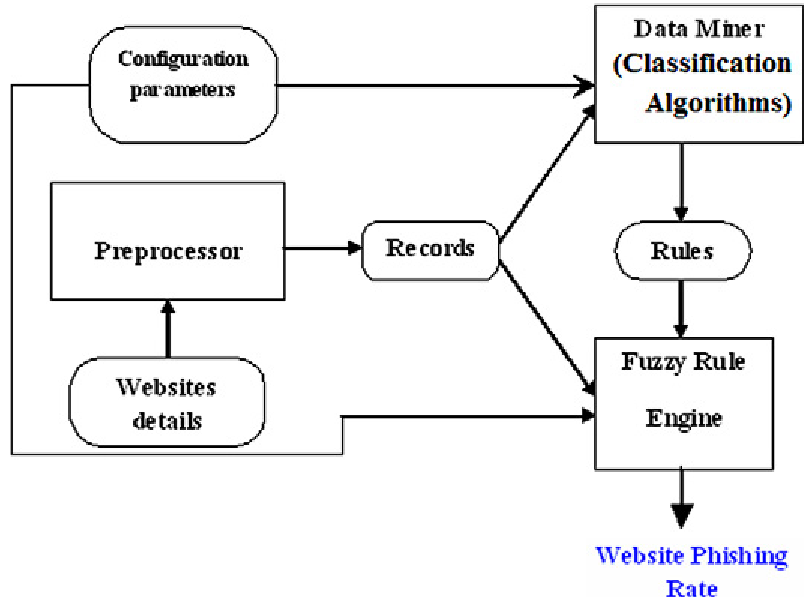
2. The Data Mining Engine
Instead of manually writing fuzzy rules (which is prone to bias), the authors used Data Mining algorithms (C4.5, PART, JRip) to discover patterns in datasets from APWG and PhishTank. These patterns were then converted into the "If-Then" rules that power the Fuzzy Logic engine.
Experimental Insights
The study puts various algorithms to the test using 10-fold cross-validation on a dataset of 1006 instances.
| Algorithm | Correctly Classified | Accuracy |
|---|---|---|
| PART | 869 | 86.38% |
| PRISM | 855 | 84.99% |
| C4.5 | 848 | 84.29% |
| JRip | 818 | 81.31% |
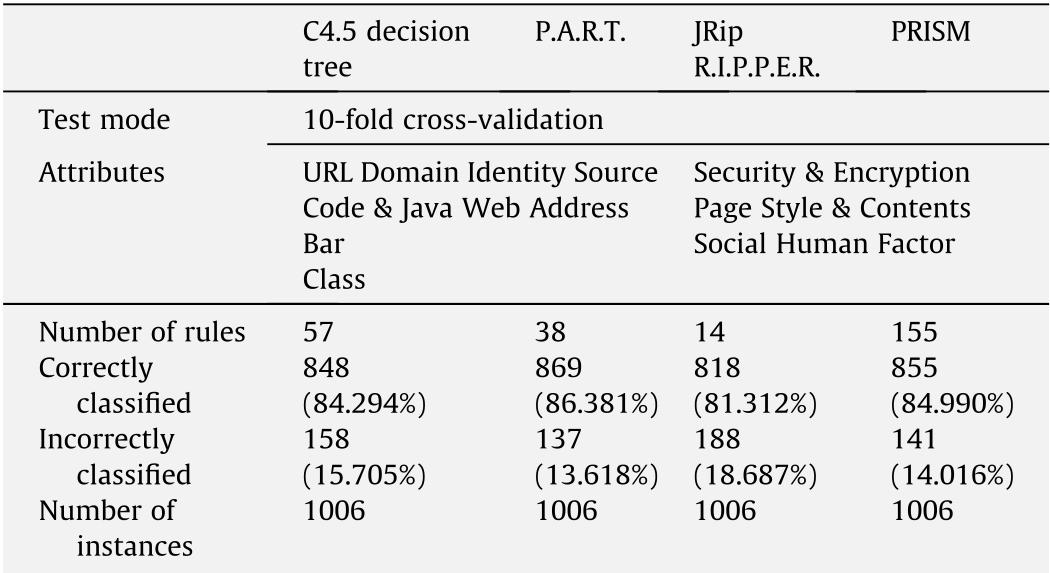
The results confirmed a crucial "Golden Nugget": If the Web Address Bar and URL Domain Identity are genuine, the site is almost certainly legitimate. Conversely, fraud in these areas is the strongest predictor of a phish.
Why It Works: The Center of Gravity
Through Centroid Defuzzification, the model aggregates multiple weak signals. For instance, a site might have a slightly weird URL (moderate risk) but perfect encryption (low risk). The fuzzy engine balances these to output a final "Phishing Rate" (0-100%).
The authors found that even if some layers are ambiguous, a site can be flagged as "Very Phishy" (reaching roughly 83.7% risk) if the primary indicators—like URL manipulation—are blatant.
Critical Perspective & Future Work
While the 86.38% accuracy is a strong baseline for 2010, the authors admit that "Finding the 'right' feature set is a difficult problem."
- Limitations: The system relies on features that may be hidden by modern obfuscation (e.g., advanced JavaScript packers).
- Future Direction: The evolution of this work likely involves Deep Learning to automatically discover features from raw HTML and pixels, reducing the reliance on manual feature engineering.
Conclusion
This research highlights that e-banking security cannot rely on a single "silver bullet." By layering signals and using fuzzy logic to handle uncertainty, we can build more resilient systems that protect users from increasingly sophisticated visual deception.