
AISLE: Bridging the Environmental Data Gap with Intelligent Service Layers
6870_An intelligent service layer upgrades environmental information management.
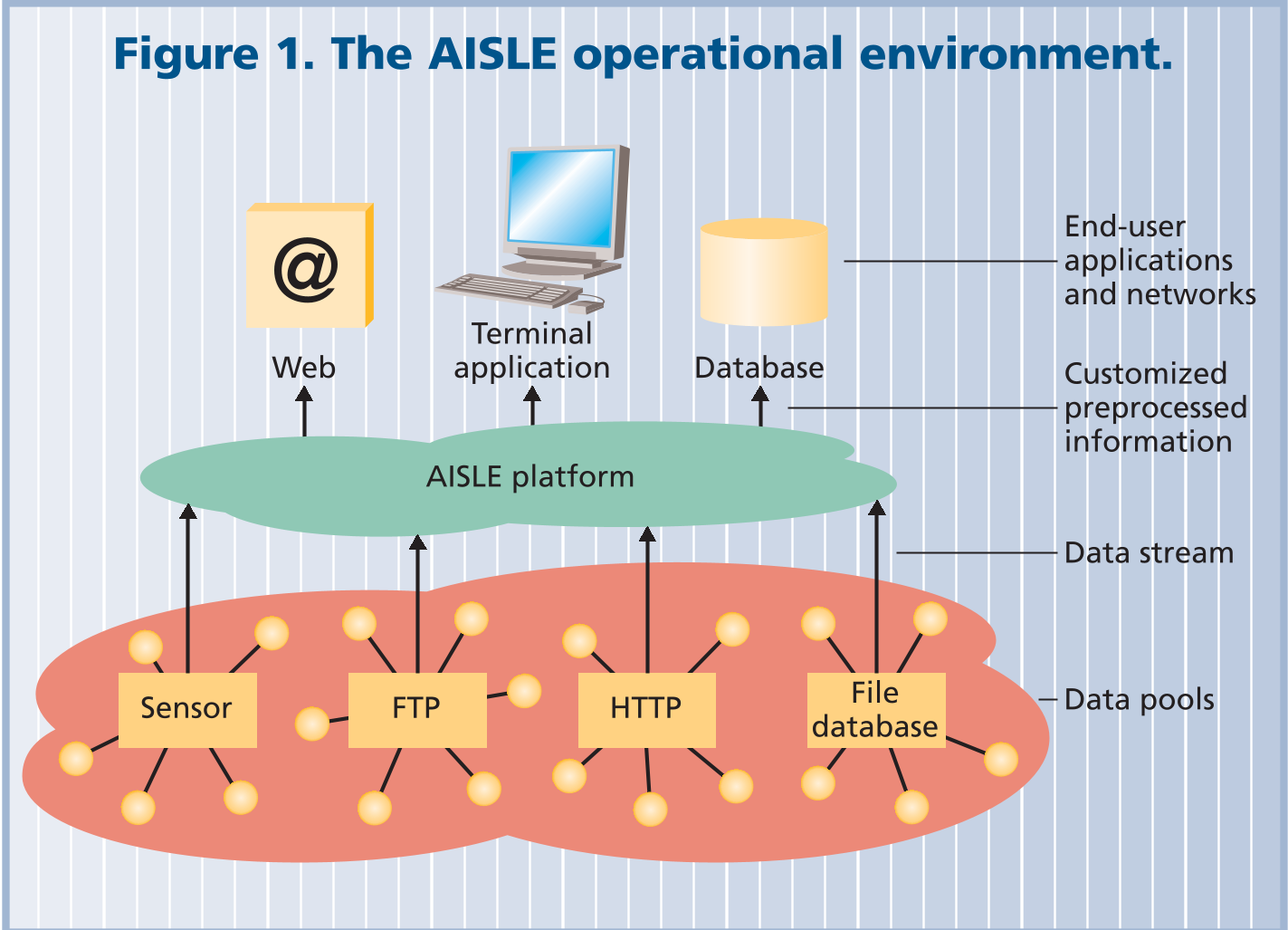
The paper introduces AISLE (Adaptive Intelligent Service Layer for Environmental information management), a service-oriented architecture designed to upgrade Environmental Management Information Systems (EMIS). By utilizing a multi-agent system (MAS), it bridges the gap between raw data pools (sensors, legacy databases) and end-user applications, providing automated validation, data fusion, and real-time dissemination.
TL;DR
The AISLE (Adaptive Intelligent Service Layer for Environmental information management) framework introduces a sophisticated multi-agent system designed to sit between raw environmental data sources and end-user applications. By automating data validation, estimation of missing values, and multi-party distribution, it upgrades legacy environmental systems into proactive, reliable information services.
Background: The "Information Vacuum" Paradox
Environmental data is theoretically a public good, yet it remains notoriously difficult to access or trust. This paper identifies a dual "vacuum": in developing nations, data isn't recorded; in developed nations, there is an overflow of "noisy" or "hidden" data. Current Environmental Management Information Systems (EMIS) are often too rigid to handle sensor malfunctions or the diverse formatting requirements of modern stakeholders, such as asthma patients needing real-time air quality alerts.
Methodology: The Three-Cluster Synergy
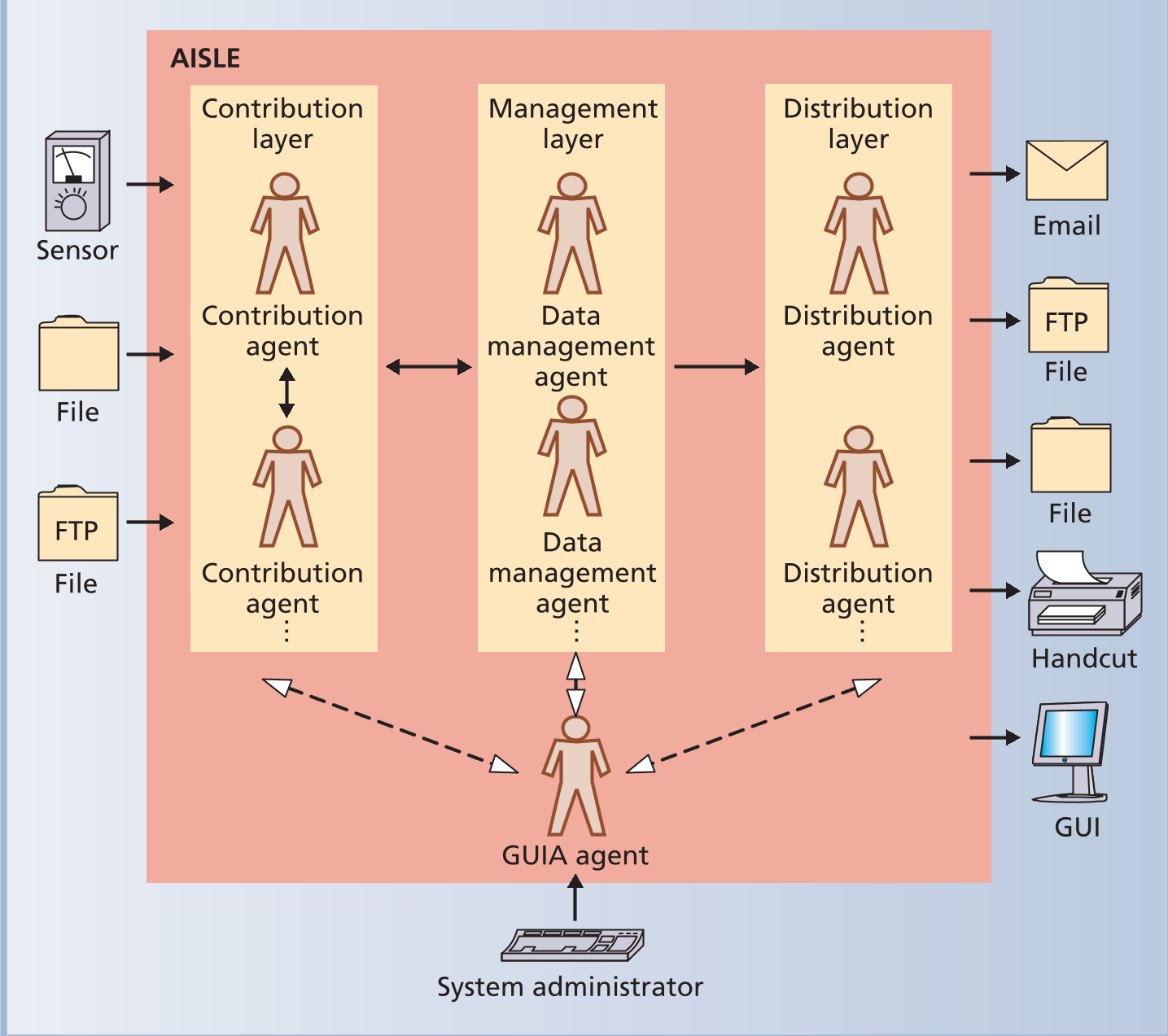
The core of AISLE is its transition from a monolithic architecture to a service-oriented, agent-based design. The system is organized into three distinct but cooperative clusters:
- Contribution Cluster (CAs): These agents are the primary sensors of the digital world. They "pull" or "push" raw data from legacy databases or real-time sensors. Crucially, they use reasoning engines to validate data, flagging noise or orchestrating the estimation of missing entries.
- Management Cluster (DMAs): These agents act as the brain of the system, performing data fusion. They integrate inconsistent streams into a unified "view," applying preprocessing functions defined by administrators.
- Distribution Cluster (DAs): These are the interfaces. They push processed information to web pages, emails, or other software systems using standard protocols like HTTP or SMTP.
The implementation uses JADE (Java Agent Development Environment) and FIPA-ACL messaging, ensuring that agents are "proactive"—meaning they can take initiative when sensor values exceed thresholds rather than waiting for a user query.
Why Agents over Web Services?
While the architecture could be implemented via standard Web Services (SOAP/WSDL), the author argues for Software Agents due to their:
- Proactivity: Agents monitor conditions autonomously.
- Mobility: They can move between servers at runtime to optimize load.
- Internal Beliefs: Agents can maintain local states or "knowledge" about the reliability of specific sensors.
Practical Success: Air-Quality Assessment
The system was stress-tested using a three-year dataset of air quality measurements (ozone levels and meteorological data).
- Reliability: The Contribution Agents successfully filtered noise from sensors.
- Intelligence: When ozone concentrations crossed safety thresholds, the Management Agents automatically triggered an alert sequence, demonstrating AISLE's capability for operational decision support.
- Performance: Lab experiments confirmed "very fast" response times for alarm delivery, proving the architecture's suitability for time-critical public health services.
Critical Analysis & Conclusion
Takeaway
AISLE moves environmental informatics from passive storage to active intelligence. By abstracting the complexity of data cleaning into a service layer, it allows domain experts to focus on analysis rather than data engineering.
Limitations & Future Work
While the agent-based approach is modular, its reliance on specific ontologies (developed in Protégé-2000) may create overhead when scaling to thousands of diverse sensors. Future iterations should explore semantic web technologies to automate the discovery of new data sources without manual administrator intervention.
AISLE serves as a foundational proof-of-concept for how intelligent, loosely coupled services can turn the "environmental information vacuum" into a stream of actionable insights.