
Modeling the Digital Mind: An Intelligent Social Collective based on Facebook Dynamics
An Intelligent Social Collective with Facebook-Based Communication
The paper proposes a computational model for an Intelligent Social Collective specifically mapped to the Facebook environment. It introduces a multi-agent framework featuring agents with statement-vector knowledge structures, Facebook-specific communication modes (Posts, Likes, Comments, Chat), and diverse knowledge integration strategies to simulate real-world social dynamics.
TL;DR
Researchers have developed a formal multi-agent model that replicates how knowledge spreads and evolves within a Facebook-like social structure. By defining specific "Integration Strategies"—ranging from naive acceptance to psychological polarization—the study quantifies how different communication habits (like Liking vs. Chatting) impact the stability and drift of a group's collective opinion.
Context: Beyond Simple Epidemics
While classic epidemic models (like SI or SIR) track if a piece of information reaches a user, they rarely address what the user does with it. This paper moves the needle from simple "infection" to "internalization," positioning itself as a bridge between sociology and computational multi-agent systems.
Problem & Motivation: The Logic of Influence
Most existing models assume a universal reaction to messages. However, human social behavior is inconsistent:
- Trust vs. Skepticism: Some users are "naive" (Substitution), while others require multiple repetitions to be convinced (Consensus).
- The Backfire Effect: When presented with opposing views, people often become more entrenched in their original position (Polarization).
The author’s intuition was that a realistic model must account for these internal psychological states and the specific "handshake" of the platform—in this case, the mix of public walls and private chats on Facebook.
Methodology: The Architecture of a Social Agent
The model defines an agent through its knowledge base , which is represented as a "vector of statements."
1. The Communication Matrix
Unlike the author's previous work on Twitter, this model introduces synchronous bi-directional chat.
- Wall Posts: One-to-many random distribution.
- Likes/Comments: Message replication with or without modification.
- Chat: Direct, two-way knowledge exchange.
2. Integration Strategies (The "Why" it Works)
The core innovation lies in how agents process incoming weights. The Polarization strategy is particularly notable: if the distance between the received opinion and internal opinion exceeds a threshold , the agent moves further away.
 The image above shows the analytical mapping of the model's parameters to a standard epidemic SI growth rate .
Experiments & Results: Stability and Drift
The author uses "Collective Drift"—the average change in opinion weights per iteration—as the primary metric.
Key Findings:
- The Stabilizers: Delayed Voting and Weighted Average strategies are remarkably stable. They act as "social filters," requiring consensus before shifting the group's needle.
- The Disruptors: Introducing a single agent using a "Discard" strategy (refusing to change their mind) acts as a catalyst for instability across almost all other strategies.
- The Polarization Effect: As seen in the table below, Polarization leads to high drift (values > 1.0), indicating a rapidly changing but fracturing social landscape.
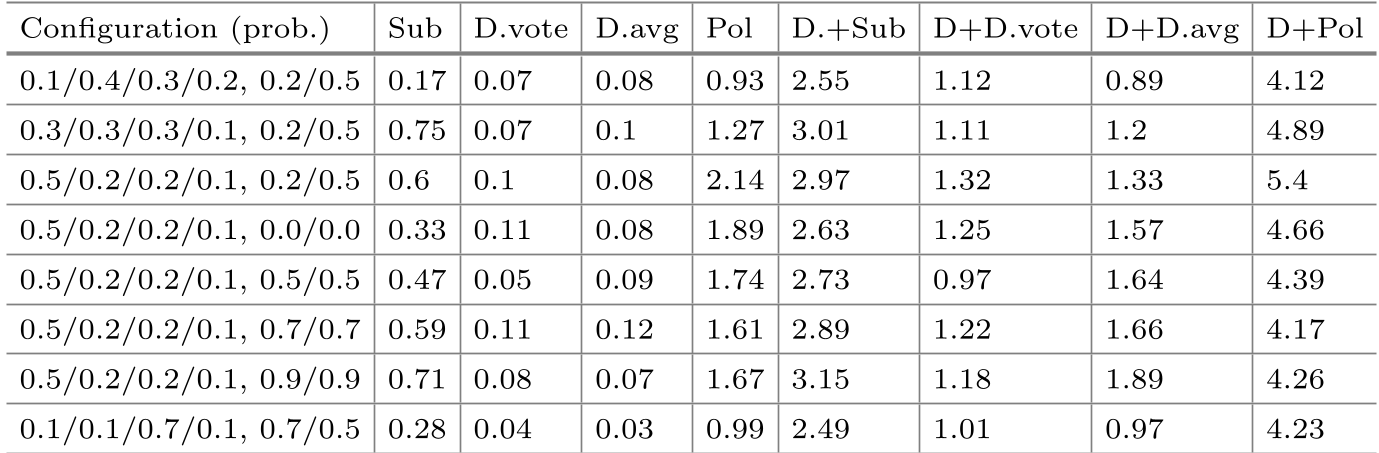 Table 1: Comparison of drift across different integration strategies. Note the massive jump in drift when a Discard agent (D+) is introduced.
Critical Analysis & Conclusion
This work provides a rigorous framework for "simulated sociology." Its strength lies in its modularity—new integration strategies can be "plugged in" to see how they affect the group.
Limitations: The current model lacks "deeper intelligence." Agents don't choose tasks or remember long-term interactions; they are reactive state machines. Furthermore, the knowledge structure is a flat vector of statements, missing the hierarchical complexity (ontologies) of real human knowledge.
Future Outlook: The author suggests that the next frontier is applying this to real-world social network datasets, though this requires solving the "privacy vs. visibility" hurdle of seeing how users actually change their minds behind closed curtains. The introduction of more complex knowledge structures like ontologies could bridge the gap between simple opinion modeling and true Collective Intelligence.