
Socializing Mathematics: Bridging AI Tutoring and Collaborative Networks
An Intelligent Tutoring System over a social network for mathematics learning
The paper presents a novel Intelligent Tutoring System (ITS) integrated with the open-source social networking engine, Elgg. Designed specifically for elementary mathematics, the system combines personalized AI-driven instruction with collaborative learning features to enhance student engagement and performance.
TL;DR
This paper introduces an Intelligent Tutoring System (ITS) built atop a social networking framework to teach mathematics. By combining the personalized feedback of AI with the community-driven environment of social media, the authors aim to solve the isolation and rigidity often found in traditional distance learning.
The Motivation: Moving Beyond "One-Size-Fits-All"
The fundamental challenge in e-learning is the heterogeneity of learners. In a physical classroom, a teacher adapts their explanation based on a student's confusion. Standard digital platforms often fail here, offering static content that ignores the student's unique cognitive state.
The researchers identify two missed opportunities:
- Intelligence: The lack of automated diagnosis for specific errors (e.g., why did the student get "31" for 25+16?).
- Social Context: The failure to leverage the social habits of digital natives to foster Computer-Supported Collaborative Learning (CSCL).
Methodology: The Anatomy of an Intelligent Social Network
The system adopts the classic four-pillar ITS architecture but layers it over the Elgg open-source social engine.
1. The Classical ITS Core
- Domain Model: A repository of math theory and exercises curated by teachers.
- Student Model: A dynamic profile tracking performance, error history, and learning habits.
- Tutoring Model: The "brain" that selects content based on the student's current standing.
- User Interface: A web-based platform accessible via desktop and mobile.
2. The Plugin Architecture
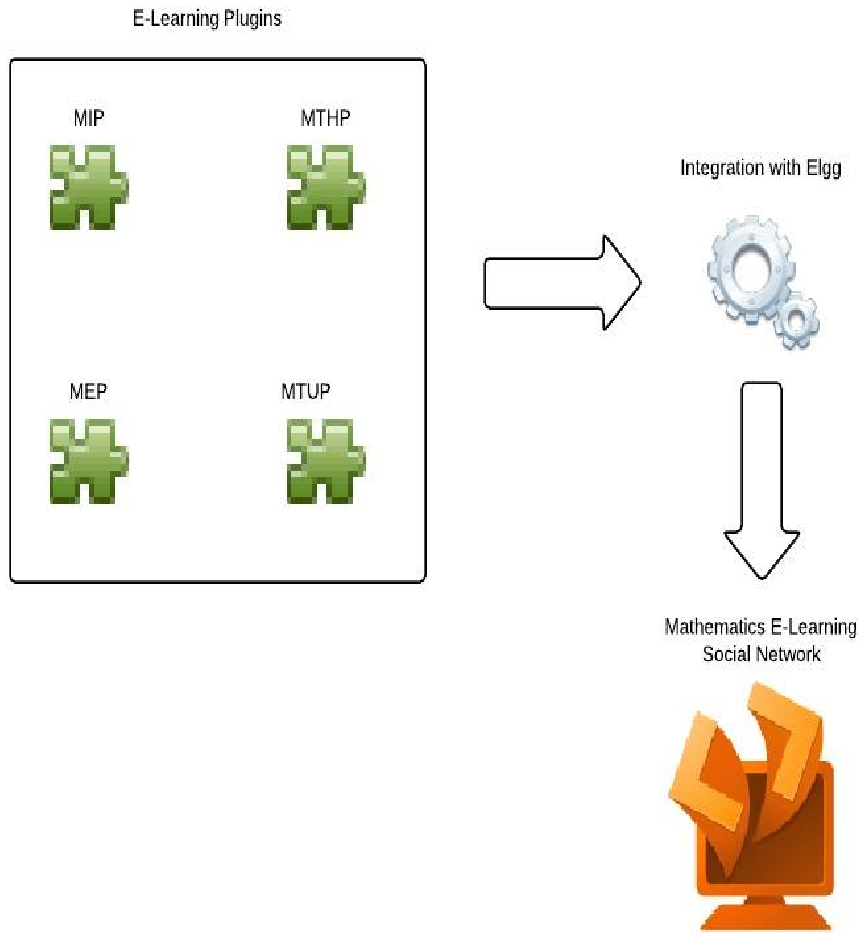
To transform a social network into a school, the authors developed four key plugins:
- MIP (Integration): Maps social profiles to academic progress.
- MTHP & MEP (Theory/Exercise): Gatekeeps content—students must master theory before attempting exercises.
- MTUP (Tutoring/Admin): Provides teachers with a cockpit to monitor class patterns and adjust the curriculum.
The "Secret Sauce": Adaptivity and Error Diagnosis
The most impressive feature is the Adaptive Error Diagnosis. Instead of just marking an answer "Wrong," the system uses a rule-based algorithm to perform a "Bug Analysis."
Example: The "Carry" Error
If a student solves 25 + 16 as 31, the system identifies that the student forgot to carry the '1' from the units column. It then provides targeted advice specifically about carry operations rather than generic addition theory.
Furthermore, the system features Dynamic Difficulty Re-evaluation: If the community struggles (e.g., >80% failure rate on an "easy" task), the system automatically elevates the difficulty tag and alerts the teacher to revise the curriculum.
Performance and Impact
While this specific paper focuses on architectural implementation, it cites significant industry benchmarks for ITS:
- Quality of Learning: Increased by 43%.
- Learning Time: Decreased by 30%.
Critical Analysis & Future Outlook
The work successfully moves the ITS from a "lonely experience" into a social one. However, the current iteration relies heavily on Rule-Based logic. In the era of modern AI, integrating Generative AI (LLMs) could allow for even more nuanced, natural language feedback beyond hard-coded rules.
The Bottom Line: This research serves as a blueprint for the future of "Social EdTech"—where the system doesn't just teach the student; it facilitates a community that learns together, guided by an invisible, intelligent tutor.