
Intelligent UAVs: Mastering Space-Time Matrix Completion for Social Network Data
Intelligent UAVs Trajectory Optimization From Space-Time for Data Collection in Social Networks
The paper introduces the SPS-IUTO scheme, a novel framework for data collection in social networks using intelligent UAVs. It integrates space-time matrix completion with an optimized ant colony algorithm to select critical sampling points and plan energy-efficient flight trajectories, achieving state-of-the-art performance in reducing data redundancy.
TL;DR
To combat the "data deluge" and battery limitations of UAVs in Social Networks (SNs), this paper proposes the SPS-IUTO (Sampling Points Selection joint Intelligent UAV Trajectory Optimization) scheme. By combining Matrix Completion (MC) with an optimized Ant Colony Algorithm, the system intelligently selects a fraction of data points to sense and reconstructs the rest, slashing redundancy and extending flight time.
Background: The Cost of Over-Sensing
As social platforms like Facebook and Twitter generate billions of data points, using UAVs to monitor user behavior or environmental metrics yields massive redundancy. Conventional methods often force UAVs to over-fly areas, wasting energy on data that adds zero "informational value." The core insight of this paper is that social network data has high spatial-temporal correlation—it is essentially a low-rank matrix that can be reconstructed from sparse samples.
Problem & Motivation
Current UAV trajectories are often pre-determined or optimized for distance only, without considering the content of the data being collected. The authors identify three major flaws in existing SOTA techniques:
- High Redundancy: Sensing every point is energy-expensive and redundant.
- Uniform Distribution Issues: Simple random sampling (Bernoulli) often leaves "holes" in rows or columns, making data recovery mathematically impossible.
- Trajectory Decoupling: Sampling logic and flight pathing are often treated as separate problems.
Methodology: The SPS-IUTO Architecture
The proposed method operates across two dimensions: Space and Time.
1. Spatial Sampling Optimization
The monitoring area is treated as a location matrix. To ensure the Matrix Completion (MC) algorithm can accurately recover the data, the authors enforce two conditions:
- Each row and column must contain at least one sample.
- Samples must be distributed uniformly to minimize estimation error.
Instead of uniform random selection, SPS-IUTO uses a dynamic probability adjustment. If a row has been sampled heavily in previous columns, the probability of selecting a new point in that row decreases.
2. Temporal Dominator Selection
For the time matrix (sensing at different intervals), the authors identify "Dominator Sampling Points"—points with the highest degree of connectivity/correlation to their neighbors.
3. Trajectory Optimization (The Enhanced ACO)
Once the optimal points are selected, the UAV needs a path. The authors employ an optimized Ant Colony Algorithm where pheromone updates are tied directly to the construction path length, ensuring the UAV covers all selected points with minimal battery drain.
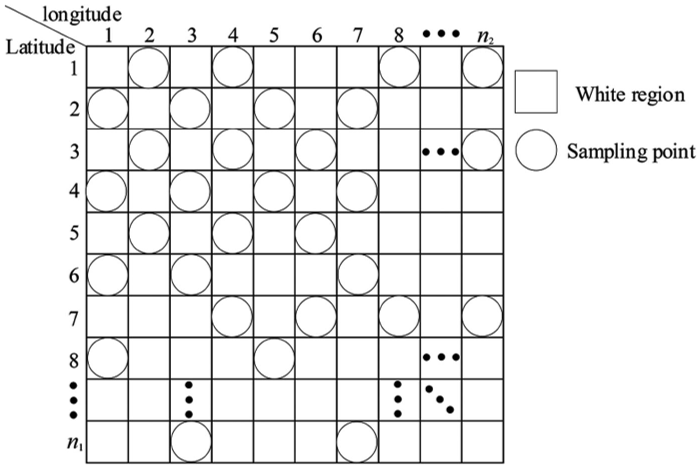 Fig 3: The location matrix based on the spatial distribution of sampling points.
Experiments & Results
The researchers compared SPS-IUTO against three baselines: BLM (Bernoulli Model), CUS (Cross Uniform Sampling), and BSPS (Basic Sampling).
Key Metrics:
- Uniformity: SPS-IUTO produced significantly more uniform sample distributions across rows and columns compared to BLM, directly leading to lower recovery errors.
- Efficiency: The "Effective Data Collection Rate" was 4.44 to 19.39 times higher than the BSPS scheme.
- Energy: Total energy consumption was lowered because the UAV only visits "informative" nodes rather than the entire grid.
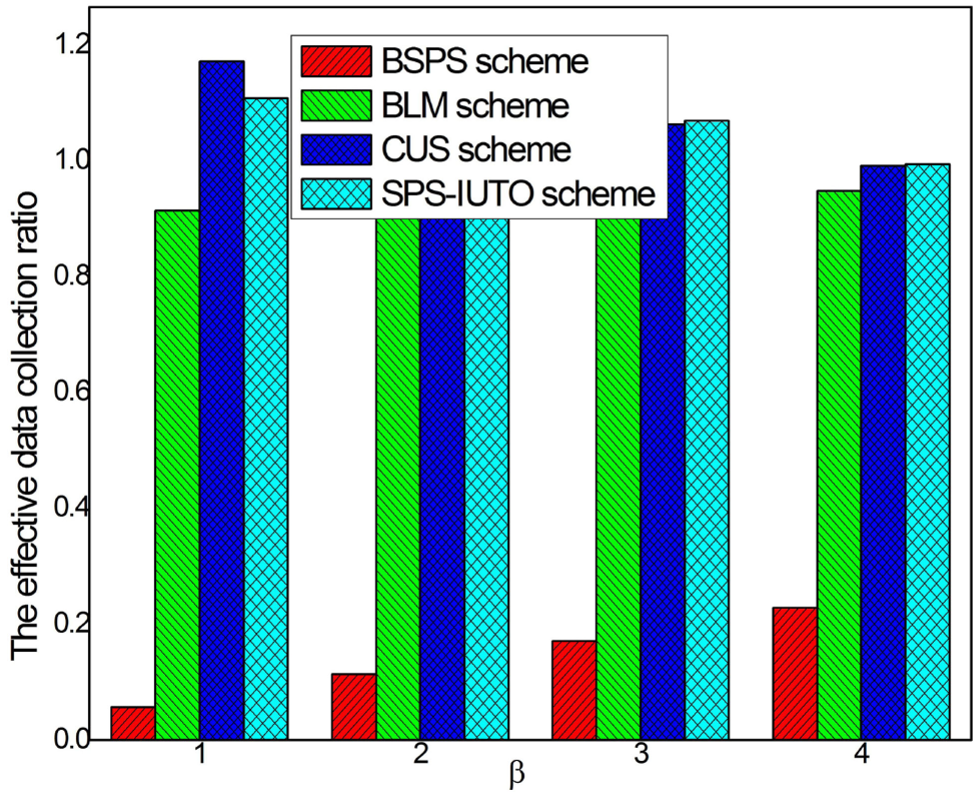 Fig 13: Analysis of effective data collection rates under different coefficients (b).
Critical Analysis & Conclusion
Takeaway
The value of SPS-IUTO lies in its mathematical rigor. By grounding UAV movement in Matrix Completion Theory, the authors move past heuristic flight paths into a regime where every flight meter is justified by its contribution to data recovery.
Limitations & Future Work
While highly effective for low-rank data, the performance of this scheme may degrade in highly dynamic environments (e.g., flash crowds) where the matrix rank increases suddenly. The authors noted that future iterations will focus on Load Balancing and Security Defense (to prevent adversarial data injection during the completion process).
Ultimately, this work serves as a blueprint for "Green AI" in the sky—achieving more while sensing less.